
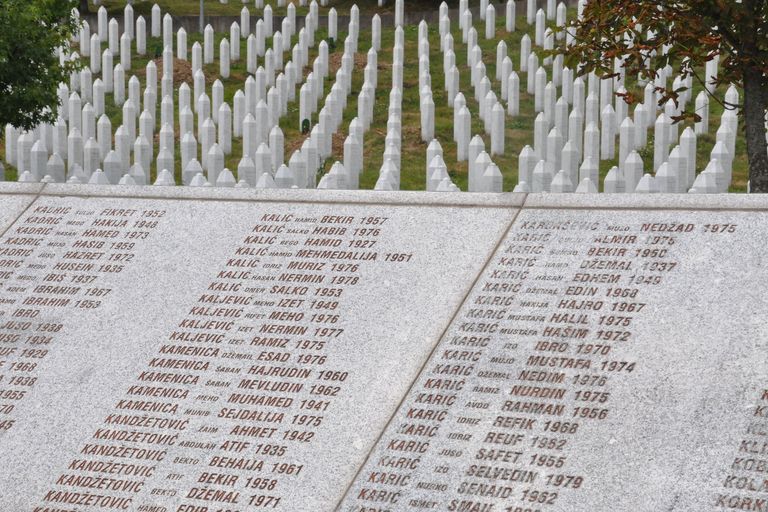
Original article (in Bosnian) was published on 7/7/2025; Author: Amar Karađuz
Members of the opposition PSG–SDA Sandžak–PDD parliamentary group proposed a resolution on the Srebrenica genocide in the National Assembly of Serbia. Media close to the ruling party falsely accused the opposition of imposing collective guilt on Serbia.
On July 3, 2025, the Facebook page of SDA Sandžak, a party of the Bosniak national community in Serbia, announced that the PSG–SDA Sandžak–PDD parliamentary group had that day submitted a draft resolution on the Srebrenica genocide to the National Assembly of the Republic of Serbia, with a request for it to be considered under an urgent procedure. The proposal was submitted ahead of the upcoming 30th anniversary of the genocide.
It was stated that the draft resolution is based on rulings of the International Court of Justice (ICJ) and the International Criminal Tribunal for the former Yugoslavia (ICTY), as well as on United Nations General Assembly Resolution 78/282 of 2024, which declared July 11 as the International Day of Reflection and Remembrance of the Srebrenica Genocide.
On the same day, the B92 portal published an article about the proposed resolution, with the headline claiming that the “blockading” opposition had proposed declaring Serbia a “genocidal state”:
Major scandal: The blockading opposition submitted a proposal to the National Assembly to declare Serbia a genocidal state
The article described certain points of the proposed resolution as shameful. One of these is point three, which states that the National Assembly expresses condolences and an apology to the families of victims for the reason that “the Republic of Serbia did not prevent the genocide in Srebrenica, nor did it punish the perpetrators.”
Point four, which states that the Republic of Serbia will ensure adequate punishment for the denial of the Srebrenica genocide as well as for the glorification of individuals and organizations convicted of the genocide by international courts, was also described as shameful.
At the end of the article, it was emphasized that this “de facto demands not only recognition that Serbia is a genocidal state, but also that any denial of this is to be punished by law.”
Claims that the opposition demanded Serbia be declared “genocidal” were repeated by several Serbian media outlets and shared on Instagram (link, link). Singer Jelena Karleuša also shared the claim on platform X (link).
What are the Facts?
The Facebook post by SDA Sandžak also included the full text of the proposed resolution on the Srebrenica genocide, stamped with the National Assembly’s confirmation of receipt. The full text can be read here.
Contrary to claims that the proposal demanded Serbia be declared “genocidal,” thereby establishing collective guilt for the Srebrenica genocide, the preamble of the draft resolution explicitly states that “guilt for genocide, war crimes and other crimes is individual, and no nation can be collectively designated as genocidal or criminal.”
In addition to this clear rejection of collective guilt, the text of the proposal does not, at any point, refer to declaring Serbs or the Republic of Serbia genocidal.
The proposal condemns the genocide committed against the Bosniak people in Srebrenica in July 1995, but does not name culprits for that crime, nor does it collectivize guilt.
Points three and four, described by the media as “shameful”, contain no form of collective attribution of guilt to Serbs or to Serbia for the genocide. Point three expresses condolences and an apology to the victims’ families because Serbia failed to prevent the genocide, although it was obligated to do so under the UN Convention on the Prevention and Punishment of the Crime of Genocide. This responsibility was established by the International Court of Justice in its 2007 ruling in the case brought by Bosnia and Herzegovina against the then Federal Republic of Yugoslavia (later Serbia and Montenegro, as also noted in the ruling).
In the same judgment, the ICJ concluded that Serbia also violated its obligation of full cooperation with the ICTY, as it had not extradited Ratko Mladić, indicted for the Srebrenica genocide.
Point four calls for the punishment of genocide denial in relation to Srebrenica, as well as war crimes and other crimes, and for the punishment of glorification of individuals and organizations convicted by relevant courts of genocide, war crimes, and other crimes. Again, this point stresses individual responsibility for crimes, not the guilt of an entire nation or state.
Finally, the explanation of the draft resolution categorically rejects the collective responsibility of the Serbian people for the genocide in Srebrenica.
Therefore, the conclusion that the draft resolution seeks to declare Serbia a “genocidal state” has no basis in the document.
Claims that various actors in domestic and international politics label Serbia, Republika Srpska, or Serbs as a people “genocidal” through resolutions and declarations condemning the Srebrenica genocide and calling for remembrance of the crime have long circulated in the media and public discourse. Tabloids reported them extensively in the context of the 2024 UN resolution that declared July 11 as the International Day of Remembrance of the Srebrenica Genocide (example here). As Raskrinkavanje explained in one of the earlier analysis on this topic, that UN Resolution, court judgments, institutions, or other organizations have not declared Serbs “genocidal” or attributed genocide guilt to an entire people, but only to individuals responsible for the crime.
Since 2005 until today, several draft resolutions on Srebrenica have been submitted to the Serbian National Assembly, but none has been adopted. The main obstacle has been disagreements among political actors over the wording of the proposals, with deep divisions around the classification of the Srebrenica crime.
Most proposals that explicitly refer to the crime in Srebrenica as genocide have come from liberal and civic parties, while larger and ruling political parties have mostly avoided using that term. Instead, they proposed documents referring more generally to “war crimes” or the “crime in Srebrenica,” without recognizing the legal classification of genocide.
For example, in 2010 the National Assembly adopted a Declaration on the condemnation of the crime in Srebrenica, which condemned the crime but did not explicitly label it as genocide. Moreover, the declaration did not contain any legal obligations that could stem from a resolution, underscoring its symbolic nature.
Media reports on the opposition’s proposal in Serbia also tied it to the ongoing student protests by using the term “blockading opposition.” Supporters of Aleksandar Vučić’s Serbian Progressive Party and certain media use the term “blockaders” to refer to students who have been protesting for months over the collapse of a railway station canopy in Novi Sad, which killed 16 people. According to philologists, the expression suggests that “blockaders” are those who “occupy space and must be removed,” ignoring the reasons for their protest.Given the facts, we rate the earliest media claim that the draft resolution on the Srebrenica genocide demands declaring Serbia a “genocidal state” as fake news. The earliest such social media post receives the same rating. Other posts repeating this claim are rated as spreading fake news.