

Original article (in Croatian) was published on 22/5/2025; Author: Ivan Nekić
Signing the Accession Treaty Was Merely the Beginning of the Constitutional Procedure, for Which the Prime Minister and the President Are Empowered under Article 135 of the Croatian Constitution.
Croatia will celebrate 12 years of membership in the European Union on July 1 of this year. More than two years ago, we also joined the Schengen Area and adopted the euro as our official currency – deepening integration into the EU’s framework of 27 member states. Although Croatian membership is rarely contested, a claim has recently been circulating on Croatian social media alleging that we entered the EU illegally.
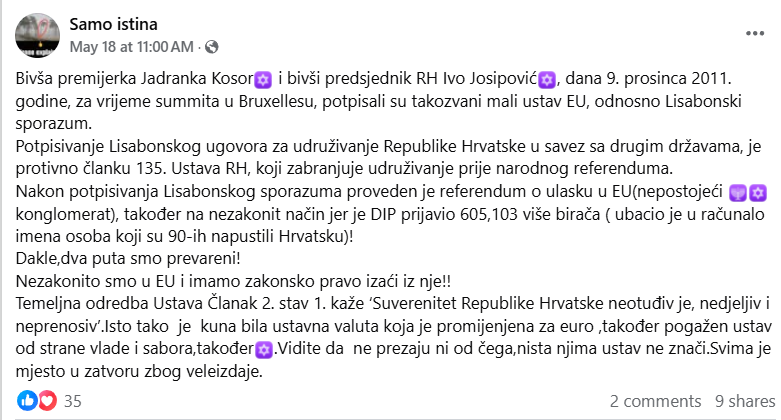
According to a Facebook post (archived here), the Accession Treaty signed in the name of Croatia by then-Prime Minister Jadranka Kosor and then-President Ivo Josipović on December 9, 2011, in Brussels is unconstitutional because “the Constitution forbids joining before a national referendum.” The full post reads:
“Former Prime Minister Jadranka Kosor✡️ and former President Ivo Josipović✡️, on December 9, 2011, during a summit in Brussels, signed the so‑called small EU constitution, i.e. the Lisbon Treaty.
Signing the Lisbon Treaty to associate the Republic of Croatia in a union with other states was in violation of Article 135 of the Croatian Constitution, which prohibits association before a national referendum.
After signing the Lisbon Treaty, a referendum was held (they say the State Electoral Commission reported over 605,000 extra voters – added to the computer were names of people who left Croatia in the ’90s)!
So, we were duped twice!
We are in the EU illegally, and we have the legal right to leave it!!
Article 2 paragraph 1 of the Constitution states: ‘Sovereignty of the Republic of Croatia is inalienable, indivisible, and non-transferable.’ Also, the kuna was our constitutional currency, and switching to the euro was another violation by the government and parliament✡️. Clearly, they fear nothing – nothing matters to them. They all belong behind bars for high treason.”
Initiation of EU Accession Is Constitutional
The claim that signing the Lisbon Treaty (the Accession Treaty) before a referendum violated Article 135 of the Croatian Constitution is incorrect. The author has misread Article 135, which clearly states at its outset:
“The right to initiate the process of associating the Republic of Croatia with unions or alliances with other states rests with at least one‑third of the deputies in the Croatian Parliament, the President of the Republic, and the Government of the Republic of Croatia.
…
Association of the Republic of Croatia is first decided by the Croatian Parliament with a two‑thirds majority of all deputies.
The decision on association shall be made by a referendum of a majority of voters who took part in it.”
Thus, the Lisbon Treaty signed by the Prime Minister and President was only the first step in a constitutionally authorized process.
The Accession Process: Step by Step
In December 2002, the Croatian Parliament passed a Resolution on Accession to the EU, designating full EU membership as a “strategic national goal”. Croatia submitted its application for EU membership on February 21, 2003 in Athens, as per standard procedure, to the presiding member state (Greece at the time). Croatia gained official candidate status at the European Council in Brussels on June 18, 2004. Accession negotiations began in October 2005 and formally concluded on June 30, 2011.
The Accession Treaty was signed on December 9, 2011, in Brussels, with a symbolic first participation of Croatian leaders as observers in the EU summit. For the Treaty to take effect, it required ratification by the Croatian Parliament and parliaments of all EU member states. In Croatia, this ratification also required a referendum. On January 22, 2012, Croatia held a referendum asking: “Are you in favor of the Republic of Croatia becoming a member of the European Union?”
With over 4.5 million eligible voters, turnout was 43.51 % (approx. 1.948 million). 66.27 % voted in favor (1,299,008 votes). This is confirmed in the official State Referendum Report.
Following the referendum, the Croatian Parliament ratified the Accession Treaty on March 9, 2012. The ratification law passed unanimously with 136 votes in favor.
The Constitutional Court received 22 motions contesting the referendum’s constitutionality. On March 5, 2012, it rejected all as inadmissible or ungrounded, stating the referendum was conducted in accordance with the Constitution, the Constitutional Court Act, and relevant legislation.
Once ratified by all member states – including the UK, which at that time was still in the EU – the accession treaty set a specific entry date, which for Croatia was July 1, 2013. A binding referendum and over 65 % popular support preceded Croatia’s accession – nothing illegal or unconstitutional occurred.
Withdrawal Is Also Legally Defined
Under Article 50 of the Treaty on European Union, any member state may withdraw from the EU in accordance with its own constitutional requirements. Upon notification to the European Council, withdrawal negotiations follow. Once the withdrawal agreement enters into force, the country ceases to be an EU member.
Since the EU’s foundation in February 1992 via the Maastricht Treaty, only one country has left – the United Kingdom, after the 2016 referendum. The UK formally left the EU on January 31, 2020 (Brexit). Croatia remains a fully compliant member.In conclusion, the allegation that Croatia’s accession to the EU was illegal is factually incorrect. Article 135 of the Constitution clearly affirms that accession procedures can be initiated by the Government, President, or at least a third of Parliament, followed by a two-thirds parliamentary vote and a binding referendum – exactly as Croatia executed.