
Original article (in Serbian) was published on 30/9/2025; Author: Marija Vučić
Former Chief of the General Staff of the Yugoslav Army and Hague convict Nebojša Pavković has been released from a Finnish prison due to poor health, two years before completing his 22-year sentence. His return to Serbia on a government plane was covered with pomp and grand words about a “hero” by pro-regime tabloids, as if it were not about a war criminal who was convicted for participating in operations that resulted in killings, deportations, persecutions, and other crimes against the Albanian population in Kosovo in the late 1990s.
“Only Serbia matters to him,” “Hero Nebojša Pavković,” “Serbian general innocent in prison for 20 years,” read the tabloid headlines in Tuesday’s editions.
Informer quoted warm words from Pavković’s daughter, describing what his journey home looked like:
“During the entire flight we held hands because I’m afraid of flying… He was impatient. The flight took a bit longer, and he kept asking if we were already over Serbia. When we finally arrived, he smiled,” she said. “If it hadn’t been for President Vučić, who initiated everything, things would have been much more difficult.”
Informer claims that Pavković was convicted “without evidence,” while some other outlets, like today’s Kurir, do not even mention the crimes for which he spent the past 20 years in prison.
He was released from prison on medical grounds but under a series of conditions: among other things, he is prohibited from engaging in political activities, commenting on his case and verdict in the media or on social networks, or making statements that deny war crimes in the former Yugoslavia or glorify other war criminals.
If he violates any of these conditions, the international court may return him to prison.
“I understand and agree that if I violate (…) any of the conditions defined by this agreement, my early release may be revoked at the discretion of the President of the Mechanism,” states the agreement Pavković signed with the court.
Who is Nebojša Pavković?
Before surrendering to The Hague Tribunal in 2005, where he was charged with war crimes, Nebojša Pavković served as the Chief of the General Staff of the Yugoslav Army and was considered Slobodan Milošević’s key military figure for resolving the Kosovo issue by force. As the commander of the Priština Corps, Pavković took part in the late 1990s conflict in Kosovo between Yugoslav forces and the Kosovo Liberation Army.
In early 2009, the Hague Tribunal convicted him and sentenced him to 22 years in prison for crimes committed against the Albanian population; the verdict was upheld in 2014.
Pavković was found guilty as a participant in a “joint criminal enterprise” led by the Yugoslav military and political leadership, whose goal, as stated in the judgment, was to expel Kosovo Albanians and establish permanent Yugoslav control over the territory.
The court determined that in the spring of 1999, grave war crimes were committed in Kosovo by members of the Yugoslav Army and police, including murders, persecution, deportations, sexual violence, the destruction of mosques, and other serious violations of the laws and customs of war.
According to the Tribunal, Pavković contributed to this joint criminal enterprise through his command and control of military forces, by issuing orders and supporting army and joint army-police operations that led to these crimes.
Media space for denying responsibility
However, he has never accepted responsibility, and in Serbia, part of the public has continued to celebrate him as a hero even after the final verdict.
With the support of pro-regime and nationalist portals and television stations, Pavković has continued to build his popularity and image as a national hero unjustly imprisoned in a Western “dungeon.”
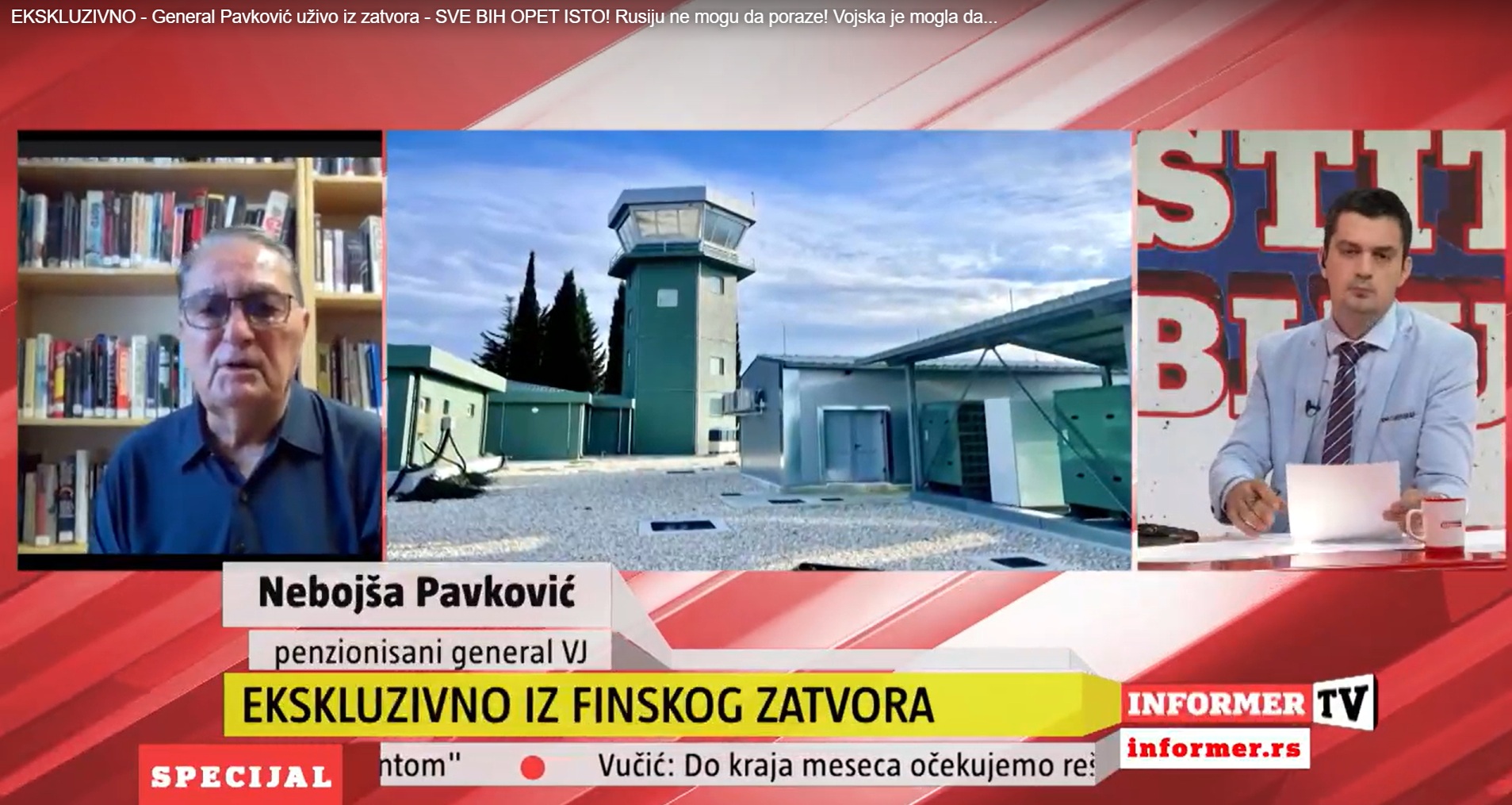
In an interview for TV Informer last year, given from prison, he denied that the army forcibly displaced Albanians. On the contrary, Pavković suggested, they left of their own accord.
“It is not true that the army expelled the population from Kosovo. To avoid clashes, they (the Albanians) went to Albania, Macedonia, Montenegro, some to Serbia,” Pavković said.
The Mechanism for International Criminal Tribunals also noted that the former Yugoslav general felt neither responsibility nor guilt when it rejected his earlier request for early release in 2022.
The court stated that Pavković, in one of his official submissions, wrote that “when my sentence expires and I am released, I will bear the burden of the sentence in its psychological, sociological, and historical sense.” However, it was determined that parts of this “remorseful” letter were copied from a similar letter previously submitted to the court by another accused and later convicted official, Nikola Šainović. The court also noted that Pavković had repeatedly tried to minimize his own responsibility and shift the blame onto others, and that in media appearances he continued to deny guilt, glorify Serbian military actions in Kosovo, and use derogatory language toward Albanians.
Translated in English using AI tools, then thoughtfully refined by a human editor.