

Original article (in Albanian) was published on 13/10/2025; Author: Patris Pustina
During Breast Cancer Awareness Month, the claim is once again circulating on social media that Switzerland has stopped using mammography as a screening method because it causes harm.
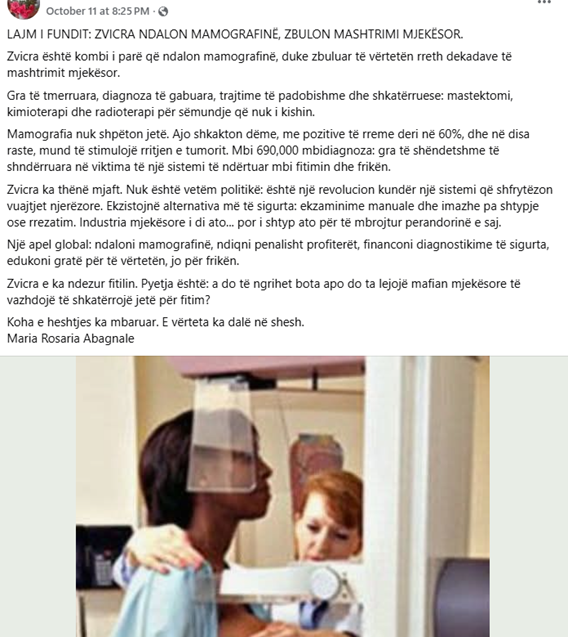
Mammograms use X-rays to detect cancer, particularly very small tumors that are hard to see or feel. The procedure involves compressing each breast between two plates, which spread the breast tissue to allow for clear imaging.
The claim may stem from a 2014 report by the Swiss Medical Board, now repealed, which questioned the benefits of mammography and suggested discontinuing its use.
Experts and medical organizations criticized the report, describing it as “wrong and misleading.”
According to the Swiss Federal Office of Public Health, the report was misinterpreted. Following its publication, the Office issued a press release to confirm that Switzerland continues to follow WHO guidelines and those of many other countries on mammography, while also aiming to develop high-quality screening programs.
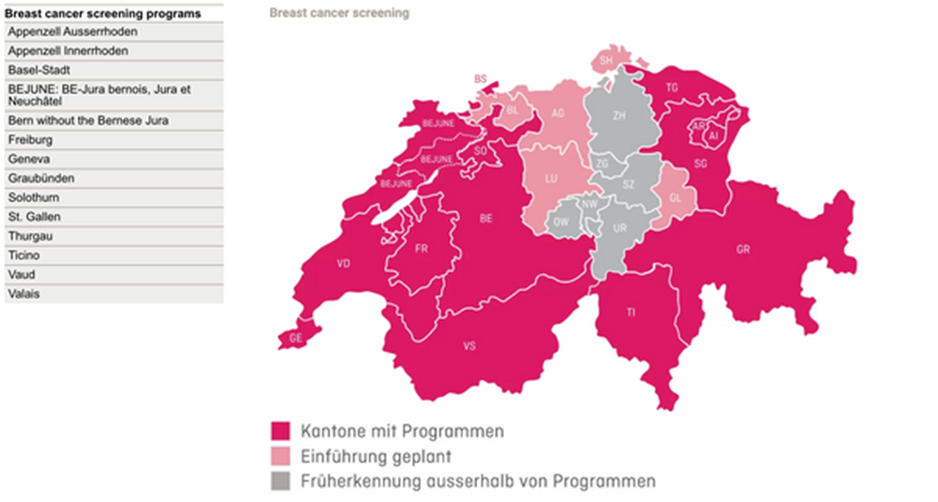
Websites of the Swiss Cancer Screening Association and the Swiss Cancer League indicate that eight out of ten women are at least 50 years old when diagnosed with breast cancer. This type of cancer is also the most common and deadly among women, with about 6,600 new cases identified each year in Switzerland. Early detection of breast cancer increases the likelihood of successful treatment. As of the time of writing, Switzerland provides systematic mammography services in most cantons nationwide, as shown on a map on the Swiss Cancer Screening Association website.
Cantons that do not offer systematic mammography services either follow a “by referral” system or plan to introduce systematic screening programs in the future. The website notes that it was last updated in early September 2025.
The Swiss Federal Office of Public Health told AAP FactCheck that the claim above is false.
“Mammography is not banned in Switzerland. It is covered by health insurance and recommended annually for women aged 40–59, and every two years for women aged 60–75,” a spokesperson said.
A spokesperson from the University Hospital of Zurich also confirmed that mammograms are available in Switzerland.
The X-rays used during a mammogram are intended to capture detailed images of the breast tissue. However, the level of radiation is low. According to the Belgian Federal Agency for Nuclear Control (FANC), the radiation dose (measured in millisieverts, mSv) is 0.4 mSv. By comparison, the Belgian population is exposed to an average of 2.4 mSv per year from natural sources of ionizing radiation. The risk of developing cancer from this radiation is real but remains very low, with an estimated probability of one case per 50,000 exams.
Mammography can have negative effects, including discomfort during the exam, overdiagnosis, and occasionally missed cancers. Nevertheless, many experts agree that the benefits of mammography significantly outweigh these disadvantages.
Lastly, the 60% “false positive” figure mentioned in the previous post seems to originate from a 2011 study published in the Annals of Internal Medicine. Researchers examined annual mammograms conducted over a ten-year period. Their results indicate that for women starting screening at age 40, the probability of receiving at least one false positive after ten years is 61.3%. This does not imply that 60% of all mammogram results are “false positives.”