
Original article (in Albanian) was published on 15/12/2025; Author: Barbara Halla
On November 26, 2025, during an attack near the White House in Washington DC, two U.S. National Guard members were shot. The attack led to the death of 20-year-old Sarah Beckstrom, while 24-year-old Andrew Wolfe remained in critical condition. U.S. authorities identified and arrested the attacker as Rahmanullah Lakanwal, an Afghan citizen who had arrived in the U.S. in 2021 on a special visa after years of cooperation with the U.S. military and CIA.
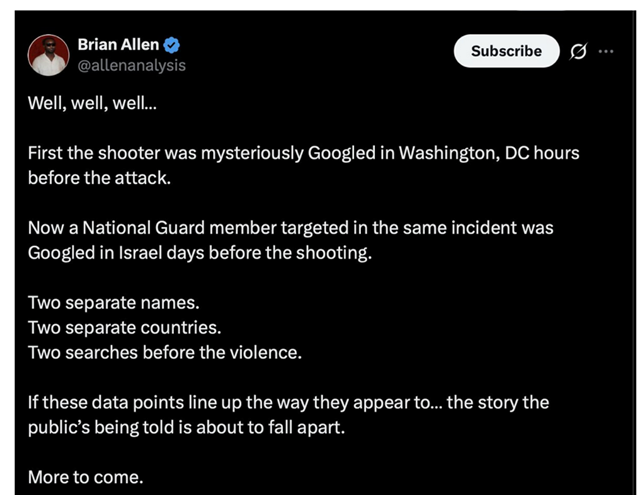
Two days after the attack, a Twitter/X user named Brian Allen posted a photo claiming that the victim’s name, Sarah Beckstrom, had been searched several times on Google in Israel days before the attack. This post suggested that someone in Israel might have had prior knowledge of the event. Allen used Google Trends to reach this conclusion. Google Trends allows users to see how often a word or name has been searched on Google.
This conspiracy theory spread rapidly across social media. In Albania, some portals translated the story from the Italian portal Inside Over. The article claims that Allen’s findings were “confirmed” using Google Trends as well. However, both Allen, who seems to be a fake, anonymous Twitter account, and Inside Over are not reliable sources.
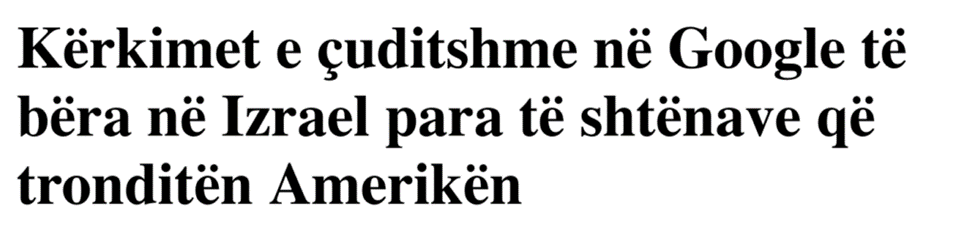
These theories attempt to involve Israel in a conspiracy, claiming that the Israeli government orchestrated the attack in D.C., even though authorities have already identified the person responsible. Additionally, the Inside Over article references another incident from May 2025, when two people were killed near the Hebrew Museum. It is alleged that the name of one of the victims, Yaron Lischinsky, was also searched multiple times in Israel prior to the event.
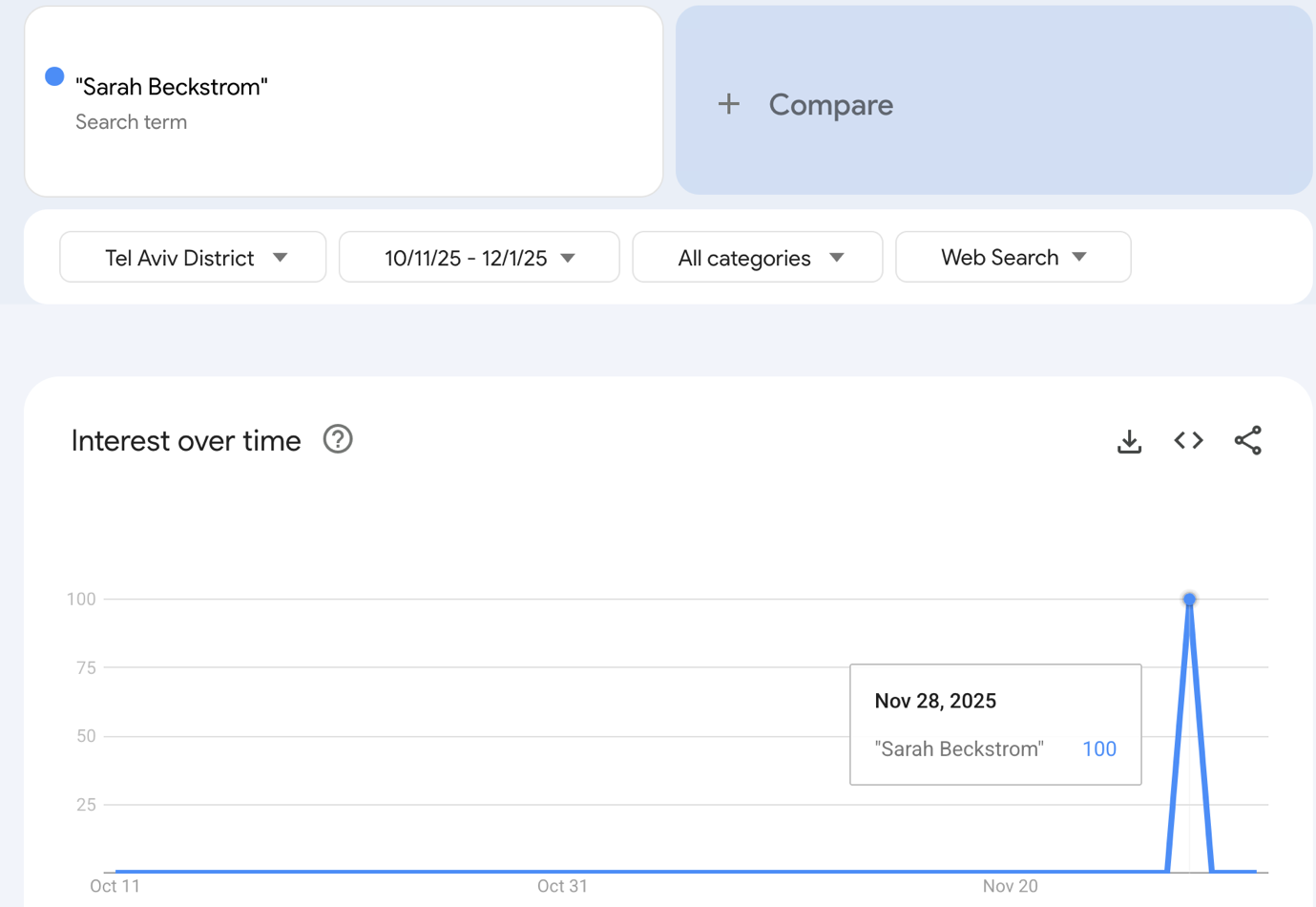
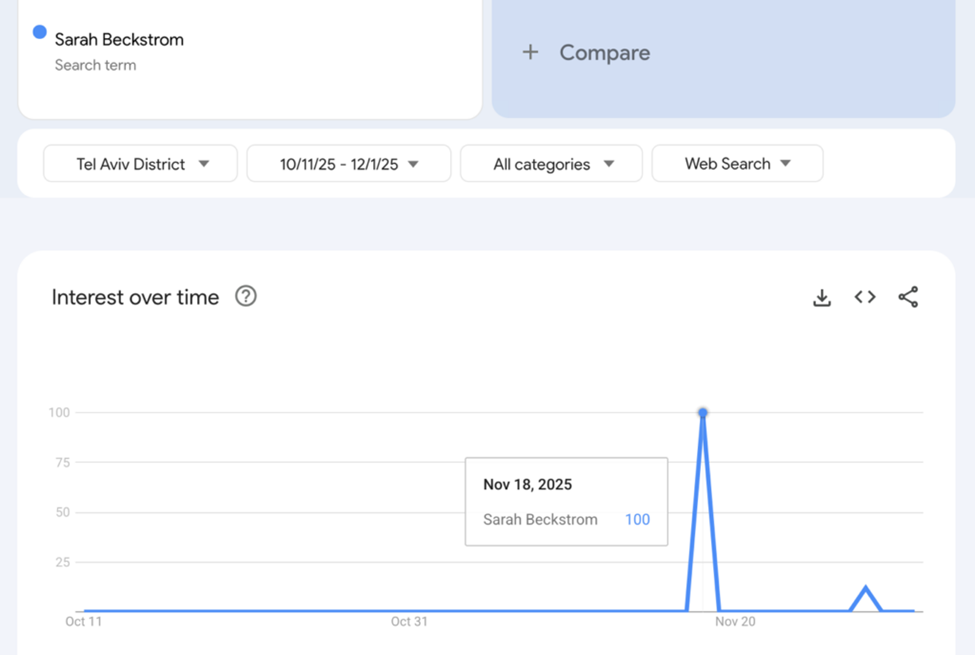
Furthermore, these claims rely on a fundamental misunderstanding of how Google Trends functions. Research has shown that Google Trends is not a reliable tool for such analysis, as the data it provides is not always accurate. Both Allen and Inside Over searched for the name “Sarah Beckstrom” without using quotation marks. In such cases, Google includes results containing the words “Sarah” and “Beckstrom” in any order or combination, not only as the full name. This can lead to misleading results, as shown in the graph below, where the name Sarah Beckstrom appears to have been searched in Tel Aviv on November 18, nearly a week before the attack.
However, a more accurate test (although not conclusive) is to search using quotation marks. When the name “Sarah Beckstrom” is searched as an exact phrase on Google, no results appear for the timeframe claimed by the article. This demonstrates that the cases reported by Albanian and foreign media are technical coincidences, not evidence of any conspiracy.
It should also be noted that the origin of a device conducting a Google search is determined by the location of its internet IP address. If the connection is made through a VPN (virtual private network) or other advanced methods, the search’s origin can remain hidden or be intentionally manipulated to appear as if it comes from a specific location.