
Original article (in Albanian) was published on 02/12/2025; Author: Patris Pustina
A post from the JOQ portal, which has garnered over 4,000 likes on Instagram, reports that beginning in 2026, “Albanian boys will receive the girls’ vaccine.”
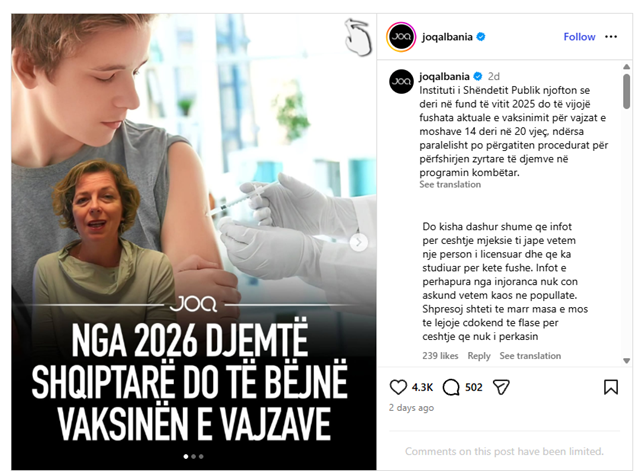
The description explains that the post refers to a decision by the Institute of Public Health to include the HPV (human papillomavirus) vaccine, which has been mandatory for girls turning 13 since 2022, into the mandatory vaccination schedule for boys aged 13 as well.
Contrary to the JOQ headline, the HPV vaccine is not a “girls’ vaccine.” The virus it protects against can affect anyone, regardless of gender, and can be transmitted by anyone, regardless of gender.
Around 80% of people are infected with HPV at some point in their lives, most often during their first sexual encounters. There is no treatment for HPV infections.
Human papillomaviruses (HPV) are a common family of viruses that are easily transmitted, almost exclusively through sexual contact, with or without penetration. As the most frequent sexually transmitted infection, HPV spreads via skin-to-skin contact in the genital area.
Most HPV infections are asymptomatic and are cleared naturally by the immune system. In approximately 90% of cases, the virus disappears within two years.
However, in some people, an HPV infection can persist and cause cellular damage, which in some instances may develop into cancer years later. This is especially the case for cervical cancer, which is primarily caused by a persistent HPV infection.
Therefore, vaccination is recommended to prevent HPV infections and to reduce the risk of developing HPV-related cancers.
HPV-related cancers include cervical cancer, oral cancer, anal cancer, penis cancer, vulvar cancer, and vaginal cancer. Almost all cervical cancer cases (99.7%) are caused by infection with a high-risk type of HPV.
The U.S. Centers for Disease Control and Prevention (CDC) reports that about 4 out of 10 HPV-related cancer cases occur in men. Each year in the United States, approximately 16,000 men develop cancer linked to HPV.
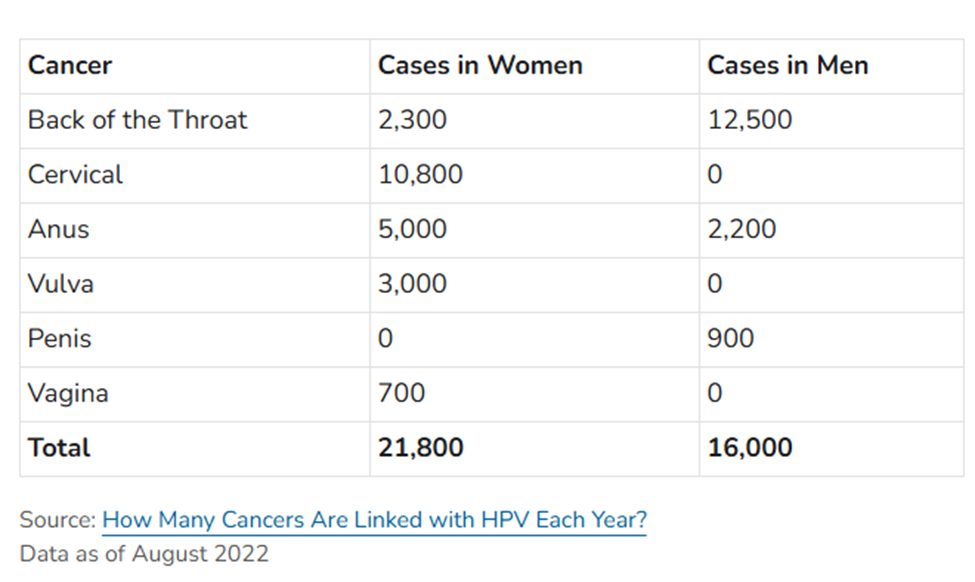
HPV-related cancer cases, divided by cancer type, cases in women, and cases in men
HPV infections can also cause genital warts in both men and women.
The human papillomavirus (HPV) vaccine is considered an effective protection against various HPV-related cancers, with cervical cancer being the most common.
HPV vaccination, which comes in several types, is recommended for both girls and boys in the United Kingdom and France because it prevents infections that can, in some cases, develop into cancer in both women and men. The American Cancer Society recommends that boys and girls receive the HPV vaccine between the ages of 9 and 12.
The vaccine is most effective when administered between ages 12 and 13, when the immune system is strong and before a boy or girl becomes sexually active.
The rate of cervical cancer among women now in their 20s who received the HPV vaccine at age 12 or 13 has decreased by 90%.
The vaccine also protects boys from HPV types that can cause head and neck cancer, anal cancer, and penis cancer.
Vaccinated boys additionally help reduce the incidence of cervical cancer in women, as men who are protected are less likely to transmit certain types of the virus to their female partners.
Vaccinating all young people against HPV also contributes to “herd immunity.” This occurs when most of the population is vaccinated, providing some protection even for those who are not vaccinated.