
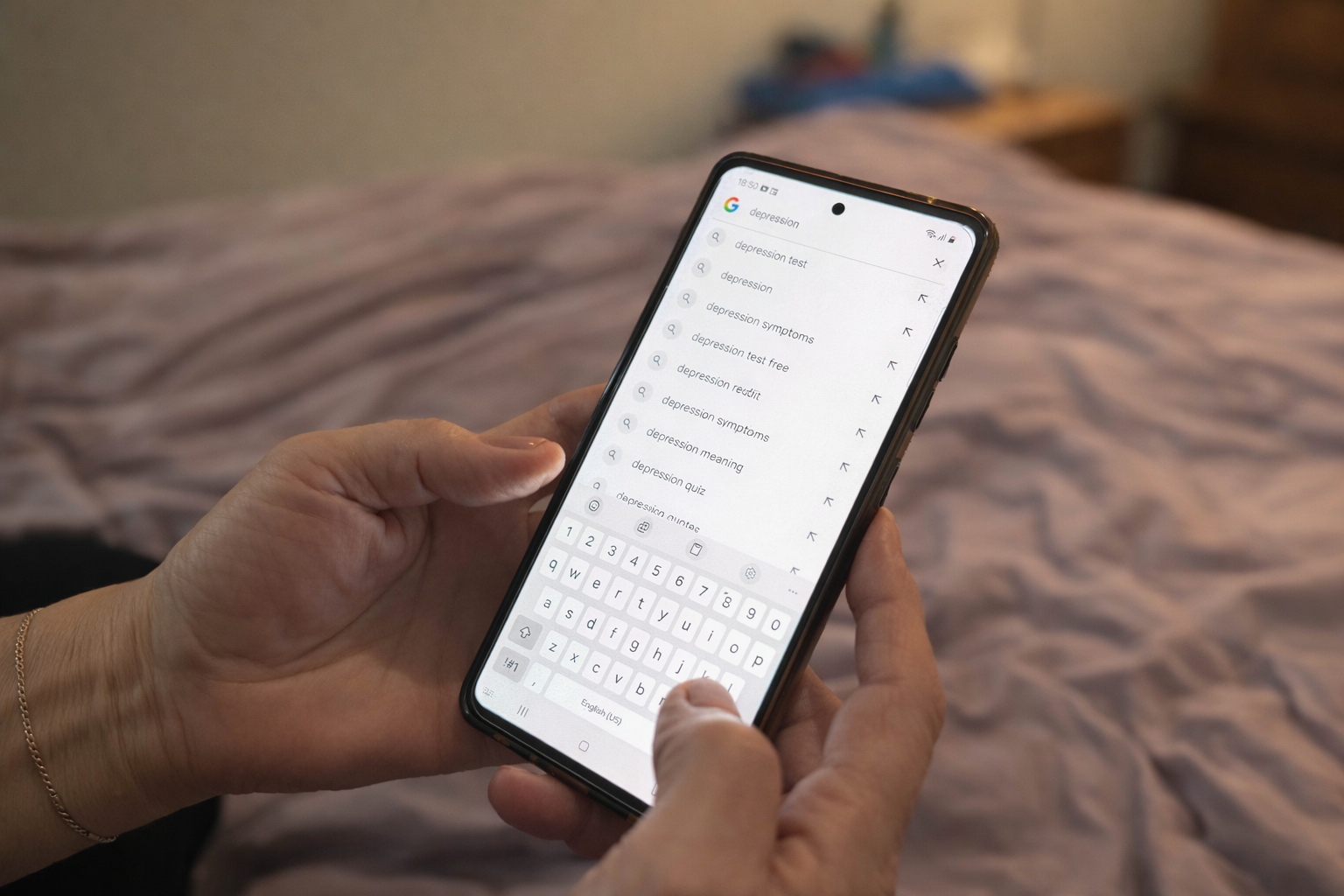
Mental health remains a neglected topic across much of Southeast Europe. In recent years, a surge of online content creators and influencers has helped bring conversations about mental well-being into the public sphere. While this increased visibility has potential benefits, it also carries risks, particularly when simplified, misleading, or pseudoscientific advice circulates without oversight.
“Not feminine enough? Maybe you’re just a woman living in male energy.”
At least, that is what a post on the Instagram account New Beginning would have you believe. With more than 260,000 followers, the account is one of many offering inspirational and self-help content to mass online audiences. The post in question was published in collaboration with a “certified life coach,” Jovana Kalaba, who sells online coaching sessions.
This is just one example in a vast ecosystem of so-called pop psychology online: content that borrows selectively from psychological language and concepts to gain either symbolic capital (likes, shares, followers) or direct financial profit. In many cases, the authority of psychology is invoked without the knowledge, education, or ethical responsibility required to apply it responsibly.
Popular Psychology and the Appeal of Easy Answers
Data from SEE Check’s survey on mental-health advice-seeking habits illustrates how audiences navigate this landscape. Out of 42 respondents, 12 (28 percent) said they seek mental-health advice on websites such as online news portals, Google, or other unofficial sources. Eight respondents (19 percent) reported turning to social media platforms like Instagram, TikTok, or Facebook, while only two respondents (5 percent) said they specifically seek advice from influencers when struggling psychologically. The majority, though, said they seek mental health advice from certified professionals, friends or family, or on official websites, sometimes in combination with other sources.
Despite this, pop-psychology influencers in Southeast Europe are numerous and often command large followings. Some combine motivational philosophy with fitness routines or “manifestation” techniques. Others use the language of psychology to promote misogyny, reinforce gender stereotypes, or offer harmful dating advice.
One account with over 5,000 followers, claiming to address Men’s Mental Health in the Balkans, regularly publishes debunked claims about feminism while attempting to explain “what women want” or “why women cheat.” Its content is interspersed with quotes from 19th-century figures such as Sigmund Freud and the notoriously misogynistic philosopher Arthur Schopenhauer – used not for critical engagement, but to lend false legitimacy to discriminatory narratives.
This strategy is typical of pseudoscientific content production. Legitimate psychological concepts, such as attachment theory, are selectively referenced, stripped of nuance, and reinterpreted by non-professionals for self-help purposes, often in ways that can cause real harm.
One survey respondent warned of the consequences:
“Unfortunately, today we see many examples of influencers on social media talking about various health conditions, including mental health, and sharing advice that is sometimes highly questionable. This can negatively affect people who are emotionally unstable and who don’t understand that who says something matters just as much as what is said.”
Dario Hajrić, a sociologist from Serbia, told SEE Check that the attention economy systematically rewards dramatic, simplified, or incorrect content, making it more visible than expert sources.
“The boundaries between psychologists, therapists, so-called life coaches, and influencers are becoming increasingly blurred, which makes it difficult to assess credibility,” Hajrić explained. “Unequal access to professional help creates a situation in which any online information appears to be a necessary and valid alternative. The culture of self-help further reinforces the idea that everyone can be their own expert, allowing verified information to be easily displaced by sensationalist narratives.”
Is Your Boyfriend a Narcissist?
Traditionally, media space was reserved for experts selected by journalists and editors, who acted as gatekeepers for public information. With the rise of the internet, and later social media platforms and artificial intelligence, this model fundamentally changed. Suddenly, anyone could publish content, and the role of editor lost much of its filtering power.
Today, the internet is flooded with advice on how to “spot a psychopath” or “identify a narcissist.” Relationship problems are increasingly framed through diagnostic labels, offering people emotional comfort by suggesting that their partner is disordered, and therefore solely to blame.
This approach is not only misleading but potentially harmful. It can be used to delegitimize a partner’s emotions or actions and to shut down accountability or dialogue. In reality, antisocial personality disorder, often colloquially referred to as psychopathy, affects an estimated 2 to 3 percent of the general population. Narcissistic personality disorder is also rare, with prevalence estimates below 7 percent.
Despite this, self-diagnosis content is widespread. Many people find themselves identifying with online descriptions of ADHD, anxiety, or depression, conditions that require careful clinical assessment.
One survey respondent expressed concern:
“It’s frightening to see how many people turn to social media for very serious diagnoses, where responses are often things like ‘just pray’ or similar advice. I think this is extremely dangerous and can push people toward harming themselves.”
At the same time, the respondent acknowledged that some online resources can be helpful when used cautiously.
“My experience is that some websites are useful for gaining a general understanding of a topic. Self-diagnosis is never good, and excessive use of professional diagnostic labels is also harmful. That’s why I’m sure I never read too deeply into medical diagnoses online.”
Trust, Institutions, and Digital Parainstitutions
Influencers often appear more approachable than formal institutions, fostering a sense of intimacy and trust that traditional healthcare systems frequently struggle to establish. In societies where mental health remains stigmatized, this perceived accessibility plays a decisive role in where people turn for support.
“Seeking help from a psychologist is still widely perceived as a sign of weakness,” said Maida Koso Drljević, a professor of psychology at the Faculty of Philosophy, University of Sarajevo. As a result, people often gravitate toward informal alternatives that feel less intimidating and more socially acceptable.
This dynamic is reinforced by broader institutional distrust. “A lack of trust in institutions naturally pushes people toward online gurus, influencers, and unregulated portals,” said Dario Hajrić. “These informal figures offer what formal structures often cannot: quick responses, clear messages, emotional availability, and a sense of community.”
At the same time, a limited public understanding of psychology itself further deepens the problem. According to Koso Drljević, greater public education is essential if psychology is to be recognized as a serious scientific discipline rather than a vague form of emotional support.
“Ignorance and lack of information encourage and sustain prejudice and stereotypes about psychologists,” she said. “They also prevent people from recognizing when professional psychological help is necessary. In our society, the term ‘health’ most often refers exclusively to physical health, understood in a narrow medical sense.”
Practices that fall outside this framework, those without tangible diagnostics or treatments such as pills or injections, are frequently dismissed as unreal or purely subjective. “Anything that does not involve visible medical interventions is often seen as ‘just in the head’ and something that can be resolved through conversations with friends, family, or close acquaintances,” Koso Drljević added.
She emphasized that this misconception obscures the scientific foundations of psychological practice. “The public needs to be informed that psychologists are not simply listeners or advice-givers. Psychology is based on research findings, and psychologists apply interventions grounded in scientific evidence.”
When these misunderstandings intersect with eroding institutional credibility, the consequences become more pronounced. “When official institutions lose credibility,” Hajrić noted, “an institutional vacuum emerges, which is then filled by digital parainstitutions. They may not be professional, but they provide a sense of being heard and of belonging: something many people fail to find within the formal system.”
Legal Grey Zones and Accountability
Regulation of online platforms in the Western Balkans remains underdeveloped. While traditional media outlets are generally self-regulated through press councils, online portals can register and operate without specific permissions, often outside any regulatory framework. Social media platforms remain largely unregulated at the national level.
Daniel Prroni, a researcher at the Institute for Democracy and Mediation in Albania, told SEE Check that responsibility for harmful content remains unclear.
“Efforts to align with the EU’s Digital Services Act could improve the situation by enabling users to report harmful content, granting authorities the power to request its removal, and clarifying the obligations of platforms,” Prroni said. “This would place online marketing under stricter regulation and increase platforms’ responsibility to monitor, restrict, and remove harmful mental-health-related content.”
Although specific accountability mechanisms are weak, legal avenues still exist. A 2018 OSCE paper on online content regulation in the region notes that while digital platforms may fall outside media legislation, users can still be held liable under general criminal and civil law.
Technology lawyer Atdhe Lila from Kosovo confirms that little has changed since then.
“There is certainly liability, because companies are not allowed to offer professional advice, whether legal or medical,” Lila explained. “The problem is that this is usually buried in terms and conditions that no one reads.”
“Young people are easily manipulated and often fall for deceptive narratives,” he added. “An influencer might include a disclaimer saying, ‘This is not medical advice,’ but in reality, almost no one pays attention to that.”
When Online Psychology Helps, and When It Harms
The popularization of psychology online is not inherently negative. Increased openness around mental health can help reduce stigma and expand public understanding. Many legitimate psychologists, psychiatrists, and mental-health professionals maintain responsible and informative online presences, and moderated forums can offer valuable peer support.
One survey respondent described how online communities helped her leave a “toxic relationship”.
“Reading about other people’s experiences helped me,” she said. “It made it easier to rationalize many things in relationships as behavioral patterns. Emotions gained context, and gestures lost their romanticized meaning because I could see how common those patterns were.”
She also noted the educational value of some accounts:
“It helped me better understand illnesses my friends were dealing with. Following people who describe daily life with certain conditions can be informative, if education is truly the intention.”
Still, the largely unregulated digital environment leaves much to chance.
“As long as legal ambiguities persist and ethical standards remain weak, inconsistently applied, or poorly enforced,” Prroni warned, “misleading, sensationalist, or potentially harmful mental-health content will continue to circulate with little consequence.”