
Original article (in Bosnian) was published on 14/11/2025; Author: Mladen Lakić
The news agency Srna published an article in which former Serbian diplomat Branko Branković incorrectly stated that Serbia and Croatia are “guarantors” of the Dayton Agreement, in the context of criticism directed at the international community for supporting the “unauthorized” High Representative Christian Schmidt.
The news agency Srna published an article in which former Serbian diplomat Branko Branković incorrectly stated that Serbia and Croatia are “guarantors” of the Dayton Agreement, in the context of criticism directed at the international community for supporting the “unauthorized” High Representative Christian Schmidt.
On 9 November 2025, the Republika Srpska news agency Srna published an article in which former diplomat and Serbia’s former ambassador to the UN, Branko Branković, spoke about the High Representative of the international community in Bosnia and Herzegovina, Christian Schmidt, the Dayton Agreement, and the international community, which he claimed was “undermining” it through its actions. He stated that the “letter” of the Dayton Agreement ensures that no “people or entity” in BiH is “harmed”, but that the international community allegedly does not adhere to this, unlike the “guarantors of the agreement”, Serbia and Croatia.
Branković stated that the international factor must fully respect what it signed together with Serbia and Croatia as guarantors and with the three peoples in BiH. “The problem is not Serbia and Croatia as guarantors; they are fighting for and respecting the Dayton Agreement. The problem is the international community, which is backing this current, so-called /Christian/ Schmidt, who arrived without approval from the Security Council and has support only from the Muslim side”, Branković said.
(…)
Branković emphasized that Schmidt needs to be shown where the line is and, as he put it, expelled. “He has no authority and cannot have it”, Branković stressed.
The article was republished without significant changes by Radio televizija Republike Srpske (RTRS), Provjereno, Argumenti, Glas Srpske, TOK TV, and Banjaluka (.net).
Does the General Framework Agreement for Peace in BiH Have “Guarantors”?
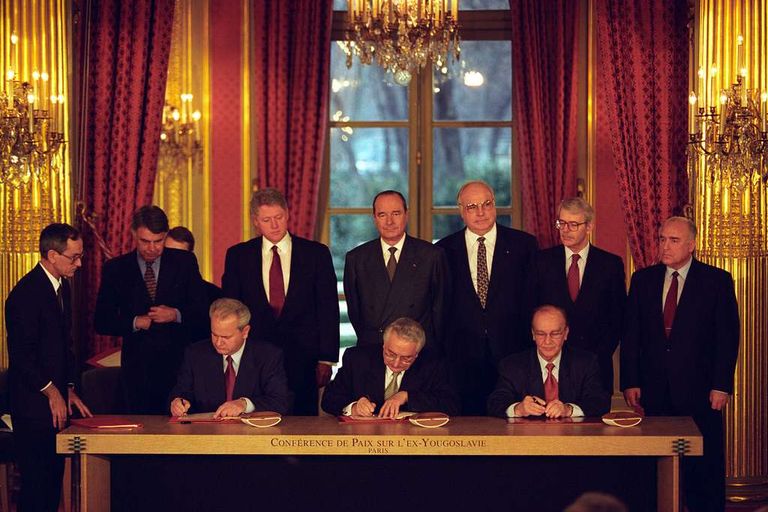
The claim that Serbia, and previously Croatia, are “guarantors” of the General Framework Agreement for Peace in Bosnia and Herzegovina, agreed on 21 November 1995 in Dayton and signed in Paris on 14 December of the same year, is repeatedly made in the media, most often in statements by political officials or commentators.
This agreement, commonly known as the Dayton Agreement, was signed by the then Republic of Bosnia and Herzegovina, the Federal Republic of Yugoslavia, and the Republic of Croatia, while the European Union, France, Germany, Russia, the United Kingdom, and the United States acted as witness countries. The Peace Implementation Council (PIC), comprising more than 50 countries and organizations, provides support for the implementation of the agreement. The Steering Board is the executive body of the PIC and provides guidance to the High Representative of the international community in BiH, who has the authority to sanction obstruction and inconsistent implementation of the Dayton Agreement.
A detailed overview of the facts about the Dayton Agreement and the current Constitution of BiH, as well as details about the countries that signed the agreement, can be found in our analysis from the “prebunking” series Rasvjetljavanje, available at the following link. In that analysis, the following is stated regarding the “guarantors” of the agreement:
Although the term “guarantors” of the peace agreement is not mentioned in the Dayton Peace Agreement, which exclusively uses the terms “parties” and “witnesses”, this does not prevent political actors in BiH, as well as in countries of the region, from claiming otherwise and using this non-existent term. The most common example of its use is the frequent incorrect claim that “Serbia and Croatia are guarantors of the Dayton Peace Agreement”.
Our partner fact-checking platform Istinomjer has also addressed claims that Serbia or Croatia are “guarantors” of the Dayton Agreement. In an analysis published in 2019, it was explained in detail that Serbia (then within the Federal Republic of Yugoslavia) and Croatia are parties to this agreement, together with Bosnia and Herzegovina (then a republic), as stated already in the first sentence of the preamble of the General Framework Agreement for Peace in BiH.
Serbia (the Federal Republic of Yugoslavia) and Croatia are mentioned in several places in the Dayton Agreement, including as “participating countries” (for example, Annex 3 – Agreement on Elections). However, nowhere is it stated that these or any other countries are “guarantors” of the agreement.
Schmidt and “Approval” by the Security Council
Since August 2021, when Christian Schmidt assumed the position of High Representative of the international community in BiH, numerous political officials in Republika Srpska have challenged his appointment. The main argument used to justify this position has been that his appointment was not confirmed by the UN Security Council.
Our partner portal Istinomjer has on several occasions addressed claims by officials who dispute Schmidt’s legitimacy in this manner (1, 2, 3, 4). In an analysis published on 7 June 2021, Istinomjer stated that it is true that Schmidt’s appointment was not confirmed by the UN Security Council, but explained that this does not make Schmidt illegitimate or “illegally appointed”. Simply put, such confirmation is not a requirement for the appointment of the High Representative of the international community in BiH.
Raskrinkavanje has written about numerous media claims that Schmidt is “illegally appointed”, “illegitimate”, or a “fake” High Representative in BiH (1 ,2, 3).
To date, in most cases, the PIC has appointed High Representatives, while the Security Council subsequently expressed agreement with the appointment through a resolution. In the cases of Christian Schwarz-Schilling and Christian Schmidt, no such resolution was adopted, but this did not prevent their appointment or the performance of the duties of the office to which they were appointed. In the aforementioned analysis, Istinomjer stated the following:
The fact that the absence of confirmation by the UN Security Council is not unprecedented is also demonstrated by the case from 2005, when Christian Schwarz-Schilling was selected as High Representative. At that time, outgoing High Representative Paddy Ashdown informed the UN Secretary-General in writing that Schwarz-Schilling would assume the position as of 31 January 2006, and that he had been informed “that this information should be forwarded to the Security Council for consideration and possible agreement”. Moreover, a defined procedure for selecting the High Representative does not exist, and even the first holder of this position, Carl Bildt, was not appointed by the UN Security Council. The Peace Implementation Conference held in London on 8 and 9 December 1995, in addition to establishing the PIC, stated in Conclusion 18 the designation of Bildt as High Representative “after consultations with the Government of Bosnia and Herzegovina”, and called on the Security Council to agree with this move.
Early elections for the President of Republika Srpska were scheduled for 23 November 2025. The elections were called after the Central Election Commission of BiH (CEC BiH) decidedin August to terminate the mandate of RS President Milorad Dodik (SNSD), following the confirmationof a first-instance verdict sentencing him to one year in prison, along with a security measure banning him from performing the duties of RS President for a period of six years. Dodik was found guilty of the criminal offense of failing to implement decisions of the High Representative under Article 203a, paragraph (1) of the Criminal Code of BiH.
We addressed disinformation regarding the details of the verdict against Dodik in an analysis available here. We have also written on several occasions about frequent disinformation aimed at challenging the legitimacy of the High Representative in BiH observed during this period (1, 2, 3, 4).
Based on the facts, we rate the claim that Serbia and Croatia are guarantors of the Dayton Agreement as disinformation. Serbia and Croatia are parties that committed themselves to implementing the agreement through their signatures. The term “guarantor” is not mentioned in the agreement. We rate the claim that High Representative Christian Schmidt “has no authority” because he was not approved by the UN Security Council as manipulation of facts.