
Original article (in Slovenian) was published on 22/1/2026; Author: Eva Gračanin
In a revised indictment against recently ousted Venezuelan president Nicolás Maduro and five co-defendants, New York prosecutors dropped their treatment of the alleged Cartel De los Soles as an organised criminal group and of Maduro as its leader.
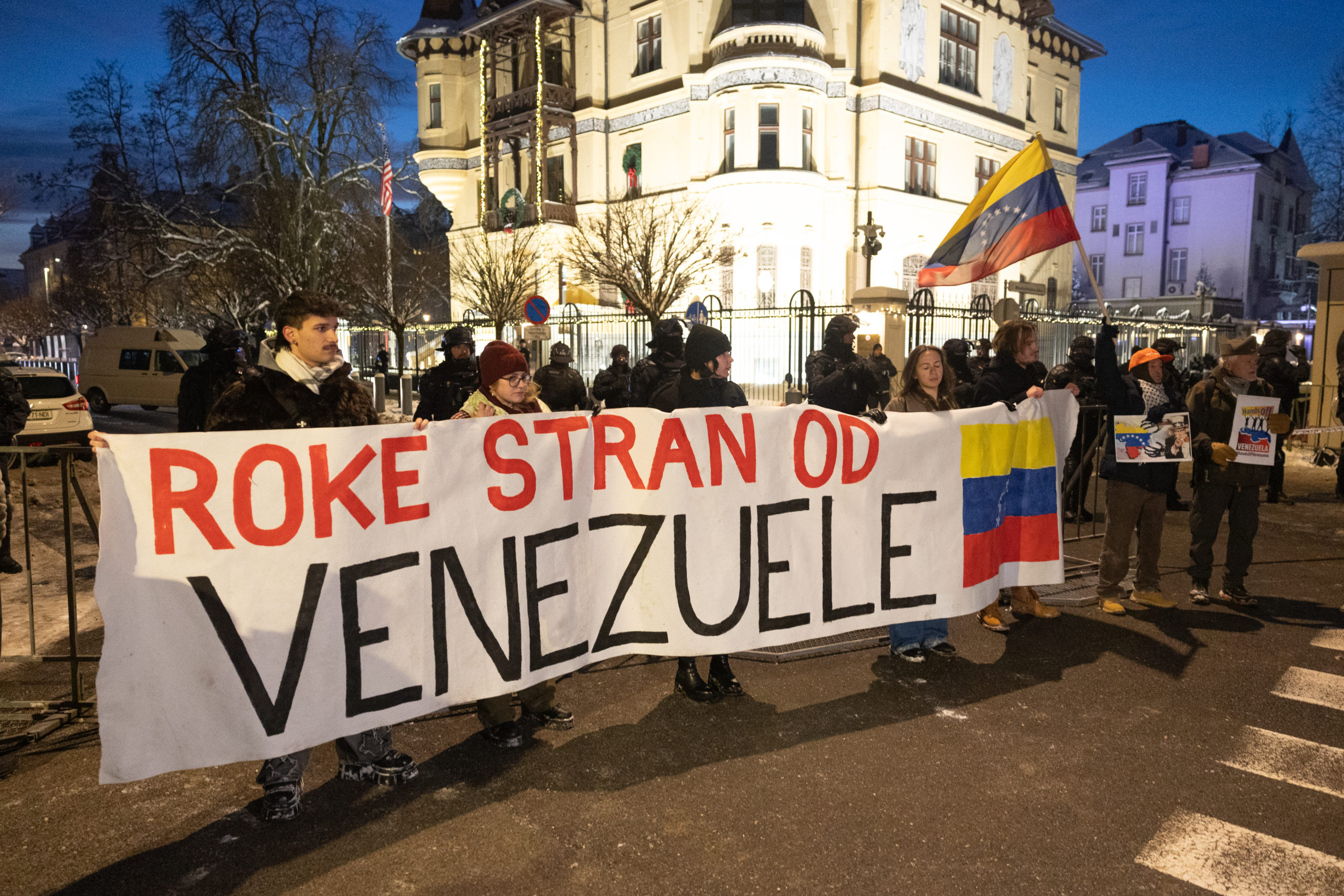
On 8 January, Slovenian member of the European Parliament Branko Grims shared on Facebook an article from the newspaper Slovenske Novice about a rally in Ljubljana organised by the student association Iskra in support of Venezuela. He accompanied the post with a comment in which he described recently ousted Venezuelan president Nicolás Maduro as a “drug cartel boss.” By the time this article was finalised, Grims’s post had been shared by 50 Facebook users. Slovenske Novice did not describe Maduro as a cartel leader in its article.
In the days after U.S. authorities apprehended Maduro, several Slovenian politicians claimed that he had led a drug cartel. Among them were SDS parliamentary group leader Jelka Godec, who posted this claim on Facebook on January 3, and Jernej Vrtovec, president of the New Slovenia (NSi) party, who made a similar assertion on 12 January during an interview on public broadcaster Radiotelevizija Slovenija.
The claim that Maduro is the leader of the Cartel De los Soles stems from a superseding indictment filed in 2020 by U.S. prosecutors against him and five other individuals at the U.S. District Court for the Southern District of New York.
The grand jury accused Maduro and the co-defendants of having, from at least 1999 through 2020, “participated in a corrupt and violent narco-terrorism conspiracy between the Venezuelan Cartel de los Soles and the Revolutionary Armed Forces of Colombia (FARC).” According to the indictment, Maduro “helped manage and, ultimately, lead the Cartel de los Soles as he gained power in Venezuela.”
On 25 July last year, the U.S. Department of the Treasury imposed sanctions on the Cartel de los Soles and designated it a terrorist organisation, while the U.S. Department of State announced on 16 November that it would add it to the list of foreign terrorist organisations 11 days later.
When the 2020 superseding indictment became public in January this year, it emerged that prosecutors no longer treat the organisation allegedly led by Maduro as a cartel, nor Maduro as its leader.
Like his predecessor Hugo Chávez, the defendant participates in, preserves, and protects a culture of corruption in which powerful Venezuelan elites enrich themselves through the drug trade and shield partners who engage in it, the revised indictment states.
The Spanish portal Factchequeado, like Oštro a verified signatory of the International Fact-Checking Network (IFCN) code of principles, reported on 31 October last year that investigations by independent civil society organisations had confirmed the existence of a network enabling Venezuelan military personnel to smuggle cocaine into Mexico and other parts of Central America.
However, they warned that the Cartel De los Soles does not have a single leader, but rather operates as a hybrid criminal structure serving foreign drug cartels, primarily Mexican ones. The Venezuelan state supports this structure, especially through the military, which exercises strategic territorial control. This assessment has also been confirmed by the U.S.-based InSight Crime foundation, which investigates organised crime in Latin America and the Caribbean and is, like Oštro, a member of the Global Investigative Journalism Network (GIJN).
Nathan Jaccard, Latin America editor at the Organized Crime and Corruption Reporting Project (OCCRP), told Razkrinkavanje.si that the Cartel De los Soles is “a kind of brand name that journalists initially introduced to describe the Venezuelan system in which drug traffickers have allies among high-ranking state officials, especially within the military.” The United States later began using the term as well.
In his view, the label is problematic because the word cartel implies a more tightly connected, hierarchical structure with one or more leaders issuing direct orders. As he explained, OCCRP has been reporting on Venezuela for years and has no solid evidence that Maduro issued direct instructions to the group, for example to organise drug shipments.
Maduro tolerated drug trafficking because it served as a lever of political power, particularly over certain military forces, Jaccard said. As a result, there may be individual traffickers who have succeeded under these conditions, but this does not amount to a tightly knit organisation with a clearly identifiable leader: “It is a looser network of corruption and cronyism embedded within the state apparatus.”
He described the designation of such groups as terrorist organisations as a narrative of the administration of U.S. President Donald Trump, which is in practice exaggerated. As he noted, there is a major difference between, for example, the Islamic State, for which terrorism is a clear operational strategy, and drug trafficking, where those involved seek to avoid public attention and operate in a discreet, “business-like” manner.
An expert panel at OCCRP had already voted Nicolás Maduro its “Person of the Year” in organised crime and corruption in 2016. He received the infamous title because of the power of his corrupt and repressive rule, under which citizens of the oil-rich country go hungry and beg for medicine.
U.S.-Venezuela relations tense for years
The deterioration of relations between Venezuela and the United States deepened on 9 March 2015, when then U.S. President Barack Obama issued an executive order in response to the threat posed to U.S. national security and foreign policy by Venezuelan corruption and human rights abuses.
In January 2019, during Donald Trump’s first presidential term, the U.S. recognised Juan Guaidó as Venezuela’s interim president. Guaidó declared Maduro’s presidency illegitimate, a stance supported by numerous Western and Latin American countries. That same year, the U.S. administration imposed additional sanctions and visa revocations to pressure the Maduro regime. For example, it announced sanctions on Venezuela’s oil sector, including the state-owned oil company.
As reported on 22 September last year by the American outlet Politifact, another IFCN code signatory, the U.S. military had since 2 September 2025 destroyed at least three vessels off the Venezuelan coast, killing at least 17 people. President Trump claimed the vessels were carrying drugs to the United States, they reported.
Experts on illicit drugs and analysts familiar with conditions in Venezuela told Politifact that the country plays a smaller role in the drug flows reaching the United States, as most fentanyl arrives from Mexico and the majority of cocaine from Colombia.
We have informed Branko Grims of our findings and will publish his response when we receive it.
Based on the statements contained in the revised 2020 indictment against Maduro, the grand jury has dropped its treatment of the organisation he allegedly led as a cartel and thus of him as its leader. Global media and other civil society organisations investigating organised crime have warned that the Cartel De los Soles is in fact a dispersed network of corruption supported by the Venezuelan government.
The claim that Maduro is a drug cartel boss is unfounded.