
Original article (in Bosnian) was published on 27/11/2025; Author: Amar Karađuz
What Is Being Claimed?
Croatia and Serbia are guarantors of the Dayton Agreement. Russia raised objections to the appointment of Christian Schmidt, citing his alleged support for neo-Nazi movements.
What Are the Facts?
The Dayton Agreement has no “guarantors.” Serbia and Croatia are parties to the agreement. Russia cited a lack of consensus within the Peace Implementation Council (PIC) as the reason for not recognizing Schmidt’s appointment.
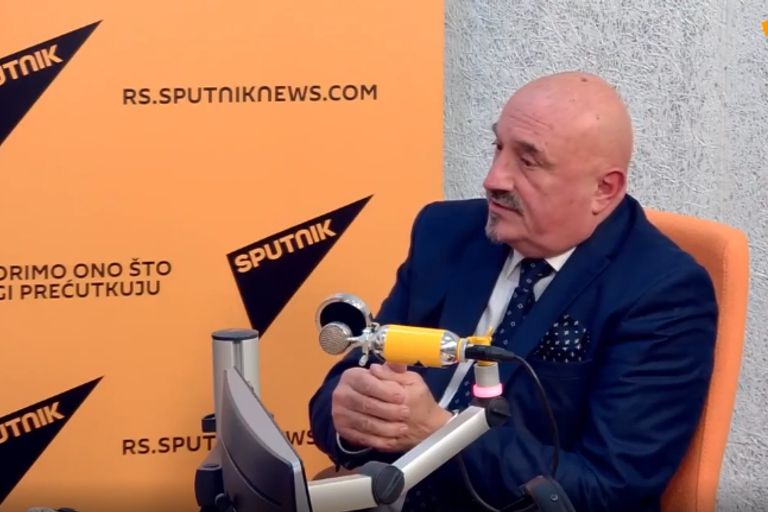
In an episode of the podcast “New Sputnik Order”, published on 5 November, 2025 under the title “A New American Plan for the Balkans”, Serbian lawyer Goran Petronijević appeared as a guest. In a discussion about an alleged new U.S. strategy for the Balkan region, and Bosnia and Herzegovina in particular, Petronijević presented a series of factually unfounded claims about the war in BiH, the role of the signatory countries to the Dayton Agreement and High Representative Christian Schmidt.
This new U.S. strategy for the Balkans discussed in the podcast was portrayed through several initiatives and events, including the proposed Western Balkans Prosperity and Democracy Act in the U.S. House of Representatives; alleged agreements that led to the lifting of U.S. sanctions against Milorad Dodik and the leadership of Republika Srpska; Russia’s involvement in that process; and purported plans by the European Union to undermine agreements among global powers regarding the future of the region.
As early as the 21st minute of the podcast, Petronijević claimed that Bosnia and Herzegovina is “the only place where, 30 years after a civil-religious war, reconciliation has not occurred,” offering a conspiratorial explanation for this situation:
This is the only place where, 30 years after a civil-religious war, reconciliation has not occurred, not because Bosniaks, or Muslims as they were called during the war, Serbs, and Croats did not want it, but because they were not allowed to do so. They cannot do it because it would primarily be against the interests of neoliberal globalists who started that war.
Commenting on reports in Sarajevo-based media about an alleged conflict between Germany and the United States over Christian Schmidt, Petronijević said, from the 41st minute of the podcast, that he had served as an advisor to the defense of Milorad Dodik in proceedings conducted against him before the Court of BiH for failing to comply with decisions of the High Representative. He stated that he jokingly remarked that, in the absence of representatives of Serbia and Croatia as the “guarantors of the implementation of the Dayton Agreement”, he and his colleague Nobilo (ed. note: Croatian lawyer Anto Nobilo) were there to make up for that absence.
In the trial we had, in which I participated in the capacity of an advisor to the defense, because I cannot be a lawyer or defense counsel there, where my colleague Nobilo and I came, we joked a bit and said: well, if there are no representatives of Serbia and Croatia as guarantors of the implementation of the Dayton Agreement, here we are, the two of us, to compensate for that somewhat.
Petronijević spoke about a perceived American shift away from full support for Christian Schmidt and about Schmidt’s alleged complete lack of legitimacy to perform the function of High Representative. In that context, he claimed that Russia, as one of the 12 members of the Steering Board of the Peace Implementation Council, raised an objection to Schmidt’s appointment when he was nominated “because he was found in footage with neo-Nazis in Germany laying wreaths on the graves of fallen Wehrmacht soldiers.”
Petronijević argued that this would not be such a major problem if it had been done in a private capacity or for religious reasons. However, he claimed that the issue lies in the fact that Schmidt attended what he described as a “neo-Nazi orgy, a gathering where ‘Sieg Heil’ was shouted, with swastikas,” in his capacity as a state secretary in the German Ministry of Defense, at a time when the minister was the current President of the European Commission, Ursula von der Leyen.
Responding to a question about the alleged lack of U.S. support for the High Representative, Petronijević said that Schmidt had “admitted” that “Germany brought him in” after receiving a “slap on the wrist” from the United States, that is, a message that he is not the High Representative of the international community as he presents himself to be.
So we claimed at the time (ed. note: when Russia initiated a discussion in the UN Security Council about Schmidt’s appointment) that he was a German diplomat or a German tourist, not a representative of the United Nations and not an international representative, only for him today, after receiving what he received from America, a slap telling him, “wait, you’re really not there, let’s see, you really are not what you present yourself to be”, to say: “no, no, no, Germany brought me here”. Look at the absurdity: he is now returning and effectively admitting what we have claimed from the beginning.
The War in Bosnia and Herzegovina and the Plan for the Breakup of Yugoslavia
The war in Bosnia and Herzegovina was a complex conflict from 1992 to 1995 in which more than 100,000 people were killed. There is no consensus on whether this conflict was an international or a civil war, nor on whether it can be described as a religious conflict. Historians and human rights advocates fear that, due to the constant politicization of this issue, a single agreed-upon position may never be reached.
Proponents of the civil-war thesis insist on the fact that, for most of the war, the three main sides were the predominantly Bosniak Army of the Republic of Bosnia and Herzegovina, the predominantly Serb Army of Republika Srpska, and the Croatian Defence Council. However, the war in BiH also had elements of an international conflict, as indicated by facts established in certain judgments of the UN Residual Mechanism for Criminal Tribunals (e.g. the Stanišić and Simatović case).
The war ended with the signing of the General Framework Agreement for Peace in BiH, known as the Dayton Peace Agreement, in Paris on 14 December, 1995. The agreement, previously negotiated in Dayton, Ohio, was signed in Paris by the then Republic of Bosnia and Herzegovina, the Federal Republic of Yugoslavia, and the Republic of Croatia, while the European Union, France, Germany, Russia, the United Kingdom, and the United States acted as witness countries.
Serbia (as the successor to the Federal Republic of Yugoslavia) and Croatia are parties to the agreement that ended the war, not “guarantors”.The term “guarantors” is not mentioned in the agreement.
Who Is Goran Petronijević?
According to a biography published by the Serbian daily Danas, Goran Petronijević was born in 1960 in Prokuplje and graduated from the Faculty of Law in Belgrade. During his judicial career, he accumulated several “biographical entries that few judges in the world could boast,” Danas notes. As a judge in Peć during the 1990s, he set a “precedent” by sentencing Kosovo Albanians accused of terrorism in one case to more than 1.600 years in prison.
The judicial panel of which he was a member symbolically convicted Western leaders in 1999 over the NATO bombing of the Federal Republic of Yugoslavia. After the change of government in Serbia in 2001, he moved into legal practice and was part of the defense teams of Radovan Karadžić and Veselin Šljivančanin. In Serbia, he has represented high-profile figures from political, security, and criminal circles.
Petronijević’s public and political engagement places him on the right wing of public life. He served as vice president of the movement “For Serbia”, whose now-unavailable website (archived here) described him as the “personal biographer of Ratko Mladić” and an “expert on events in Srebrenica”. The organization’s programstated that it advocates for the “revival of national self-awareness of the Serbian nation and the strengthening of comprehensive cooperation with all Orthodox Slavic peoples and all peoples of the Balkans, for the affirmation of the right to unite all state-forming parts of the Serbian people that remained outside the borders of Serbia, and for the eradication of Serbophobia and interethnic hatred”.
According to reporting by Radio Free Europe, Petronijević acted as an observer at Russian local elections in occupied parts of Ukraine, and he frequently appears in the media as an interpreter of legal and international-political developments.
The belief that the breakup of Yugoslavia and the wars that followed were a direct consequence of the interests of Western governments at the time is not new and is widespread across nearly all ethno-national communities in Bosnia and Herzegovina. According to this belief, the West (primarily the United States) had a plan to fragment Yugoslavia. We assessed such claims as a conspiracy theory in a previous analysis.
The wars in the former Yugoslavia (1991-1999) are well documented, and the individual responsibility of representatives of local political and military leaderships for war crimes has been established in judgments of the International Criminal Tribunal for the former Yugoslavia (1, 2, 3) and the Residual Mechanism for Criminal Tribunals (1, 2).
The breakup of Yugoslavia occurred in a specific geopolitical moment at the end of the Cold War and the “fall” of communism in Eastern Europe – external events that may have contributed to such developments in a socialist state. However, placing emphasis on a “neoliberal” conspiracy as the cause of the wars in the former state, and in Bosnia and Herzegovina in particular, represents a denial of the established responsibility of local and regional actors in the war in BiH.
The Appointment of Schmidt
The Steering Board of the Peace Implementation Council (PIC SB) appointed Christian Schmidt to the position of High Representative in BiH in May 2021, after he was nominated by the Federal Republic of Germany. In its statement on the appointment, the PIC noted that Russia did not agree with the decision. Schmidt assumed office in August of the same year.
During 2022, media outlets in BiH wrote about Christian Schmidt’s political past, citing the German magazine Kontraste and a report showing Schmidt laying flowers at a memorial during a gathering of Wehrmacht veterans in the town of Mittenwald, Bavaria. According to these reports, Schmidt, as a senior official of the German government, attempted in 2007 to rehabilitate Nazi pilot Werner Mölders. However, this did not take place during the mandate of Ursula von der Leyen as Germany’s Federal Minister of Defence, a position she held from 2013 to 2019.
Following media reporting, the Center for Socio-Political Research of Republika Srpska published an extensive text with similar claims about the High Representative in BiH in September 2023.
However, in posts published on the Facebook page of the Embassy of the Russian Federation in Bosnia and Herzegovina that mention Christian Schmidt, we did not find any statement or comment citing his political past, attendance at events glorifying Nazis, or similar reasons as grounds for Russia’s “objection” regarding the appointment of the current High Representative. In a comment on the appointment from August 2021, the embassy emphasized its disagreement due to the lack of consensus within the PIC Steering Board during Schmidt’s nomination, as well as the absence of approval by a UN Security Council resolution, which Russia considers necessary for the legitimacy of the High Representative. According to Russia’s position, bypassing confirmation in the Security Council and violating the consensus rule means that Schmidt “formally and legally” cannot be recognized as High Representative.
In the same statement, it was even emphasized that the Russian Federation is not opposed to Schmidt and that it values his political experience:
We are not against Mr. Christian Schmidt. We appreciate his political stature and take into account his knowledge and experience working in the “Balkan direction”. However, the principle of consensus was not respected when proposing Christian Schmidt’s candidacy, nor was approval obtained from the UN Security Council. Therefore, for us, he is illegitimate as High Representative.
As highlighted in earlier Raskrinkavanje analyses, the issue of Schmidt’s appointment was further amplified during the election campaign for early elections for President of Republika Srpska, which were held after Milorad Dodik lost his mandate as entity president due to a final conviction for failing to implement decisions of the High Representative. Petronijević’s statements can also be viewed in this context.
UN Security Council Session
Petronijević stated that Schmidt received a “slap on the wrist” from the United States in the form of questioning his status as High Representative, in the context of a UN Security Council session on the situation in BiH. The session was held on 31 October 2025 at Russia’s initiative. The High Representative, or Schmidt by name, was not mentioned in the speech delivered at that session by Dorothy Shea, Deputy Permanent Representative of the United States to the UN. Regarding international engagement in BiH, Ambassador Shea emphasized the following U.S. position:
Colleagues, the United States no longer engages in nation-building or heavy, imposed international interventions. Now is the time for local solutions, led by local actors representing the three constituent peoples of Bosnia and Herzegovina. These actions reflect a step in that direction and the spirit of U.S. policy.
It is true that the speech emphasized the U.S. position that it does not pursue a policy of “imposed international intervention” and conveyed a message about the need for local solutions to be implemented by local actors representing the constituent peoples of BiH. However, this stance was justified by the “spirit of U.S. policy”, not by animosity toward Christian Schmidt as the representative of the international community in BiH.
Additionally, the ambassador noted in her speech that sanctions against Milorad Dodik were lifted following the session of the Republika Srpska National Assembly on 18 October, at which laws, information and conclusions of that parliament were withdrawn that challenged, alongside state-level institutions, the decisions of High Representatives and Christian Schmidt.
According to the facts above, we rate the claim that the war in BiH was caused by the interests of “global neoliberals” and that reconciliation is prevented due to those interests as a conspiracy theory. We rate the claim that Serbia and Croatia are “guarantors” of the Dayton Agreement as disinformation, given that these countries are parties to the agreement who committed to its implementation by signature.Claims that Russia challenged the appointment of Christian Schmidt due to his alleged support for neo-Nazism are rated as manipulation of facts. We assign the same assessment to claims that the United States is questioning the legitimacy of the High Representative.