
Original article (in Montenegrin) was published on 11/11/2025; Author: Jovana Đurišić
Those who oppose the student blockades in Serbia – whether political actors, media outlets, or social media users – often claim that the protests are being orchestrated by a “third party,” alleging that neighboring countries are instructing the demonstrators, most frequently pointing the finger at Croatia.
A rally in support of students from Serbia was recently held in Zagreb on the anniversary of the tragedy in which sixteen people were killed when a concrete canopy collapsed in Novi Sad. The protest took place in front of the Embassy of Serbia in Zagreb, and some used the event to promote a narrative claiming that the protests were backed by a neighboring country.
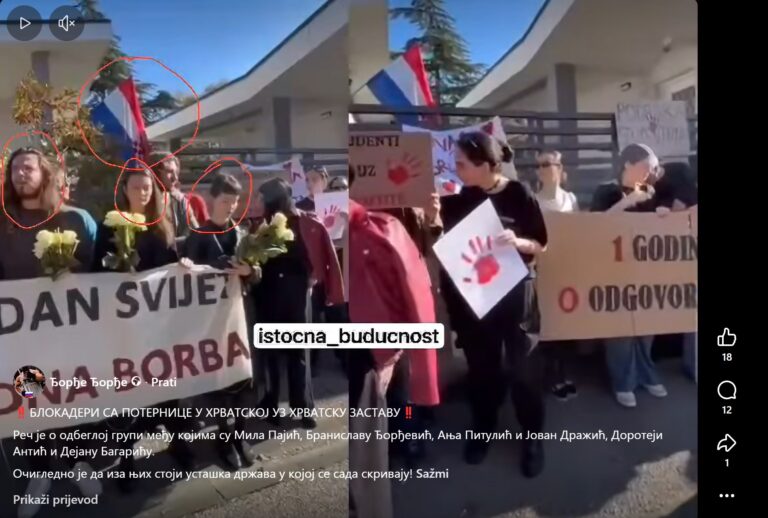
“Blockaders from the wanted list in Croatia, standing next to the Croatian flag!!
This is a fugitive group including Mila Pajic, Branislav Djordjevic, Anja Pitulic, and Jovan Drazic, Doroteja Antic and Dejan Bagaric.
It is obvious that behind them stands the Ustasha state, where they are now hiding,” reads the posts we found on Facebook (1,2), Instagram (1,2,3) and TikTok (1) (archived here).
What is this about?
Several hundred students and citizens gathered in front of the Embassy of Serbia to express support for those assembled in Novi Sad. Among them were activists from the organization Students Against Authoritarian Rule (STAV), whom the post’s author mentioned. These are students who have been living in exile in Croatia since March of this year, after being accused in Serbia of an alleged attempt to overthrow the constitutional order.
The gathering in front of the Serbian Embassy in Croatia’s capital, marking the anniversary of the Novi Sad canopy collapse, was called by students of the Faculty of Political Science and the Faculty of Philosophy Zagreb, via Instagram, and representatives of these university units were among those present.
They recalled that on November 1, 2024, a recently renovated concrete canopy collapsed, killing 16 people. “November 1, Zagreb, 11:30, Embassy of Serbia. One year, zero accountability,” they wrote in the posts.
Moreover, the so-called “blockaders from the wanted list,” as labeled in the posts, were not standing “next to the Croatian flag.” As explained, the protest was held in front of the Embassy – more precisely, across the street from it.
The Serbian Embassy in Zagreb is located at 23 Jabukovac Street. What appears behind the gathered people is not that building, but the building of a private school located at Jabukovac Street 26 in front of which the Croatian flag is displayed. Footage from the gathering shows participants standing across from the Embassy, that is, in front of the school; when the camera pans to the right, the embassy building at number 23 is visible, along with the Serbian flag flying at half-mast.
A simple search on Google Maps shows Jabukovac Street, the Serbian Embassy, and the building across the street referenced in the disputed posts.
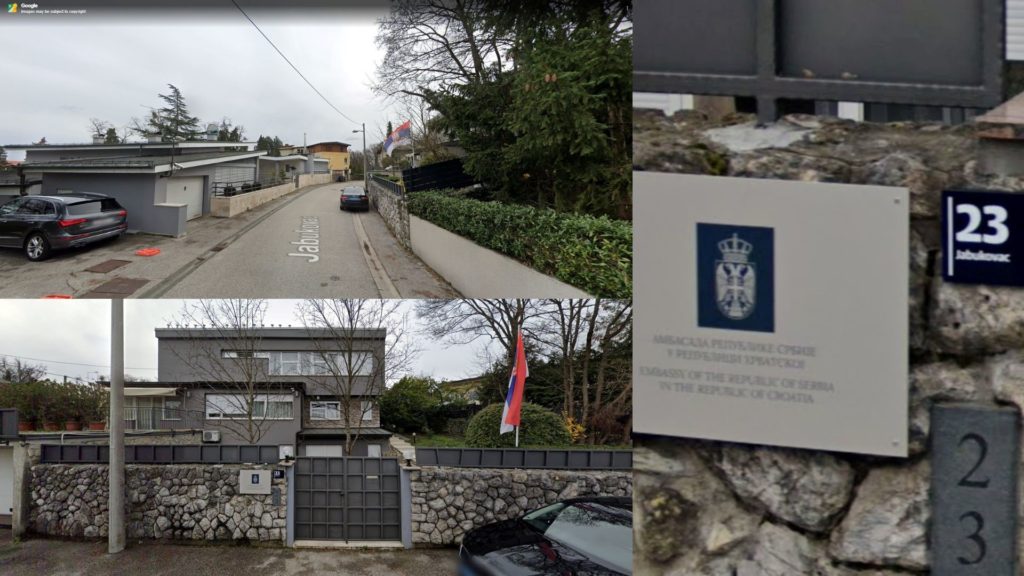
It is therefore clear that the participants were not standing beneath the Croatian flag, as claimed in the posts, but that the protest took place in front of the Serbian Embassy in Zagreb.
In light of the above, we rate the social media posts as disinformation.
The “Disinformation” rating is given to media reports that use well-known and accurate facts but interpret them in a misleading manner. These reports generally use accurate information to draw incorrect conclusions or claims, thereby steering the audience’s understanding of the media content in a direction that deviates from the actual meaning of the presented facts.