

Original article (in Serbian) was published on 6/2/2026; Author: Teodora Koledin
In the morning program of Pink Television on February 4, 2026, the President of the National Assembly and former Prime Minister Ana Brnabić was a guest. On that occasion, manipulations were presented regarding a statement by lawyer Božo Prelević, taken from the program Glas javnosti, and a recently published study on annual pensions and pensioners’ expenses in Europe was also misleadingly interpreted.
About Božo Prelević’s statement
The hosts of the show “Novo jutro”, Dejan Sarapa and Jovana Maksimović, broadcast in the program a tendentiously edited clip of Božo Prelević in which he says that “Jasenovac could only have happened where you did not defend your own citizens.” Over the clip, they inserted the caption: “blamed Serbs for Jasenovac.”
The former politician did indeed say that sentence, but his original statement was deliberately shortened:
“Jasenovac is the consequence of two things: One sick Ustaša mind – and not all Croats are Ustaše; there were also Croats in Jasenovac, a small number but there were victims. That is one thing. The second thing: Jasenovac could only have happened where you did not defend your own citizens. Why didn’t you defend your own citizens? Hey, brothers Serbs, why didn’t you defend them? Why don’t you defend Kosovo now?”
After the video was aired, the President of the National Assembly Ana Brnabić added that the policy of the “blockaders” is that “Serbs, the Serbian people, are always to blame for everything, even when the worst monstrosities are committed against them.” Brnabić sarcastically added that “it wasn’t the Ustaše who wanted to kill us, they weren’t monsters, killers, butchers, executioners…”, and that they would not have been killers “if we had defended ourselves.”
However, with his statement, Božo Prelević did not deny the responsibility of the Ustaša movement for the crimes committed in the Jasenovac camp. On the contrary, he first speaks about a “sick Ustaša mind.” The former Serbian prime minister further modifies the narrative by claiming that Prelević meant the Serbs (the victims of Jasenovac) when he asked, “Why didn’t you defend them,” even though it is obvious from the context that he was referring to the Serbian power-holders of that time.
The manipulation claiming that Prelević said that Serbs, rather than the Ustaše, were responsible for the suffering in Jasenovac was also reported by the media outlets b92, NS Uživo, Novosti, Alo, Informer, 24sedam, and Republika.
Are pensions in Serbia better than in Norway or Luxembourg?
The second manipulation concerns an arbitrary interpretation of data from a study recently published by DataPulse, a studio focused on data-driven journalism. In a later post on X, Brnabić confirmed that she relied on these data.
The research compared annual pensioners’ income with their annual expenses in 27 EU member states, Serbia, Montenegro, and Norway. Its results showed that “in some countries pensions approximately cover typical retirement costs, while in others a significant additional income is needed for the same lifestyle.” The differences between income and expenses were expressed in percentages:
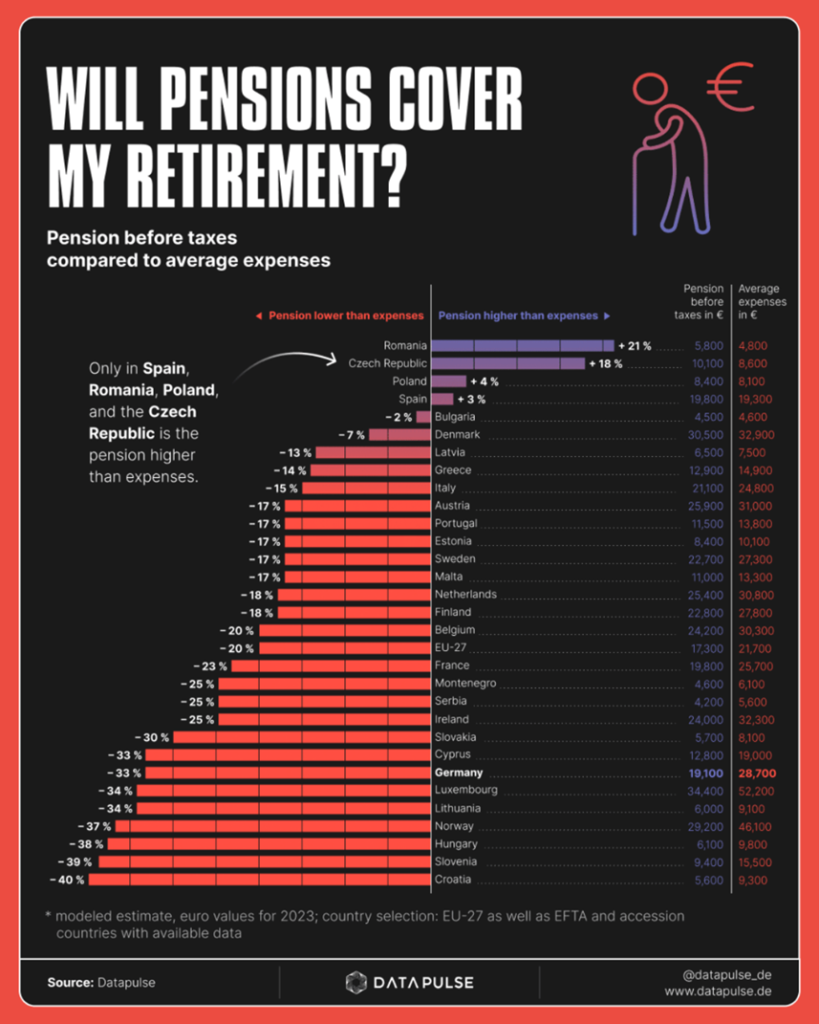
Brnabić stated in the morning program that this ranking shows that Serbia is “the best in the region.” However, the study cannot serve as valid evidence for that claim because it did not include several countries in the region – Bosnia and Herzegovina, North Macedonia, and Albania.
At the same time, the former prime minister’s claim that Serbia is “better” than Montenegro is also incorrect, since Montenegro is ranked above Serbia on the list with the same percentage of -25 percent. Brnabić also stated that Serbia is “even better than Norway, better than Germany,” as well as “better than Luxembourg.”
In the first chart, these countries appear below Serbia, meaning their state pensions cover a smaller share of retirees’ regular monthly expenses. However, there is an important “catch” that the authors point out later.
An important question is whether a so-called pension deficit automatically leads to poverty. The short answer: not necessarily. Although there is a pattern suggesting that the risk of poverty is generally lower in countries where pensions exceed expenses (and vice versa), there are also several exceptions.
As the authors explain, “in countries such as Norway, Slovakia, and Luxembourg, where state pensions do not fully cover living costs, the risk of poverty remains surprisingly low” because “in such systems the state pension is not designed to be the only source of income.”
Unlike in some other countries, these societies have developed secondary and tertiary systems, such as private savings or employer-provided pension schemes, which help retirees live comfortably.
For example, on the official website of the Norwegian government, we can see that their pension system consists of three parts:
- The National Insurance Scheme
- Occupational (workplace) pensions provided by employers
- Optional personal pension savings
The National Insurance Scheme is Norway’s public pension system, covering everyone who lives or works in the country. The size of this pension is based on lifetime income and length of employment.
As for occupational pensions, all employees in the private sector are entitled to them, and the amount depends on the workplace and the employer’s contract. Employees in the public sector are covered by a public occupational pension scheme that “provides a pension proportional to income during employment.”