
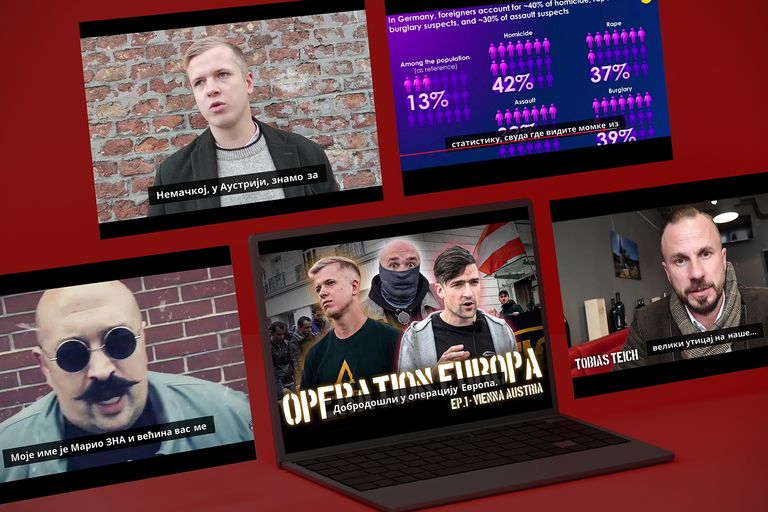
Original article (in Bosnian) was published on 16/02/2026; Author: Nerma Šehović
What are the claims?
The European Union is carrying out a planned replacement of the native population through mass migration from Asia and Africa.
What are the facts?
The “great replacement” conspiracy theory is based on the unfounded belief that elites are using mass migration to change the demographic makeup and culture of Western countries.
Conspiracy theorist and editor and owner of the Nulta tačka news outlet Mario Bojić, also known as Mario ZNA, published a documentary titled “Operation Europe” on his X account on January 12, 2026.
As part of this English-language documentary, subtitled in Serbian, Bojić travels to Vienna and speaks with a number of interlocutors about the “migration problem” that is supposedly destroying Europe. The video received 82.000 views on X and was also published on YouTube on January 17, 2026. At the time of writing this analysis, it had 5.200 views on that platform.
Several key claims form the narrative of this documentary. It is claimed that a larger number of immigrants in European countries is leading to rising crime rates and that migration is part of the “great replacement”, that is, a plan to replace the white European population with people from Asian and African countries. Responsibility for implementing this plan is attributed to the European Union.
Besides the European Union, the left-wing anti-fascist movement Antifa, as well as the political left in general, are presented as the “villains” in this narrative. It is claimed that Antifa works for the “state” and is funded by the “state”.
This narrative is constructed throughout the documentary without presenting any actual evidence, data, figures, or statistics to support the claims being made. In this analysis, we take a closer look at the narrative itself and the facts surrounding the claims presented.
The “great replacement” conspiracy theory
At the beginning of the video, Mario Bojić speaks about Vienna, the capital of Austria, and comments on the alleged demographic changes in the city and the country:
(…) And the native population is shrinking, replaced by waves of migrants who share neither the culture, nor the history, nor the values that built this country. This is not immigration. This is a transformation. This is a replacement. A silent, calculated demographic shift carried out by EU elites, financed by NGOs, protected by censorship, and defended by a political class more loyal to Brussels than to its own people.
Similar claims are repeated throughout the documentary and are also voiced by Bojić’s interlocutors. In this context, the term “migrants” is used primarily to refer to immigrants from Middle Eastern and African countries.
These claims promote the “great replacement” conspiracy theory, which gained popularity in European far-right circles in 2011 after French author Renaud Camus published a book under the same title. At the core of this conspiracy theory is the belief that “elites” (in this case, the European Union bureaucracy) are deliberately and systematically “bringing in” masses of people from Asian and African countries in order to “replace” the native white population and destroy Western culture or, in some versions, to “commit genocide against white people”.
There is no evidence that migration is actually a conspiracy against the native populations of Europe or North America, nor is there any coherent explanation of what the goal of such a conspiracy would be. However, this conspiracy theory is often used to “justify” discrimination, racist and xenophobic rhetoric, and violence against minorities. Referring to data from a Guardian article published on June 8, 2022, we stated the following in an analysis of similar claims published in November 2022:
Numerous violent attacks carried out by radical supporters of this conspiracy theory against groups perceived as threats to the “preservation of the white race” demonstrate that these are not harmless claims. The armed attack on members of the African American community in Buffalo in June of this year, the terrorist attack in Oslo, Norway, in 2011, the mosque shooting in New Zealand in 2019, and the attack on a synagogue in Pennsylvania in 2018 are just some of the attacks carried out by followers of this radical right-wing conspiracy theory listed by The Guardian.
Therefore, there is no evidence that the European Union or anyone else is “bringing” migrants to Western countries in order to replace the white population. This is a conspiracy theory that seeks to justify racism and xenophobia by portraying every person of non-European origin as a threat that is legitimate to target. The “great replacement” theory is based on racist stereotypes and then, in a conspiratorial vicious circle, further reinforces them.
In reality, both Germany and Austria, which are the focus of this “documentary,” still have overwhelmingly European populations.
According to 2023 data, 73,3% of Austria’s population is of Austrian origin, without a migration background, while 26,7% has a migration background. Most immigrants or people of immigrant origin come from other European countries such as Germany, Romania, Hungary, or former Yugoslav countries, primarily Serbia, and since 2022, Ukraine. Besides European countries, Turkey is also among the ten most common countries of origin for Austria’s immigrant population, while Syria and Afghanistan are near the bottom of that list. In other words, more than 90% of Austria’s population is of European origin, most of them Austrian (1, 2, 3).
Germany has a similar demographic picture. According to 2023 data, 79,6% of the population is of German origin, while 20,4% is of foreign origin. A significant portion of that population consists of people of European origin from countries such as Russia, Poland, and former Yugoslav states. Overall, it is estimated that between 87% and 93% of Germany’s population is of European origin (link).
Therefore, claims that people of Asian and African origin are “taking over” European countries such as Austria and Germany are unfounded. Statistics clearly show that Germans and Austrians remain a large majority in their respective countries, while people from the Middle East and Africa constitute a relative minority, even within the migrant population. A similar demographic picture can be observed in other EU member states as well (1, 2).
What are the facts about crime rates and migration?
Bojić claims that migration is causing crime rates to rise in Austria and Germany. This claim is repeated by some of his interlocutors as well. Wieland Kubitschek, a member of the far-right identitarian movement whom Bojić interviewed in Vienna, stated the following:
Bojić: So when it comes to statistics, when it comes to the situation in Germany and Austria together, when it comes to the crime rate, when it comes to violence, how does your group comment on that?
Kubitschek: Yes. I mean, I won’t tell you the exact figures, because that’s a minefield. They differ depending on which source you look at, what you define as an attack, what you define as whatever. And of course, we know about the major attacks in Germany and Austria, we know about the terrorist attack in Vienna, in Villach last year. No, actually this year. We know about the major attack in Magdeburg, the major attack in Berlin, at the Berlin Christmas market. But that’s not even the main thing. The main thing is the small attacks that happen every day in Vienna, Berlin, Cologne, Frankfurt, the small attacks. Girls being raped, our boys getting stabbed. Those are the important things, not even the major attacks. And of course, we see danger. We see an inherent danger to our people in Germany and Austria. And that’s what we’re fighting against.
Kubitschek refused to cite any statistics related to crime rates in Austria, but the statistics do not support the narrative that crime is increasing because of migrants from the Middle East and Africa. Austria has a relatively low crime rate, and overall crime has generally been declining since the beginning of the 21st century, with some year-to-year fluctuations. Moreover, since 2001, the number of suspects has increased while the number of convictions has sharply decreased, indicating that police are acting more efficiently and that the number of actual crimes is declining (1, 2).
On the other hand, it is true that a significant proportion of crime suspects, nearly half, are foreign nationals, around 65% of whom live in Austria, 32% do not live in Austria, and around 3% are undocumented migrants. Among these foreign suspects, Romanians are the most numerous, followed by Germans and Syrians. Half of Austria’s 9.700 prisoners are also foreign nationals, most commonly Serbs, Turks, Russians, Slovaks, Romanians, and Afghans (link, link).
Foreign nationals are also at greater risk of becoming victims of crime and account for 36% of all victims. Afghans, Iraqis, and Syrians are particularly prominent in this regard, as they are victims of crimes committed both by Austrian citizens and by other foreign nationals.
According to data from Austrian authorities, far-right extremist groups contributed to crime rates in 2025, with such crimes increasing by 40%.
Therefore, statistics do not show any significant correlation between the presence of immigrants from Asia and Africa and an increase in violent crime. This does not, of course, mean that there are no criminals among people arriving from other continents, but the data do not show that they are particularly prone to crime because of their nationality compared to other groups.
Bojić also spoke with Tobias Teich, a Bundestag representative from the far-right AfD party, about crime rates and migration in Germany. He claims that Germany has a security problem and links it to migrants from Syria, Afghanistan, and African countries.
And this is actually connected with mass migration from certain places into Europe and Asia. Mostly from Asia or Africa. Schengen, the Schengen Agreement, was one of the biggest mistakes ever. And it got even worse when migration increased in scale. Then 2015 had the biggest impact ever because of the mass migration that happened from 2015 onward. Just imagine, we had around 1,2 million Syrians in our country. Nobody should have been granted asylum here, but they gave it to them. And now we have around 300.000 Syrians who are now German citizens. So they are part of this group of 1,2 million people in Germany. And now we still have around 900.000 Syrians remaining here in Germany. We also have around 500.000 Afghans in Germany.
And there are also 1,5 million Ukrainians, but with Ukrainians and Afghans and Syrians, you have to take a closer look. It’s very different because they are much closer to our culture. There are fewer problems with them. And if you just look at criminal complaints, the statistics, everywhere you see guys from Syria and guys from Afghanistan, they are overrepresented. So you cannot deny the fact that these people affect our internal security and politics.”
While he speaks, a graphic is shown in the background allegedly indicating that foreigners account for 40% of suspects in murders, rapes, and robberies, and around 30% of suspects in assaults.
In Germany, crime rates have also generally been declining over the past several decades and remain very low by global standards. However, over the past three years, crime has increased compared to the previous decade, which right-wing circles often attempt to portray as a result of migration (link). A study published in February 2025 by the Ifo Institute, a German organization researching social and economic issues, found no correlation between immigration and rising crime rates in Germany. This conclusion was reached after a detailed analysis of police data from 2018 to 2023. The full analysis is available here, and the summary explains the following:
“We find no correlation between the growing share of foreigners in a district and the local crime rate. This also applies specifically to refugees,” says Ifo researcher Jean-Victor Alipour.
“The results are consistent with international research, according to which migration and refugee inflows have no systematic effect on crime in the host country.”
Foreign nationals are overrepresented in crime statistics relative to their share of the population. This is due to factors independent of origin: migrants usually settle in urban areas, where the general risk of crime is higher for the native population as well. The fact that foreigners are on average younger and more often male is less important.
“If you take these factors into account, there is no statistical correlation between the regional share of foreigners and crime rates,” says Ifo researcher Joop Adema.
“The assumption that foreigners or refugees are more inclined to commit crimes than demographically comparable natives is not sustainable.”
The “statistics” presented in Bojić’s documentary are manipulative. According to 2024 data, 34% of crime suspects were foreign citizens, 8,8% were temporary immigrants (whom Teich portrays as the main threat to security in Germany), while 64,6% were German citizens (link).
Temporary immigrants include groups such as asylum holders in Germany, including Ukrainians, Syrians, Iraqis, and Afghans, as well as people with temporary work or student permits. The data show that Ukrainians are disproportionately underrepresented among crime suspects relative to their share of this population. Syrians are represented roughly proportionally, meaning that their share of the population corresponds to their share among crime suspects. The groups that are more represented among suspects relative to their share of the population are people from Morocco, Georgia, Algeria, Albania, Tunisia, and Nigeria (link).
It is important to emphasize that these are suspects, not people convicted of crimes. Stereotypes and prejudices promoted by such conspiracy theories, and further reinforced by unprofessional media reporting, can lead to racial profiling, that is, targeting people based on their race or ethnicity. This is a documented problem in Germany.
Ultimately, many factors affect crime rates in a given community, including population density, the degree of urbanization, the share of young people, especially young men, in the population, unemployment and poverty, access to education, police work, drug and alcohol abuse, and so on.
Immigrant communities in many countries have traditionally been exposed to a greater number of risk factors (poverty, lack of educational opportunities, unemployment) than the native population, which can lead to greater representation of members of those communities in crime statistics (1, 2). These are therefore primarily economic and social problems, not issues related to someone’s skin color, religion, or country of origin.
Most of the interlocutors Bojić interviewed advocate remigration, that is, the mass and forced deportation of immigrants, refugees, and their descendants from their countries. Bojić implicitly supports this position throughout the documentary, but he never asks any of his interlocutors whether this would also apply to people from our region, many of whom live in Germany and Austria and are also heavily represented in crime statistics.
There was probably no need to ask such a question, given that radical right-wing figures generally mean only immigrants and refugees of non-European origin when speaking about remigration, calling for them to be stripped of legally obtained residence permits and even citizenships, regardless of whether they have committed a crime or not (1, 2).
What is Antifa and how is it funded?
Besides the European Union and migrants of Asian and African origin, Mario Bojić also presents the left-wing “organization” Antifa as a threat. At the beginning of the video, he claims that “Antifa terrorizes the streets with violence and intimidation, protected by the same political class that punishes citizens faster than criminals.” In a conversation with radical right-wing figure Martin Sellner, after discussing remigration, Bojić asks what should be done with Antifa “and the other leftists”, suggesting they should be sent for “re-education.” Sellner, as well as another interlocutor, Christoph Albert, claims that Antifa is funded by the state and that this is the source of its power.
The term “Antifa” is short for anti-fascism. It refers to a broad and decentralized left-wing movement that argues that fascism remains a threat to society and that it should be fought through radical, and in some cases violent and illegal, methods.
Antifa cannot really be described as an organization, since it has no structure, hierarchy, or leadership. The term is mostly used to refer to participants in radical (and in some cases violent) left-wing protests carried out under the banner of anti-fascism. It is therefore, at best, an informal network of individuals and groups sharing similar beliefs.
There is no evidence that Antifa in Germany or Austria is “funded by the state” or by the EU. Groups operating under this ideology are generally believed to finance themselves through community donations or contributions collected from members, and their budgets are considered to be very small.
Although Bojić attempts to portray left-wing organizations as a serious threat to public security that “terrorizes the streets,” statistics contradict these claims. According to 2024 data, only 6% of individuals charged with terrorist activities in the European Union were arrested for activities connected to radical left-wing or anarchist terrorism.
Although radical left-wing terrorism is real, it is considered a low-risk threat in EU countries.
Controversial interlocutors
The documentary created by Mario Bojić presents a highly one-sided perspective on migration in Europe. All of the interlocutors are far-right extremists, and many are members of notorious radical groups whom Bojić simply presents as “patriots”.
One of the interlocutors is Martin Sellner, a notorious extremist who has been banned (or is still banned) from entering the United States, the United Kingdom, and Germany because of his criminal history and ties to people who committed terrorist attacks and hate crimes. Sellner became known to the global public after it was revealed that in 2019 he had regularly communicated with the man who carried out the terrorist attack on a mosque in New Zealand, in which more than 50 people were killed, and who shared political views similar to his own. He has repeatedly had conflicts with the law both in Austria and abroad (1, 2).
Sellner is one of the most prominent members of the radical right-wing, and according to some descriptions neo-fascist, Austrian identitarian movement.
Besides Sellner, several other interlocutors featured in Bojić’s documentary are also members of this movement, namely Wieland Kubitschek, Christoph Albert, and Andreas Hinterberger. Kubitschek, who is not himself an Austrian citizen, became known to the public after a 2023 incident in Vienna in which he struck another protester on the head with a bottle during a demonstration, believing him to be an anti-fascist.
Albert and Hinterberger are mentioned in statements by local authorities as participants in extremist protests during which racially motivated attacks on passersby, harassment of journalists, and the display of illegal hate symbols took place (link).
According to the facts, we rate the claim that EU elites are carrying out a planned replacement of the population in European countries as a conspiracy theory. We give the same assessment to the claim that the EU and the authorities in Austria and Germany are financing Antifa.We rate the claim that crime rates are rising in Austria and Germany because of migration as manipulation of facts.