
Original article (in Bosnian) was published on 06/03/2026; Author: Nerma Šehović
In the early morning hours of February 28, 2026, Israel and the United States launched attacks on Iran. Targets were struck in Tehran, Isfahan, Karaj, Qom, and Kermanshah. In the days that followed, Iran retaliated with attacks on targets in Israel, as well as in Bahrain, Saudi Arabia, the United Arab Emirates, Kuwait, Oman, Qatar, Iraq, Jordan, and Cyprus. The attacks primarily targeted U.S. military bases, but also other infrastructure such as ports and airports. Israel also attacked Lebanon.
It has been confirmed that Iran’s Supreme Leader Ayatollah Ali Khomeini was killed in the Israeli-American strikes. According to Iranian state media, more than 1.000 people have been killed and more than 6,000 injured in the attacks so far. During the initial strikes on Iran, a girls’ school in the south of the country was also hit, and according to Iranian authorities, 165 people, mostly children, were killed in the attack.
Casualties on a smaller scale were also recorded in attacks on other countries. At the time of writing this analysis, the conflict in the Middle East was still ongoing at full intensity.
Media outlets around the world have been reporting extensively on what has now become a regional conflict, and the public has been alarmed both in Bosnia and Herzegovina and the wider region, as well as internationally. However, among the many authentic videos of attacks on Iran and other countries circulating in recent days, there have also been videos that do not depict real events.
On March 3, 2026, the Facebook page of the portal Tutinske novine published a video allegedly showing an Iranian missile strike on Tel Aviv.
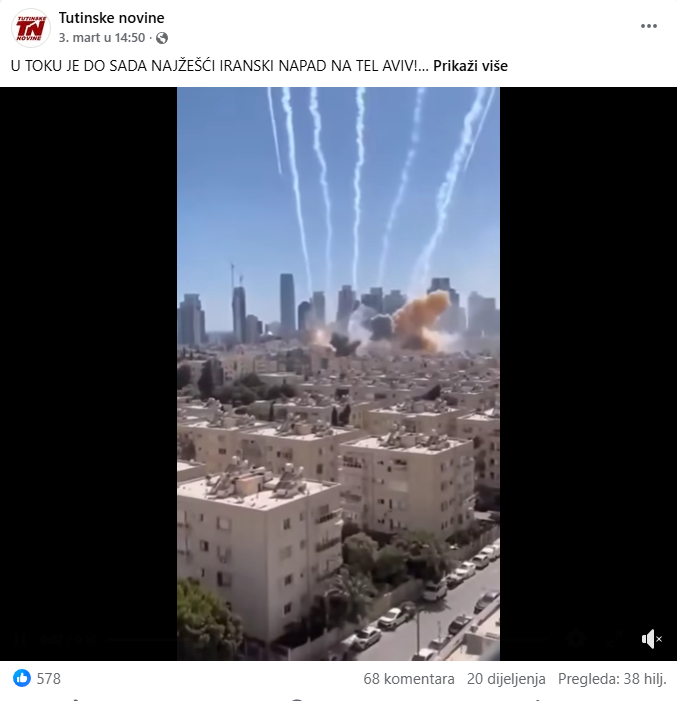
By the time this analysis was written, the video had been viewed 38.000 times. It was also published on several other Facebook pages, where it likewise received tens of thousands of views (1, 2).
Screenshots from the video were also published on March 6, 2026, on the Facebook page “Association of Turks in Serbia,” along with claims that they showed an attack “currently underway.”
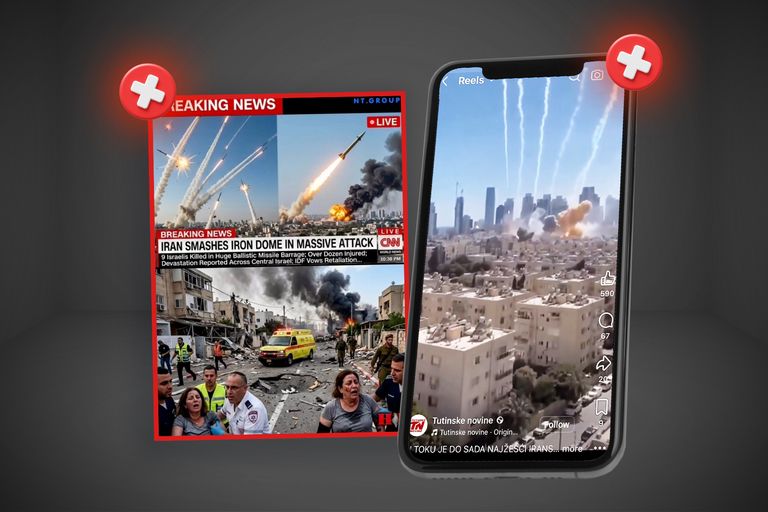
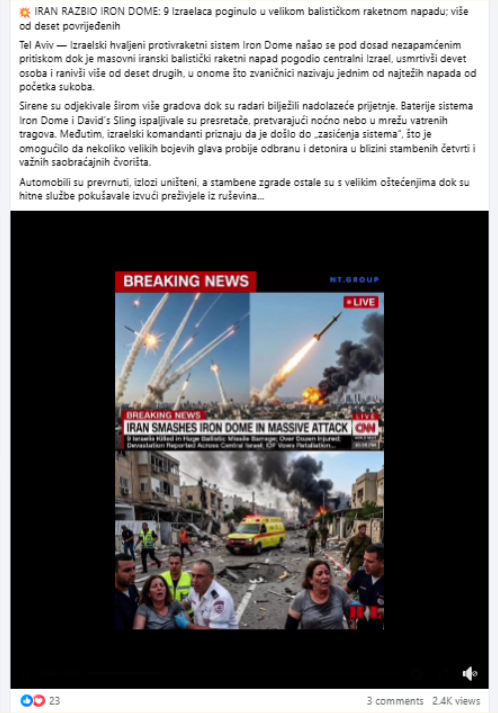
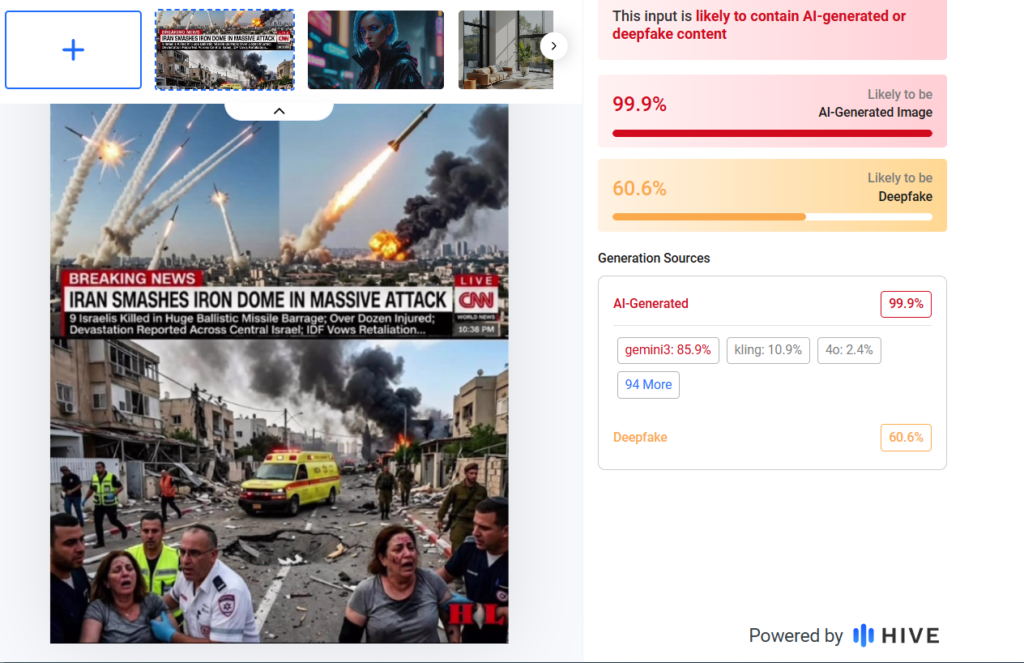
On March 3, 2026, another Facebook post shared news of an Iranian attack on Tel Aviv alongside a collage of images allegedly showing the attack, branded with the CNN logo. The network was also falsely attributed with a headline claiming that “Iran shattered the Iron Dome in a massive attack.”
Real Events, Fake Footage
Iran did carry out several missile attacks on Tel Aviv in March 2026, including attacks on March 3 (1, 2) . Authentic footage and photographs of those attacks can be found in media reports covering the events (1, 2).
The video that went viral on social media, however, is not authentic. It was created using artificial intelligence. As explained in an analysis published by the fact-checking platform Lead Stories on March 4, 2026, the video was originally posted on March 2, 2026, on the Facebook page “Vids Booster,” with a clear disclaimer stating that it was AI-generated and not real footage of an attack.
The AI detection tool Hive Moderation also assessed a 99% probability that artificial intelligence had been used to create the video.
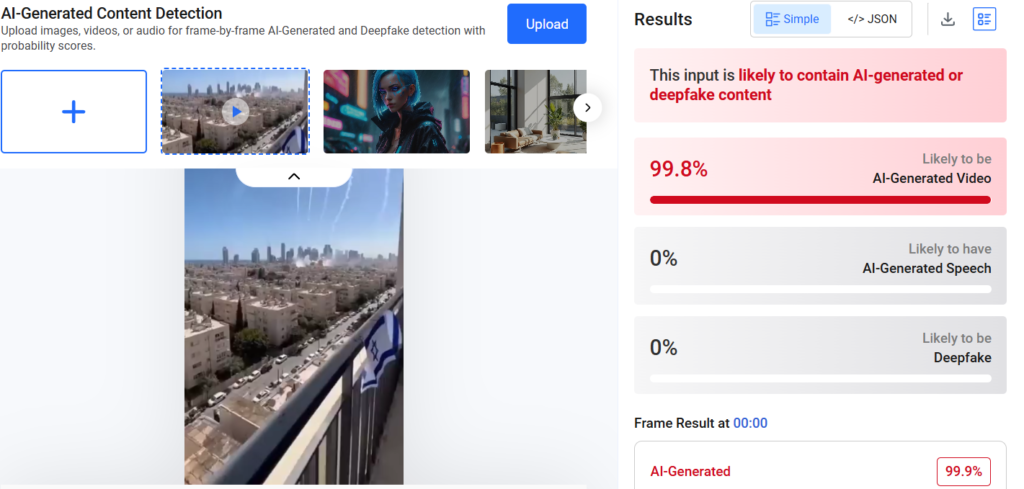
In addition, careful viewing reveals several inconsistencies suggesting that the footage was AI-generated. For example, the smoke appearing in the distance after the explosion spreads in unusual patterns that do not resemble the behavior of smoke following a real explosion.
The images in the collage allegedly depicting the Iranian attack on Tel Aviv were also generated using artificial intelligence. First of all, a Google search showed no evidence that CNN had ever published an article with the headline shown in the image. The pictures in the collage resemble illustrations more than actual photographs.
Hive Moderation likewise assessed a 99% probability that AI was used to create the collage.
Artificial intelligence is frequently used to generate content related to events that attract public attention or provoke fear and concern. Such content is often created in a way designed to trigger emotional reactions from audiences, thereby generating more engagement, views, clicks, and comments.
Raskrinkavanje has previously written about similar phenomena. In June 2025, we covered AI-generated videos used to “depict” the conflict between Iran and Israel at that time. You can also read about how artificial intelligence was used to create emotional, and in some cases even morbid, content related to the Sarajevo tram accident in February 2026 in our analysis here.Therefore, while the Iranian attack on Tel Aviv did occur, the AI-generated video and image collage shared in the analyzed posts do not depict real scenes. Based on the facts, we rate these posts as manipulation of facts.