
Original article (in Bosnian) was published on 28/04/2026; Author: Nerma Šehović
What are the claims?
The drought in Iran was caused by weather manipulation in the United Arab Emirates.
What are the facts?
Weather manipulation technology cannot significantly alter the climate in distant regions.
In late April 2026, claims circulated on social media alleging that a secret “climate war” was taking place in the Middle East. On April 22, 2026, the Facebook page “Türkiye & BosnaHercegovina” published two posts about a weather-control system in the United Arab Emirates (UAE) that had allegedly been “stealing rain” from Iran, Iraq, and parts of Türkiye for years, and which Iran had recently destroyed. This supposedly led to the end of a years-long drought (1, 2).
One of the posts stated the following:
When Iran struck the secret rain-making and cloud-removal center in the United Arab Emirates on April 13, 2026, it wasn’t just targeting a “base”.
The target was the “heart” of an air-control system that had deliberately been drying out Iraq and eastern Iran.
The result was a sudden and rapid climate change:–After years of drought, rain returned to Iran and Iraq.
–Temperatures dropped (by up to around 5 degrees).
–Floods reappeared and partially saved agriculture.
–Wind patterns changed, and clouds began returning to the region.This is not a “natural change”.
This is the exposure of a secretly conducted “climate conspiracy”.
The post further claimed that the “secret rain and cloud-removal center” in the UAE was part of a “global air-control network”. The alleged methods used for this weather manipulation included spraying specific chemical compounds, radio-broadcasting technology “similar to HAARP,” and redirecting atmospheric moisture.
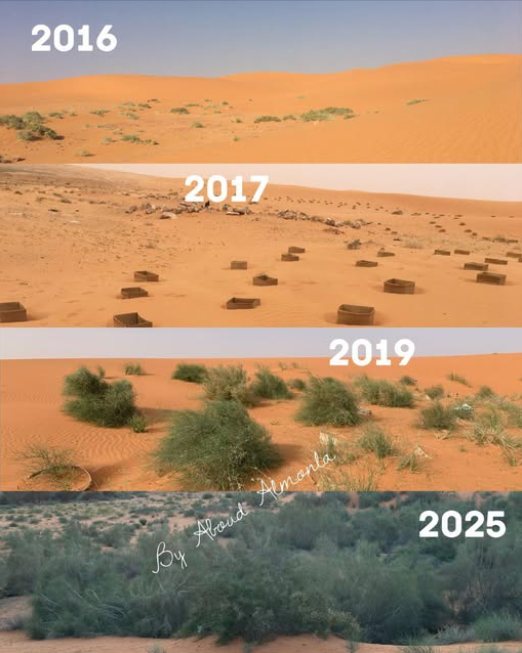
As “evidence” for these claims, one of the posts shared photographs allegedly showing the Nefud Desert in Saudi Arabia, where vegetation had reportedly developed between 2016 and 2025.
Similar claims were also published on other Facebook profiles and pages.
Rumors from social media
The global public has been closely following developments in the war in the Middle East, which began on February 28, 2026, when the US and Israel attacked Iran. In March, the conflict expanded across the region after Iran began retaliating strikes targeting sites in several Gulf countries and after Israel also attacked Lebanon.
At the height of the conflict, Iran closed the Strait of Hormuz, a maritime passage through which around 20% of the world’s oil supply is transported. This led to rising fuel prices and shortages in several countries (1, 2). A ceasefire between Iran, the US, Lebanon, and Israel was reached on April 8, 2026, but negotiations on a permanent peace agreement were still ongoing at the time this analysis was written, without significant progress.
Since the beginning of the war, Iran has targeted multiple sites in the United Arab Emirates. However, credible media reports about the war, as well as official sources, contain no information suggesting that Iran struck any “rain-making center” in the UAE on April 13, 2026 (1, 2).
Despite this, claims about the destruction of such a center and the resulting “return” of rain to Iran spread across social media and in foreign-language online spaces. An article published by the portal Turkiye Today on April 27, 2026, stated that the source of the claim was an X profile connected to the Iranian embassy in Afghanistan and that the post was deleted shortly after it had been shared.
Scientific facts, however, contradict these claims.
Cloud seeding, HAARP, and drought in Iran
The social media posts blame so-called cloud seeding in the United Arab Emirates for “stealing rain” from Iran. Cloud seeding is a technique intended to encourage precipitation, but it cannot “steal rain” from another region.
Cloud seeding is a technique that has been experimented with since 1947. It involves intentionally introducing substances that act as nuclei around which water or ice can condense in clouds. Carbon dioxide and silver iodide are most commonly used. Aircraft or ground-based cannons are typically employed for these purposes. However, this technique cannot create rain out of nothing; a key aspect of the process is injecting these substances into existing clouds in order to stimulate precipitation.
In recent years, meteorologists have questioned the actual effectiveness of cloud seeding, arguing that the practice does not result in more precipitation than would naturally occur and that it contributes to environmental pollution.
Cloud seeding is not a secret practice. It has been used for decades by many countries in efforts to stimulate rainfall and alleviate drought conditions. These countries include the United States, China, the United Arab Emirates (link), and Iran.
Therefore, there is no way for one country to “steal rain” from another through cloud seeding.
The UAE has been using cloud seeding for years to encourage rainfall, most commonly through aircraft operations. That the practice is still ongoing is demonstrated by media reports from April 26, 2026, stating that the country had carried out its 80th cloud-seeding operation of the year.
This indicates that the UAE’s rain-enhancement capacities were not destroyed.
The social media posts also mention HAARP, a device that conspiracy theorists claim heats the ionosphere and prevents cloud formation, with its waves allegedly being deliberately directed toward Iran. HAARP has been the subject of numerous conspiracy theories for years. It has been falsely accused of causing storms, droughts, and earthquakes. Raskrinkavanje has previously addressed these claims in analyses available here, here, and here.
In reality, HAARP (High-frequency Active Auroral Research Program) is a large radio transmitter facility located in Alaska and used by a local university to study the thermosphere and ionosphere. The process is explained on the university’s website:
The ionosphere begins at about 60 to 80 km altitude and extends above 500 km. The ionosphere contains free electrons and ions that radio waves can interact with. HAARP radio waves heat electrons and create small perturbations similar to interactions that occur naturally. Natural phenomena are random and often difficult to observe. Using HAARP, scientists can control when and where disturbances occur so they can measure their effects. In addition, they can repeat experiments to confirm that measurements actually show what researchers believe they are observing.
In response to the many conspiracy theories surrounding the project, the website also explains that HAARP cannot influence weather conditions. The radio waves it emits are not absorbed in the stratosphere and troposphere, the layers of the atmosphere where weather forms.
Therefore, HAARP has nothing to do with weather conditions on Earth, including droughts in Iran.
Iran has indeed been facing a water crisis for around 20 years, with the situation becoming particularly alarming over the past five. Iranian officials have previously claimed without evidence that the drought was caused by “weather manipulation” carried out by the US and Israel.
The real reasons behind Iran’s critical water situation are more complex. Lack of rainfall is only one part of the equation. Iran, like other Middle Eastern countries, is naturally arid, which contributes to the problem. A significant portion of the crisis, however, is caused by inadequate infrastructure and decades of poor management of existing water supplies. Agricultural self-sufficiency policies, largely driven by international sanctions, encouraged intensive cultivation of crops requiring large amounts of water in areas already lacking water resources. Permits for hundreds of thousands of wells were issued with little or no oversight, leading to overexploitation of groundwater, while rapid urbanization and aging, poorly maintained water systems further contributed to the crisis (1, 2).
In late April 2026, Iran experienced heavier rainfall, which will certainly help temporarily ease the crisis. However, it is unlikely that these rains will provide a long-term solution to Iran’s water problems (link).
As for the “evidence” presented in the Facebook posts, it is true that parts of the Al-Nafud Desert have seen increased vegetation growth in recent years due to higher rainfall and anti-desertification policies implemented by the Saudi government, including tree-planting initiatives (1, 2). However, the claim that this was caused by “stealing rain” from Iran is, as explained above, unfounded.
According to the facts above, we rate the claim that the United Arab Emirates is “stealing rain” from Iran using HAARP and cloud seeding, and that rainfall returned to Iran after it destroyed a “secret rain-making center” in the UAE, as a conspiracy theory.