
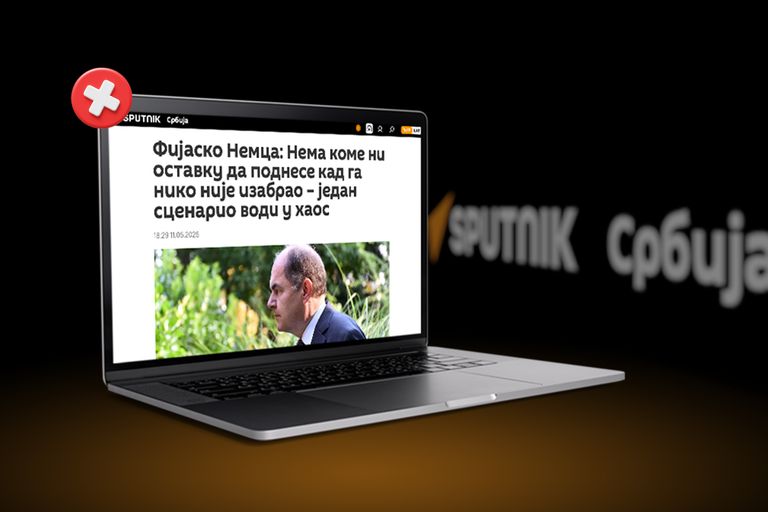
Original article (in Bosnian) was published on 14/05/2026; Author: Amar Karađuz
What are the claims?
The UN Security Council appoints High Representatives. Christian Schmidt should submit his resignation to the Security Council, but cannot do so because that body never appointed him.
What are the facts?
The High Representative is appointed by the Steering Board of the Peace Implementation Council, which Christian Schmidt informed of his resignation. Confirmation by the Security Council is not required for the appointment or dismissal of High Representatives.
High Representative of the international community in Bosnia and Herzegovina Christian Schmidt announced his withdrawal from office on May 11, 2026, one day before a session of the UN Security Council at which he presented his final report on the situation in Bosnia and Herzegovina. A statement from the Office of the High Representative (OHR) noted that Schmidt had informed the Steering Board of the Peace Implementation Council (PIC Steering Board) of his “personal decision” to step down from office, a position he will retain until the selection of the next High Representative is completed.
On May 11, 2026, the news outlet Sputnik Srbija published an article about Christian Schmidt’s resignation under the following headline:
A German Fiasco: There Is No One He Can Submit His Resignation To Because Nobody Elected Him – One Scenario Leads to Chaos
The article claims that Schmidt should submit his resignation to the UN Security Council (UNSC), but cannot do so because that body did not appoint him. This is presented as proof that Schmidt’s mandate was “illegal”.
The resignation announced by Christian Schmidt proves that he has been illegally occupying the position of High Representative all along. Logically, he should submit his resignation to the UN Security Council. But how can he resign to them when they never appointed him?
Instead of the UNSC, Sputnik claims, Schmidt is submitting his resignation to the Peace Implementation Council (PIC), which is described as a “phantom body made up of ambassadors of Western European countries” in Bosnia and Herzegovina.
And that is why he is submitting his resignation to the PIC, a phantom body that usurped authority in Bosnia and Herzegovina and appointed a gauleiter. The Peace Implementation Council in Bosnia and Herzegovina, abbreviated PIC, a phantom body consisting of ambassadors of Western European countries based in Sarajevo, appointed Christian Schmidt as the alleged High Representative of the international community in Bosnia and Herzegovina even though it has no authority to do so.
The article further claims that the UN Security Council is responsible for appointing High Representatives. It attributes a statement to Bosnia and Herzegovina’s Ambassador to Serbia, Aleksandar Vranješ, claiming that Schmidt is resigning to the PIC so that this body can continue operating outside the authority of the Security Council.
The UN Security Council is responsible for selecting the High Representative. Schmidt, however, is announcing that he will submit his resignation to the PIC, which prejudges that the retired German diplomat and minister, known in Republika Srpska as “tourist Schmidt”, is resigning to that body so that it can continue operating outside the highest political body of the world organization, explains Bosnia and Herzegovina’s Ambassador to Serbia, Aleksandar Vranješ.
The remainder of the article contains statements from Ambassador Vranješ regarding possible scenarios following Schmidt’s resignation. One option mentioned is the “return” of the issue of the OHR and the High Representative to the UN Security Council, where, according to his claims, Russia and China could influence the selection of a new High Representative with a limited mandate and without the “Bonn powers”.
Another scenario, which Vranješ associates with continued appointments outside the UN Security Council, is described as a continuation of “chaos” and actions serving Western interests. The article further speculates on possible reactions by the United States and European countries to Schmidt’s resignation, claiming that the international community is losing influence in Bosnia and Herzegovina and that the country’s future should be determined by agreements among domestic political actors.
The article was republished by the website Vaseljenska.
What are the facts?
The claim that Christian Schmidt was illegally serving as High Representative in Bosnia and Herzegovina because he was not appointed by the UN Security Council, or because the Security Council did not confirm his appointment, is inaccurate. Throughout Schmidt’s nearly five-year mandate, Raskrinkavanje has repeatedly assessed such claims as manipulative (1, 2, 3, 4).
The Steering Board of the Peace Implementation Council appointed Christian Schmidt as High Representative in Bosnia and Herzegovina on May 27, 2021, succeeding Valentin Inzko in the position. His appointment was not confirmed by a UN Security Council resolution. However, this does not make Schmidt’s position illegal.
As explained in an analysis by our partner fact-checking portal Istinomjer on June 7, 2021, confirmation by the UNSC is not a requirement for appointing the High Representative in Bosnia and Herzegovina. Although the Security Council has on several occasions expressed its views regarding the selection of High Representatives, there have also been instances where it did not confirm appointments.
Furthermore, the absence of Security Council confirmation is not unprecedented. In 2005, when Christian Schwarz-Schilling was selected as High Representative, outgoing High Representative Paddy Ashdown informed the UN Secretary-General in writing that Schwarz-Schilling would assume the position on January 31, 2006, and noted that he had been informed “that this information should be forwarded to the Security Council for consideration and possible agreement”.
Moreover, no formally defined procedure for selecting High Representatives actually exists, and even the first officeholder, Carl Bildt, was not appointed by the UN Security Council.
(…)
Therefore, although there have been cases in the past where the Security Council expressed a position regarding the appointment of a High Representative, there is no legal basis for such practice, making claims by certain officials regarding Christian Schmidt’s alleged lack of legitimacy questionable.
Therefore, the fact that Schmidt’s appointment was not confirmed by the UN Security Council does not make him an illegally appointed High Representative.
Claims that the UN Security Council is responsible for selecting the High Representative are also inaccurate, as Raskrinkavanje has previously explained. In clarifying the appointment procedure on the OHR website back in 2023, it was explicitly stated that the UN Security Council does not appoint the High Representative.
Based on the text of Annex 10, it is clear that the appointment of High Representatives (unlike the appointment of military forces – IFOR, now EUFOR-ALTHEA, under Annex 1A) is not carried out by the UN Security Council, although it must be consistent with relevant resolutions. The practice of the Peace Implementation Council clearly shows that the High Representative is appointed by the Steering Board of the Peace Implementation Council and that this practice is “consistent with UN Security Council resolutions”, beginning with Resolution 1031 (1995) of December 15, 1995.
As emphasized in the OHR statement, practice has shown that High Representatives are appointed by the Steering Board of the Peace Implementation Council (PIC SB). UN Secretary-General António Guterres also confirmed in July 2023, in response to a letter from Bosnia and Herzegovina Presidency member Željka Cvijanović, that the UN has no role in the selection of the High Representative and that this responsibility lies exclusively with the Peace Implementation Council.
Aleksandar Vranješ is Bosnia and Herzegovina’s ambassador to Serbia and, according to information from our partner portal Istinomjer, several of his statements, including those concerning the Peace Implementation Council in Bosnia and Herzegovina, have been assessed as untrue.
Falsehoods about the Peace Implementation Council
Christian Schmidt did not submit his resignation to the PIC itself but rather to its Steering Board. The PIC is an international body established at the London Peace Implementation Conference in December 1995 following the signing of the Dayton Peace Agreement. It brings together 55 countries and agencies that support the peace process in Bosnia and Herzegovina in various ways. It consists of full members and observers and includes countries from Europe, North America, Asia, and Africa, as well as international organizations.
The PIC is therefore not a “phantom body” made up of Western European countries but an institution established at an international conference following the signing of the Dayton Peace Agreement and involving countries and organizations from different parts of the world.
The Steering Board of the Peace Implementation Council (PIC SB), on the other hand, is a smaller coordinating body that works closely with the High Representative. It was also established at the London Conference and includes Canada, France, the Russian Federation, Germany, Italy, Japan, the United Kingdom, the United States, the European Union External Action Service, the European Commission, and the Organization of Islamic Cooperation represented by Türkiye. The Steering Board provides political guidance to the High Representative, who chairs biweekly meetings of ambassadors from member countries. The body also meets twice annually at the level of political directors.
The Russian Federation announced in a July 2021 letter that it would no longer participate in meetings of the Steering Board chaired by the High Representative. In another letter sent in February 2022, it informed the OHR that it was suspending its participation in financing the office.
According to the facts, we rate Sputnik’s claim that the UN Security Council is responsible for appointing the High Representative in Bosnia and Herzegovina as fake news. We rate the same claim in Vaseljenska’s article as spreading fake news.
We rate the claim that Christian Schmidt’s resignation confirmed that he had been serving illegally as High Representative in Bosnia and Herzegovina as manipulation of facts. It is true that Schmidt is not submitting his resignation to the UN Security Council because that body did not appoint him. However, High Representatives are appointed by the Steering Board of the Peace Implementation Council, which was informed of his resignation, not by the Security Council.We rate the claim that the PIC is a “phantom body” made up of ambassadors from Western European countries in Bosnia and Herzegovina as disinformation. The PIC includes countries and organizations from almost every continent. The Steering Board of the PIC includes some Western European countries, but also other states and organizations.