Original article (in Bosnian) was published on 7/05/2026; Author: Amar Karađuz
What are the claims? The EU ruled in court that Hungary must expose children to LGBTQ+ content or face consequences. What are the facts? The Court of Justice of the European Union ruled that a Hungarian law introduced under the pretext of protecting children from sexual content contains discriminatory provisions and does not reflect the fundamental rights and values of the EU.
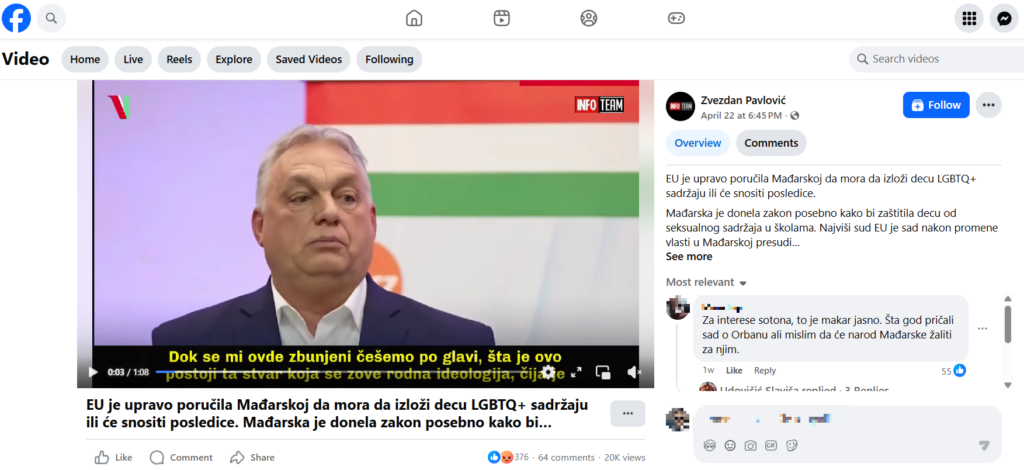
On April 22, 2026, the Facebook profile “Zvezdan Pavlović” shared a video in which former Hungarian Prime Minister Viktor Orbán spoke about “protecting children from gender ideology”. The description accompanying the post claimed that the Court of Justice of the European Union had ruled that Hungary’s law protecting children in schools from sexual content “violates human rights”. It further claimed that Hungary had been ordered by the ruling to expose children to “LGBTQ+ content”.
The EU has just told Hungary that it must expose children to LGBTQ+ content or face consequences. Hungary passed a law specifically to protect children from sexual content in schools. The EU’s highest court has now ruled, after the change of government in Hungary, that this law violates human rights.
The post stated that Hungary adopted the law in question in June 2021 and that this led to restrictions or bans on content dealing with sexual orientation or gender identity in materials available to children and adolescents.
Hungary was almost the only country that said “no”. And now it has been punished because of that. Protecting children from sexual content is now considered a violation of human rights in Europe.
The post also claimed that the European Union wants to completely prohibit young people from accessing social media except in relation to “LGBTQ+ content”, which would supposedly be the only permitted content.
At the same time, this scandalous union wants to completely ban young people from social media — except for transgender pornography — which should, of course, be available to eleven-year-olds. Think about that for a moment. The EU wants to ban social media for young people — except LGBTQ+ content, because that is apparently essential! Whose interests are these institutions really serving, because it is clearly not the interests of children or their parents.
Claims that the EU is ordering Hungary to expose children to “LGBTQ+ content”, that the EU’s highest court ruled the 2021 Hungarian law violates human rights because it protects children in schools from sexual content, or that protecting children from sexual content is considered a violation of human rights in the EU were also found on other Facebook profiles (1, 2, 3), as well as on Telegram and Instagram.
What are the facts?
In 2021, Hungary adopted the Act on Taking Stronger Action Against Pedophile Offenders and Amending Certain Laws for the Protection of Children, introducing stricter measures aimed at protecting children, including amendments to several existing regulations. Although the government at the time stated that the law’s purpose was to protect minors, some of its provisions in practice restrict or completely prohibit minors from accessing content related to gender identity, gender transition, and homosexuality.
However, the proceedings before the Court of Justice of the European Union, initiated against Hungary by the European Commission, concerned whether the Hungarian law was compatible with EU law. The European Commission did not challenge the “protection of children from sexual content”, but rather legal provisions that selectively target issues related to sexual and gender minorities, which are considered discriminatory. The full verdict can be read at this link.
The Court found that a Member State has the right to adopt laws limiting the freedom to provide and receive services when doing so serves the best interests of children, but such measures must nevertheless comply with the Charter of Fundamental Rights of the European Union, particularly with regard to protection against discrimination based on sex or sexual orientation.
The Court specifically emphasized the margin of discretion that Member States have, in the absence of harmonized EU rules, when defining content — including audiovisual content — that could negatively affect the physical, mental, or moral development of minors. However, it concluded that this discretion must be exercised in accordance with the Charter, particularly concerning the prohibition of discrimination based on sex or sexual orientation as guaranteed by Article 21(1). The Court concluded that this requirement had not been respected in this case.
The Court found that the amendments to the law were incompatible with several fundamental rights protected by the Charter.
(…) those amendments constitute a particularly serious interference with several fundamental rights protected by the Charter, namely the prohibition of discrimination based on sex or sexual orientation, the right to respect for private and family life, and freedom of expression and information. Specifically, this Hungarian law stigmatizes and marginalizes people who are not cisgender – including transgender individuals – as well as people who are not heterosexual, by portraying them as harmful to the physical, mental, and moral development of minors solely on the basis of their gender identity or sexual orientation. The title of the law associates these individuals with people convicted of pedophilia, further deepening their stigmatization and potentially encouraging hostile attitudes toward them.
According to the Court, Hungary also violated Article 2 of the Treaty on European Union, which lists the values on which the EU is founded, stating that the law is incompatible with the EU’s identity as a common legal order in a society characterized by pluralism. The judgment further noted that the Hungarian law violates the General Data Protection Regulation as well as the right to data protection under the Charter.
Manipulative claims in the post
Therefore, the Court of Justice of the European Union was deciding whether the Hungarian law adopted in 2021, officially justified as protecting children, violated provisions of EU law. The Court confirmed that states have the right to regulate content in order to protect minors, but emphasized that such measures must comply with fundamental rights, especially the prohibition of discrimination. It concluded that the Hungarian law selectively restricts content related to sexual and gender minority issues, thereby violating several fundamental rights and conflicting with the values on which the EU is based.
The claim that Hungary was punished because it “refused” to expose children to “LGBTQ+ content” is manipulative. The ruling established that the amendments introduced in the 2021 law discriminate against one group within a pluralistic society, which conflicts with the standards Hungary agreed to uphold upon joining the EU. In this context, the claim that protecting children from sexual content in schools is considered a violation of human rights in the EU is also unfounded. Aside from the fact that the ruling did not address such a legal issue, the very idea that a child’s right to access sexual content could somehow be considered a human right is absurd.
The EU court did not order Hungary to “expose children” to any type of content. No such legal consequence appears in the ruling. Rather, the Court found that the restrictions imposed under the 2021 law may discriminate against the LGBTQ+ community and violate rights to freedom of expression and non-discrimination.
EU regulations such as the Digital Services Act (DSA) address issues including child protection, privacy, algorithm transparency, and targeted advertising on digital platforms. However, there is no plan or legal framework that favors or permits explicit content related to sexual and gender minority topics, nor was such an issue part of the case against Hungary. On the other hand, some EU member states have introduced or are considering introducing minimum age requirements for access to and use of social media platforms.
According to facts above, we rate the earliest post claiming that protecting children from sexual content in the European Union is now considered a violation of human rights, based on the ruling of the Court of Justice of the European Union, as fake news. The ruling established no such thing. Rather, it found that provisions of the Hungarian law, which nominally sought to protect children from sexual content, were incompatible with guaranteed fundamental rights of the European Union prohibiting discrimination. Later posts repeating this claim receive the rating spreading fake news.
Claims implying that Hungary was punished because it refused to expose children to “LGBTQ+ content” in schools are assessed as manipulation of facts and a conspiracy theory. Hungary was sanctioned because the 2021 law introduced provisions that discriminate against or stigmatize gender and sexual minorities. The same assessments apply to claims that the EU ordered Hungary to expose children to “LGBTQ+ content”. The Court found that the provisions banning such content were discriminatory.