
Original article (in Albanian) was published on 02/06/2026; Author: Esmeralda Topi
The image shared on social media as proof that protesters from Greece were heading to Tirana has turned out to be generated by artificial intelligence
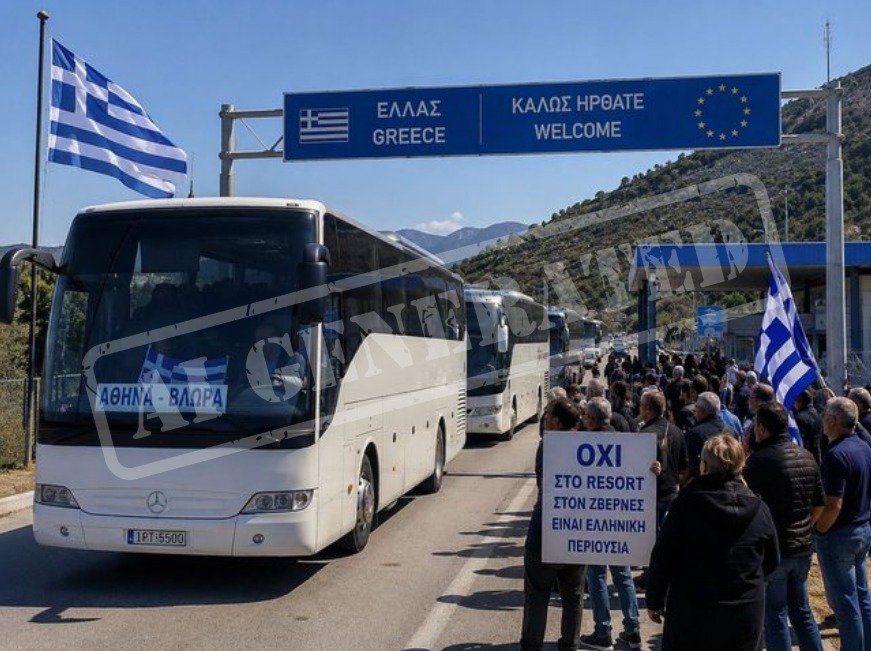
Since the evening of June 1, a photograph showing a row of buses near a border crossing has been widely shared across Albanian social media, accompanied by claims that it depicted Greek protesters entering Albania to join the protest against the tourism project in Pishë Poro-Nartë.
The photograph began circulating shortly after the protest held in Tirana, where thousands of citizens gathered for the second time on “Dëshmorët e Kombit” Boulevard to oppose the project in Zvërnec.
Images from the June 1 protest, Tirana
The fact-check conducted by Faktoje shows that the photograph is not real. To verify its origin, Faktoje used OpenAI’s official verification tool, which detects AI-generated images through the presence of SynthID technology.

The results confirmed that the photograph contains a SynthID signature originating from OpenAI, indicating that the image was generated using artificial intelligence.
SynthID is designed to survive common image alterations such as cropping, color adjustments, screen captures, and file compression, making it possible to trace the origin of AI-generated content.
Beyond the technical verification, the image also displays several typical features of AI-generated visuals, including blurred faces within the crowd, nearly identical buses, unusual or inconsistent text on banners, and an overly uniform scene composition.
These characteristics are frequently found in AI-generated images and serve as additional indicators that raise questions about the image’s authenticity.
How did the claim start?
The photograph first surfaced during a television debate on the evening of June 1. On a private TV channel, analyst Artur Meçe claimed that he was presenting a photo from Kakavija, which he said showed buses organized by the Greek state bringing protesters into Albania.
“This is today’s protest. This is today’s photo,” Meçe said during the broadcast.
The claim then spread across social media and was picked up by several Albanian online outlets, which referenced reports from Greek media.
In reality, the Greek newspaper Kathimerini published an article on June 1 about the protest held on May 30 in Zvërnec. The article by journalist Yannis Papadopoulos was published at 11:24 and noted that two buses had left Athens for Saturday’s protest in Zvërnec, while other participants traveled by their own vehicles.
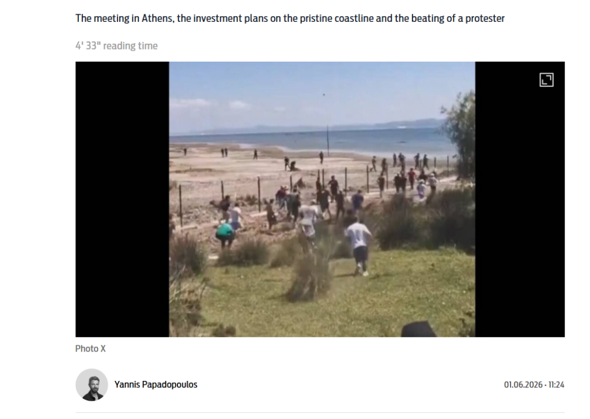
Thus, the reporting by Kathimerini was unrelated to the June 1 protest in Tirana and was not accompanied by any image of buses at the border.
During the previous day, Prime Minister Edi Rama described the project as a transformative opportunity for the economy, tourism, and Albania’s international image, while characterizing the opposition as politically driven or influenced from abroad, including Greece.
AI is being used to manipulate the public opinion
Erion Tase of the Academy of Political Studies told Faktoje that this case demonstrates how artificial intelligence can be used to spread misleading narratives.
“This is a case where artificial intelligence is used to manipulate public opinion and reinforce specific beliefs. In this instance, tensions between neighboring countries, Albania and Greece, are being exploited, supporting the narrative that the protests are organized from abroad and do not reflect the real concerns of Albanian citizens,” Tase said.
According to him, the case involving the alleged Greek buses is similar to other recent cases where AI-generated images have been used to support false claims.
“These cases should make us more cautious about what we see online. Artificial intelligence has made it much easier to produce convincing content, so citizens should rely on trustworthy information sources rather than content circulating on social media,” he adds.
Media and communication lecturer Erlis Çela also considers the case a typical example of how artificial intelligence can be used to distort public discourse.
“The dissemination of AI-generated photos as real evidence risks distorting public debate by replacing facts with fabricated perceptions. It has already been shown that such images are not only meant to mislead, but also to influence how citizens interpret an event or a cause,” Çela tells Faktoje.
According to him, the main concern in this case lies in the narrative being built around the protest.
“These images can be used to discredit causes, individuals, or social groups and to polarize public opinion. The case in question seeks to promote a narrative that portrays the protest against the development project in the Zvërnec area as a movement supported or sponsored by external actors, also giving it nationalist undertones.”
Erlis Çela notes that Albanian society remains insufficiently prepared to deal with AI-assisted disinformation. According to him, this calls for greater efforts both in public education and in strengthening the capacities of professional media.
“There is an urgent need to expand initiatives on education about artificial intelligence and media. At the same time, more work is needed with journalists and professional media, not only to debunk false content, but also to explain the mechanisms of manipulation and the objectives sought through the use of AI,” Çela concludes.