
Original article (in Montenegrin) was published on 02/04/2026; Author: Marko Vukajlović
Red Star lost 2–0 at home to Lille and was eliminated from further competition in the Europa League.
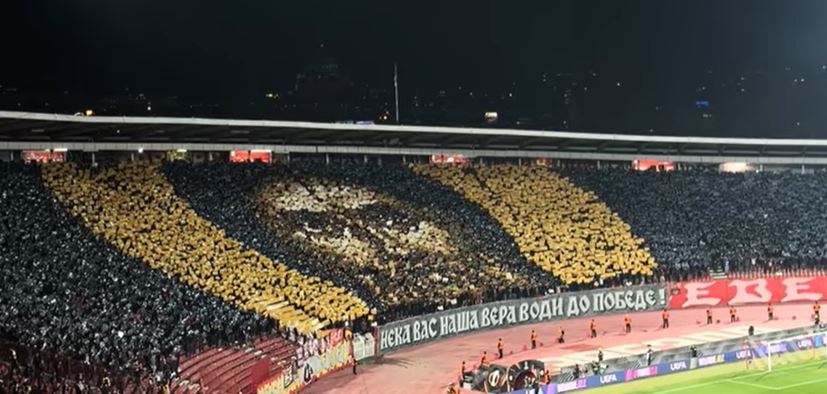
After the match in Belgrade, public attention shifted away from the result and toward a UEFA fine imposed on Red Star. Many reports claimed that the club had been punished because of a supporters’ choreography depicting Saint Simeon the Myrrh-Streamer, who is considered the patron saint of the club’s ultras group, the Delije. Domestic and regional media outlets, along with numerous social media accounts, competed to publish increasingly sensational headlines, including: (1, 2, 3, 4, 5, 6, 7, 8, 9, 10, 11, 12, 13, 14, 15, 16, 17, 18, 19, 20, 21, 22, 23, 24, 25, 26, 27, 28, 29, 30) (archived: 1, 2, 3, 4, 5)
UEFA Fines Red Star Over Christian Fan Choreography and Image of Saint Simeon
UEFA Punishes Red Star: Saint Simeon Choreography Comes at a Heavy Cost
UEFA Fines Red Star 95,000 Euros Over Saint Simeon Choreography
SHAME! RED STAR PUNISHED BECAUSE OF SAINT SIMEON
Europe Rises Up Over Saint Simeon! Famous Politician Attacks UEFA, Greeks File Complaint, Satanism Mentioned
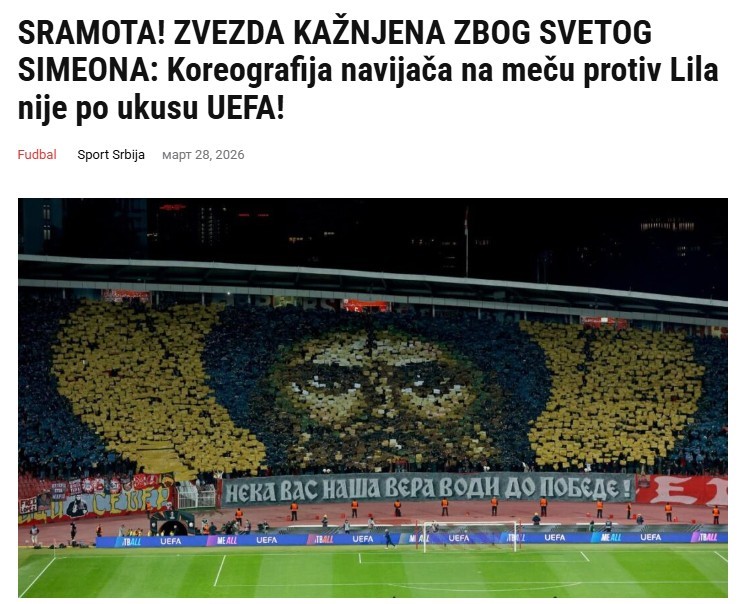
However, UEFA clarified to Raskrinkavanje, a fact-checking project run by the Serbian investigative outlet KRIK, that the total fine of €95,000 was unrelated to the display of a saint’s image, but rather to a number of offenses committed during the match.
According to UEFA, Red Star Belgrade was fined a total of €95,500 for several violations that occurred during the same game.
These included the use of pyrotechnics (€17,000), throwing objects (€10,500), blocking passageways in the stadium (€28,000), as well as a €40,000 fine that was incorrectly linked by some media outlets to the choreographed display.
“This charge related to the banner ‘F*** UEFA’,” UEFA’s Media and Public Relations Department explained to Raskrinkavanje, adding that the sanction was imposed because the banner contained an offensive message displayed at a sporting event and was considered damaging to the reputation of football and UEFA in particular.
The ball is round – faith and politics are not
Football stadiums, like many other sporting venues across the region, are often used to settle ideological scores, spread propaganda messages and display symbols that have no place in sport. A similar situation occurred late last year during a match in Montenegro’s second football division. During a game between Grbalj and Berane, various chants were heard that had nothing to do with football.
The Football Association of Montenegro fined both clubs for the use of pyrotechnics and inappropriate behavior by supporters, not for alleged chants about Kosovo or glorification of the Kingdom of Serbia, as some media outlets reported at the time. Raskrinkavanje previously wrote about that case, which bears similarities to the one in Belgrade.
During the Paris Olympic Games, some media outlets also rushed to defend Serbian judoka Nemanja Majdov, claiming that he had been prohibited from making the sign of the cross before stepping onto the tatami. What was often omitted, and what Raskrinkavanje clarified, is that the restriction did not apply only to him. Under the rules of the International Judo Federation, “religious, political, personal or commercial connotations or demonstrations are prohibited for everyone on the field of play.”
For some time now, sport in the region has been making headlines for reasons other than athletic achievement and increasingly resembles the crime pages. Recent events in Montenegro provide further evidence of this trend. One telling example is the fact that police had to secure a schoolgirls’ volleyball tournament. However, that is a topic deserving a separate and more detailed analysis.
Given all of the above, and UEFA’s clear statement that Red Star Belgrade was not punished for displaying an image of Saint Simeon the Myrrh-Streaming, but rather for the use of pyrotechnics, throwing objects, blocking passageways and displaying offensive banners, the disputed claims are rated as disinformation.
Edit: 6 April 2026
The portal Borba published a correction to its original article, clearly following professional journalistic standards and correcting the initial claims. As a result, the article receives the rating “Corrected.” This rating is given in cases where the media outlet establishes that the content it has published falls under one of the above-described negative ratings and then proceeds to correct it in a clear and visible way, per the principles of publishing corrections.