
Original article (in Serbian) was published on 25/7/2025; Author: Stefan Janjić
“We have lost 41 percent of foreign direct investment due to the blockade,” President Aleksandar Vučić said in the “Hit Tweet“, talk show broadcast on Pink television. Before that, in April, he stated that the decline in investments was directly related to “the blockade attack : “It’s about people’s fear, the entire economic activity has slowed down, and no one else is responsible but those who tried to destroy the country.” Similar statements were made by Saša Stevanović, State Secretary of the Ministry of Finance, who – poetically – added that “capital is a timid bird. “
But was this “bird” scared off by the whistles of the protesters, or is there a broader problem? Although we are not claiming that the current political crisis has not had an impact on foreign direct investment (FDI), we draw attention to two facts: the decline in FDI was predicted even before the canopy fell, and comparing 2025 with 2024, although logical, also carries with it one big “but”. We reviewed data from the National Bank of Serbia (NBS), reports from the International Monetary Fund (IMF), and spoke with Predrag Bjelić, a professor at the Faculty of Economics in Belgrade, who tells Tragač that the biggest cause of the decline in FDI is “global geoeconomic turbulence”.
Between two Januaries
When the president first complained this year that demonstrations and blockades were disrupting the country’s economic stability, the statistical reports for January were not even in sight. The president announced that – based on 21 days of measurements – the beginning of January 2025 was worse in terms of FDI than in 2024, and even worse than in 2023. When the month ended, we saw that it was worse than January 2024, but not January 2023 .
However, how fair is this comparison? In response to a question from Bloomberg Adria, the NBS stated that inflows in the first month of 2025 did decline, “whereas it is important to point out that the amount of inflows in January of the previous year was above the usual average for that period of the year.” Not only was the previous January above average, but the entire year was also a record. In December, the Serbian President boasted that “2024 is the best year for Serbia in terms of attracting foreign investment.”
In this light, although it is logical to compare two adjacent years, one should keep in mind the “high base effect”, which is presented in the Nedeljnik article on this topic.
How are things?
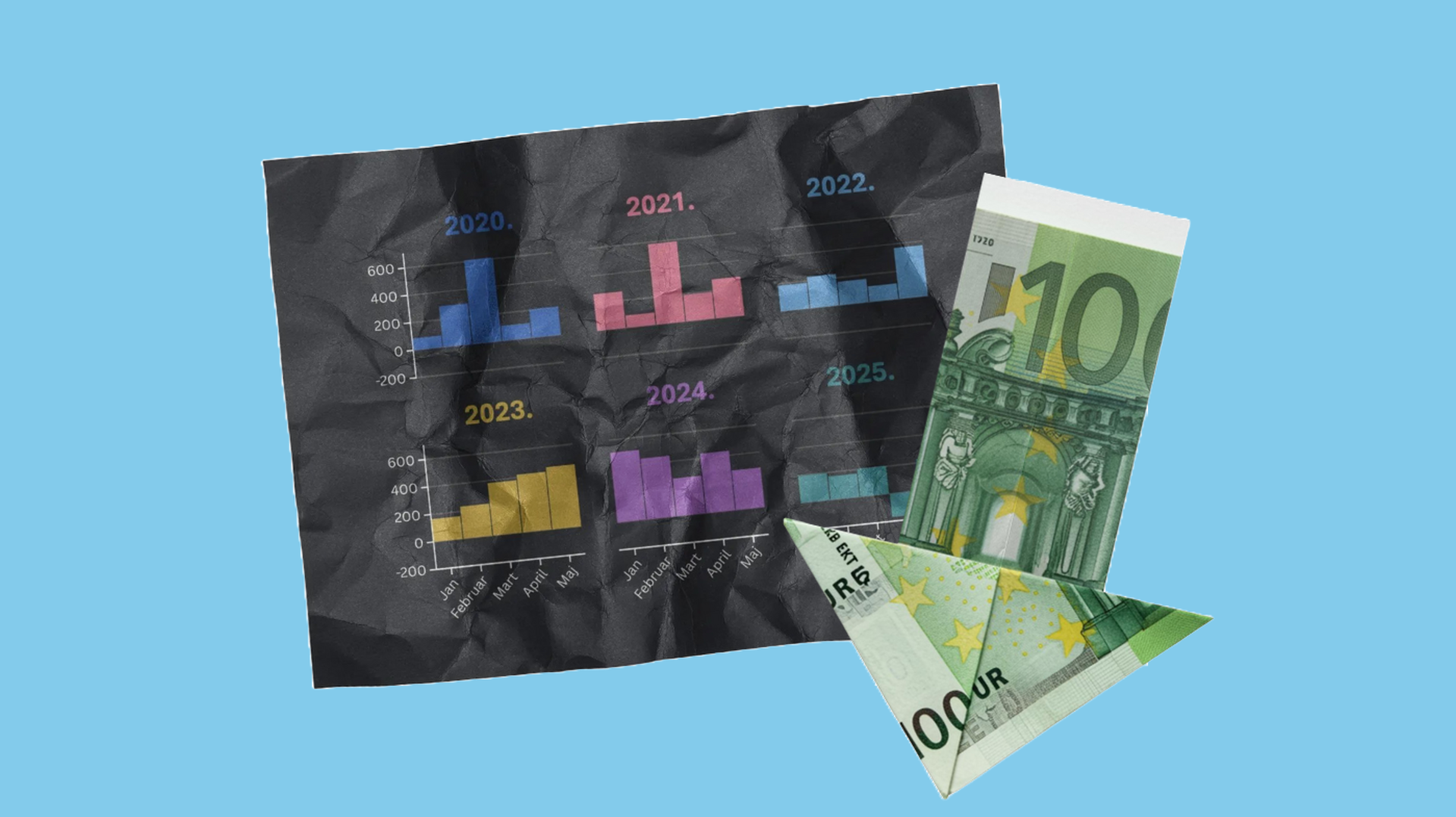
We reviewed the NBS balance of payments reports for the first five months of 2025, and compared them with data for the period from 2020 to 2024. January, for example, was significantly worse than 2024, but it was still better than 2020, 2022, and 2023. You can view detailed data in this interactive chart:
The biggest problem was observed in April of this year, when a net outflow of investments was recorded. Overall, it is true that in the context of FDI, this is, for now, the worst in the previous six years. Although it seems simple ( in the words of former Minister Nebojša Stefanović) to connect “some persons with some areas” and “some persons with other persons”, and conclude that the decline was due to blockades, it is clear that the decline was predicted even before there was any indication that demonstrations would occur.
Forecasted decline
The IMF’s December 2024 report for Serbia projected a decline in the share of foreign direct investment in GDP in 2025 and 2026. The decline in net inflows was also predicted in last year’s July IMF report, three months before the fall of the canopy and the start of protests. The new report, published this July , notes a decline in foreign direct investment, noting that the authorities point to the protests as the leading cause of the decline. It adds, however, that other factors should be taken into account , such as global uncertainties, and that the projected decline (until 2030) is “mainly caused by a continued decline in inflows to the manufacturing sector, as well as to other sectors in general,” and that “structural weaknesses continue to play an important role in foreign investors’ decisions.”
The same page of the new report (76) shows the differences between Serbia and its regional competitors in terms of investment barriers. Serbia’s position is good in the context of electricity, tax rates ,and workforce education, but it is worse in the domains of corruption, labor regulations, political stability, and tax administration.
Bjelić: The leading cause is global geoeconomic turbulence
To better understand what factors influenced the decline in FDI, and what role blockades and protests play in this, we turned to Predrag Bjelić, a professor at the Faculty of Economics in Belgrade and an expert in international trade.
In his response to Tragač, he states that the biggest cause of the decrease in FDI is global geo-economic turbulence. “The offshoring phase has ended, when the EU sent FDI to countries close to it, where Serbia was suitable for investment. Also, costs in Serbia have increased significantly and that is the reason why some investors are leaving. Blockades did play a role, but to a smaller extent,” says Bjelić.
A journalist from Nedeljnik also spoke with experts about the causes of the decline in FDI, so we recommend that text for more details.