
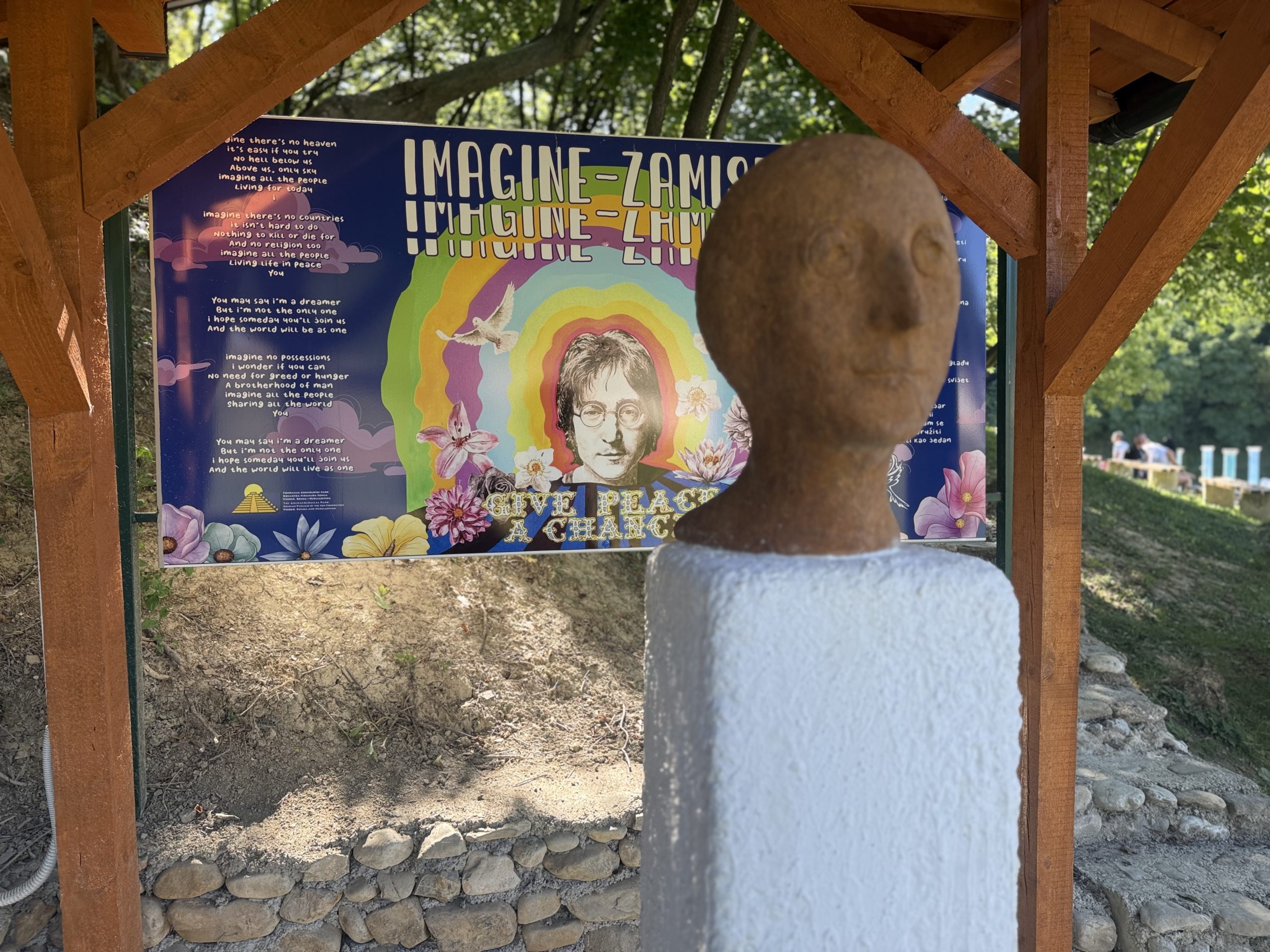
Our arrival at the Ravne 2 park in Visoko was anything but organized: we were late, got lost, and had no set plan. Still, it paled in comparison to the disarray of the event known as “Alter Media.”
“New media, for new times, with new, bold, and courageous people.” That’s how the festival Alter Media – Through Truth to Freedom was announced. It took place from July 17 to 20, 2025, in the Ravne 2 park in Visoko, under the leadership of Semir Osmanagić. A few days before the event, we published an article introducing the organizers and highlighting the featured presenters.
Amid a global rise in distrust toward institutions, the media, and science, a gathering like Alter Media offers a glimpse into the formation of a parallel informational reality. The festival in Visoko is not merely a bizarre attraction, it rather functions as a living display of a growing, profitable ecosystem of disinformation, pseudoscience, and digital spirituality that increasingly bridges the gap between the virtual and the physical world.
“Those who wish to be in the company of Dr. Osmanagić and his associates will have the opportunity to secure it by paying for a four-day package, which includes accommodation, organic lunches, presentations, tickets to the sites, and priority seating in the Lecture Hall in the park,” the announcement stated. This privilege came at a price of €195 to €330, while single-day tickets were €50.
The cameraman and I chose the single-day option for Saturday, July 19. We emailed to register the day before, but, having received no reply by Saturday morning, we decided to join the group at the first scheduled stop: a 9 a.m. visit to the tumulus in Vratnica.
Naturally, we were late. Owing to chaotic organization (mea culpa), we decided to head straight to Ravne 2 park, where a presentation was scheduled for 11:00 a.m. We arrived at 11:30, worried we had missed much, only to find the lecture hall empty.
In the park, besides other visitors, we met a staff member who was packing gifts for the guests: a set of Semir Osmanagić’s books Alternative History. She kindly offered us more information: the group was running late; they were still at the tumulus. “They probably got lost in meditation,” she said. The schedule she showed us didn’t match the one available online.
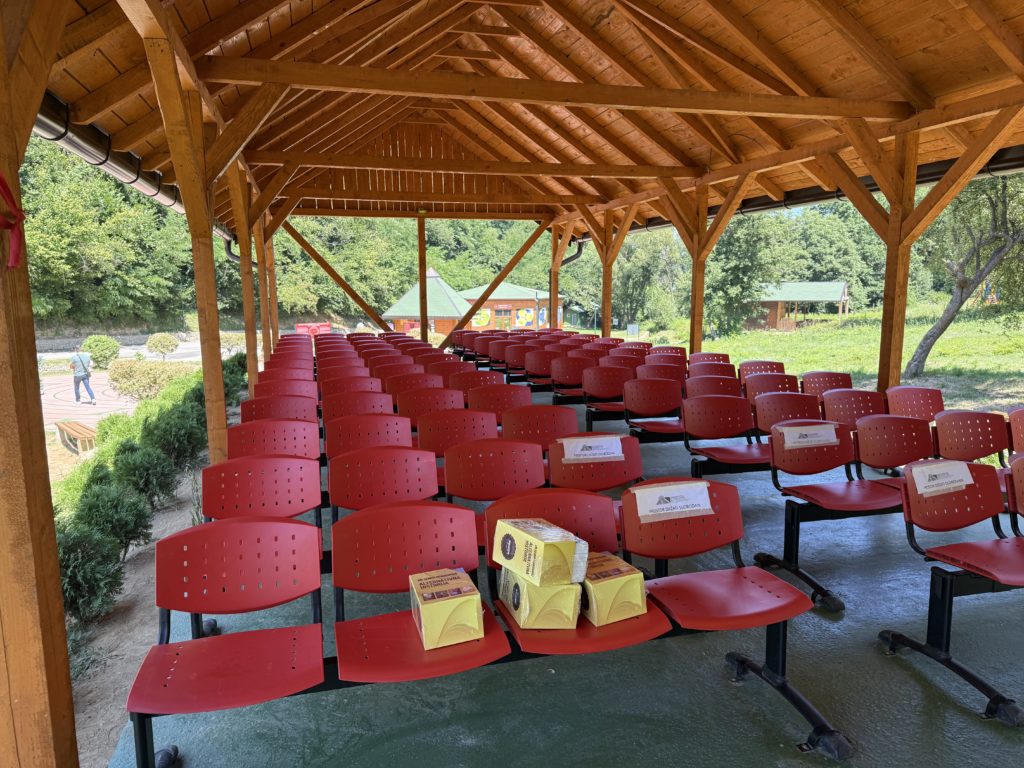
The list of presenters didn’t look quite the same either. Well-known names? Nowhere to be seen. (“Not ringing any bells, honestly. No big names here,” as one visitor told me.)I asked about Saša Borojević, a well-known Serbian disinformer and a major figure in conspiracy theory circles. “He canceled because of the situation in the country,” the employee said vaguely. Lana Stanišić, a well-known Bosnian TV personality who had been announced, will reportedly attend an event later in the year. Among the presenters, there were only a few more recognizable names, such as Slovenian actress Tanja Ribič, who had already given a presentation.
Also standing out was Mario Bojić from Serbia, known for his striking curled mustache and his podcast Mario zna (“Mario Knows”), in which he hosts some of the biggest stars of the conspiracy theory scene, such as anti-vaccine pulmonologist Branimir Nestorović and conspiracy theorist Mila Alečković. Bojić, whom the Novi Sad-based Fake News Tragač rather cynically renamed Mario ne zna (“Mario Doesn’t Know”) for the falsehoods he spread about electric buses, and who cannot tell artificially generated images from authentic ones, held his presentation the day before. As much as we would have liked to hear him, we couldn’t have planned our arrival more precisely anyway, since the presenters’ schedule was never published in advance. I’m beginning to understand why.
According to the schedule, lunch is at 1 p.m., with participant presentations starting at 2 p.m. and running until the evening. By 1 o’clock, however, there’s still no sign of the group we’re waiting for.
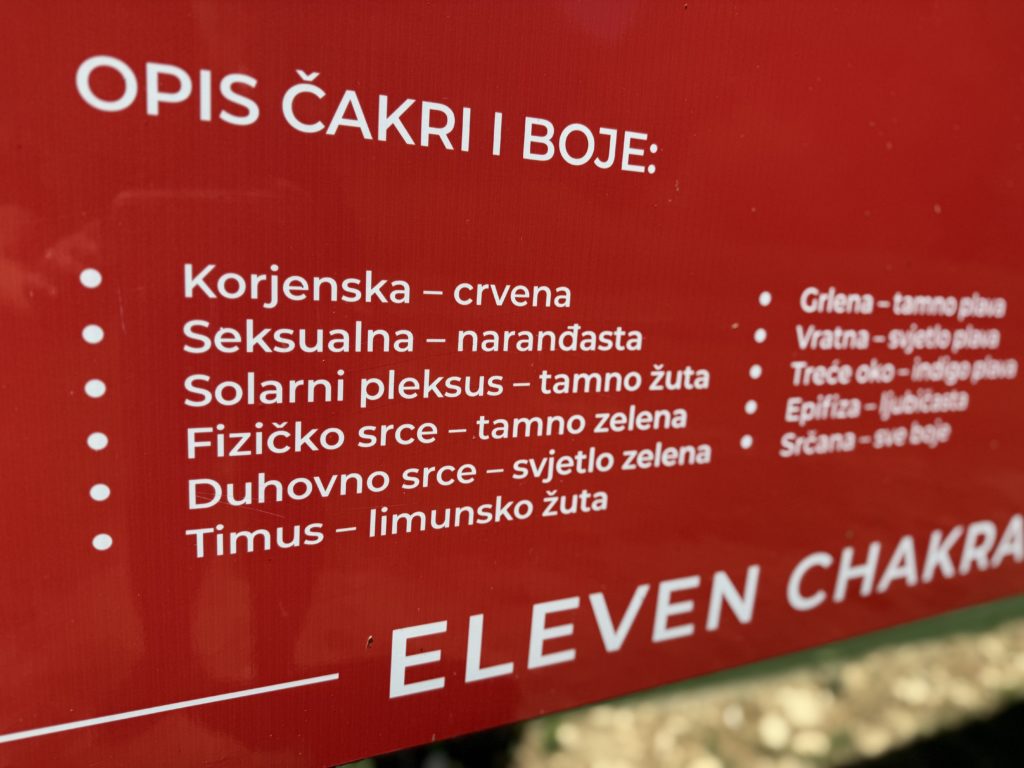
I head over to a building painted with “chakras” and decorated inside with local artwork, mandalas, sold for around 60 euros and up. There I run into the same staff member, and I ask her for an explanation. “If fashionably late is fifteen minutes, then on YouTuber time it’s a full hour,” she says, adding, “You know, this isn’t like the German system, where if something’s at 9, it starts at 9. Especially if they’re better-known people; they give themselves extra time,” she explains. I start to wonder whether it’s even worth it for the cameraman and me to pay 50 euros each for the rest of the day.
Spirals, Mandalas, and a Canine Tesla
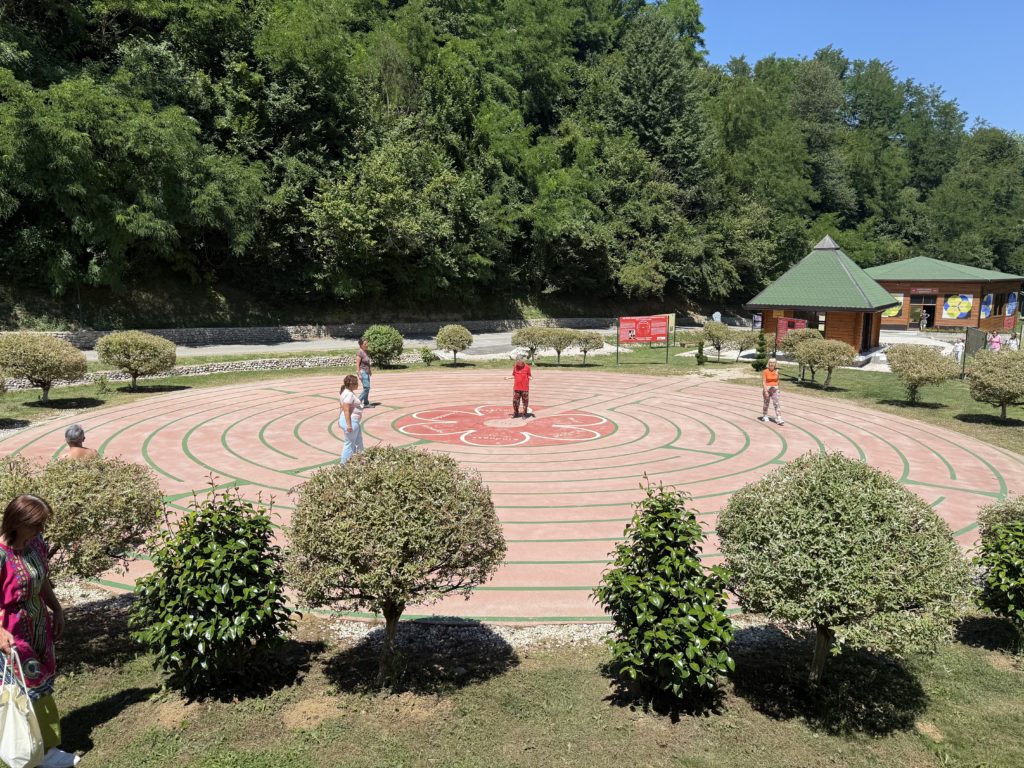
At least it means we have time to explore the park. And it really is an impressive creation: a mélange of spiritual and pseudo-spiritual practices from around the world. In one section stand Vedic houses from India. Right next to them is the Rose Labyrinth of Love, with concentric walking circles. There are also “energy spirals,” where, depending on the direction you walk, you supposedly either give energy to the Earth or draw it from her.
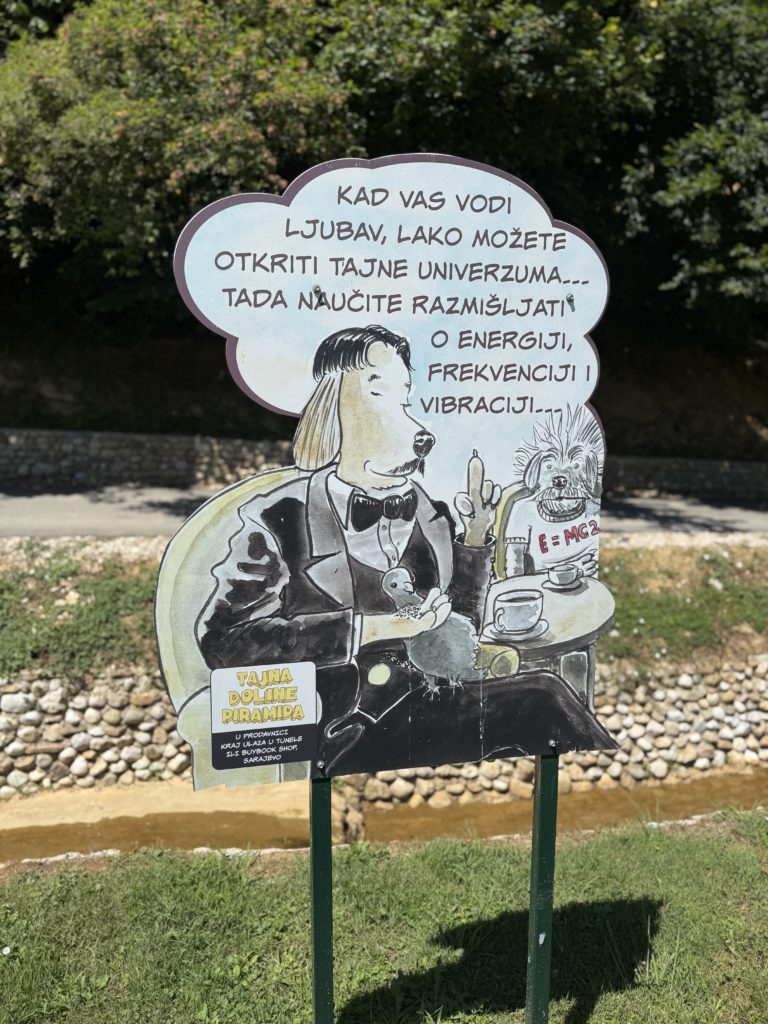
On “Tesla Square” stands a statue of the famous scientist, while inspirational and spiritual messages are scattered throughout the park. “When you are guided by love, you can easily uncover the secrets of the universe,” proclaims a cartoon dog, Nikola Tesla, wearing a bow tie and holding a dove, while across the table, another dog with wild hair and a T-shirt bearing Einstein’s famous equation of relativity looks at him.
“Path of Smiles,” “Path of the Heart,” “Chamber of Life Energy” – signposts everywhere point toward new promises of physical and mental well-being.
A little further on, past the well-known tennis courts, the spiritual mishmash is joined by a literary one. “Immortal Poets,” announces a park sign beside busts of Desanka Maksimović, Edgar Allan Poe, Tin Ujević, Yesenin, Lorca… Without any clear logic, the same simulacrum also includes Vladimir Prelog, Mileva Marić Einstein, and Mihajlo Pupin.
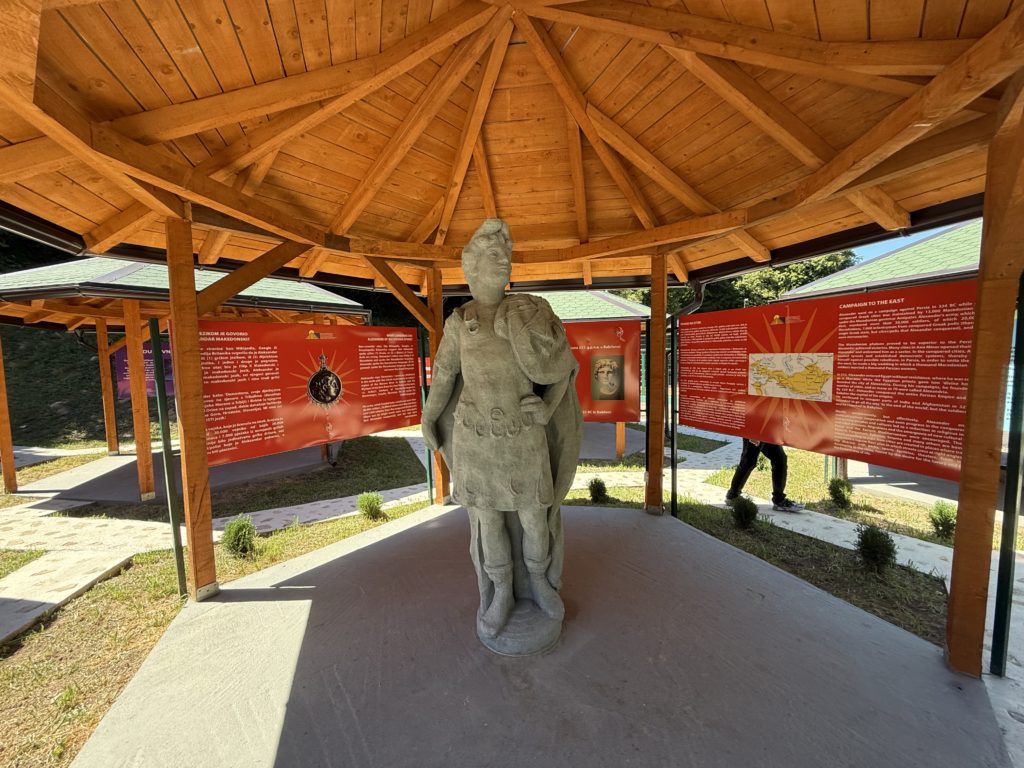
Just a few meters away stand pavilions dedicated to the historical figures Baton of the Daesitiates, Alexander the Great, and Husein-kapetan Gradaščević. “What’s Alexander the Great doing here?” I hear a passerby ask their group – the same question I’m asking myself.
Tunnels, Energy, and Novak Đoković
On a bench near the lecture hall, we meet two lively women who are happy to chat with us. They are enthusiastic fans of the park and the healing powers of the Ravne tunnels.
“My right leg was 1.8 cm shorter than my left, I used to wear insoles,” begins Milena from the Netherlands, originally from Mladenovac. “When I entered the tunnel, I started swaying like this and making circles like this to the left,” she demonstrates, claiming that after coming to Visoko, she now walks completely normally. One of those responsible for her visit to the tunnels, she says, was tennis player Novak Djokovic, whose victories she attributes precisely to his visits to this place, a claim with no scientific basis, but one often repeated in these circles.
“If only we had more places like this. I feel some kind of positive energy here: wherever I go, wherever I stand, it just feels so good to me,” she says.
The women reveal that during the pandemic they got their information exclusively from Osmanagić and similar “alternative media.” “I’ve been following Osmanagić for years, I’ve watched every one of his videos, and I felt like I was living with him during the pandemic. I only trusted him, he was the only one telling the truth,” says Milena.
When asked why she didn’t trust the media, Milena replies that she can feel the energy. “For me, the truth is my feeling,” she says.
They attend the lectures during “Alter Media,” which are free for park visitors. At that moment, I decide that we definitely won’t be buying the day pass, even though it includes lunch and my stomach is already growling loudly. Milena eyes me suspiciously.
“And you… are you mainstream media?” she asks. And it’s clear to me: that’s where the conversation ends.
“It’s Not Proven, but It Feels Good”
In the lecture hall, people occasionally gather, wait, and then leave again. We persist. It’s already half past two, and the group still hasn’t returned. While we wait, we take the opportunity to film the park.
“Don’t film me,” says a woman standing in the “geopuncture circle.” “You can film me, no problem,” chimes in a cheerful woman we find in the middle of meditation. Her name is Dragana, and this is her fourth visit. She and her group came from Belgrade.
The woman who didn’t want to be filmed adds: “It’s interesting… but it’s not scientifically proven.” Still, she emphasizes that she keeps an open mind.
“At first it seems silly, then your head stops hurting, and then you realize it all makes sense,” says Dragana. Experiences like these mostly remain in the realm of subjective perception, and no scientific confirmation of the effects is available.
When asked if they attend the lectures, they say no. “None of them really have a scientific background,” explains the woman from Belgrade. “It’s more of a self-promotion,” she adds, while her companion describes it as pseudoscience.
Like the two women we spoke to earlier, Dragana says it all comes down to the feeling: when she’s in the park, she simply feels different. I mention that I don’t share that feeling. “I think it’s about the level of consciousness,” she says.
“I Do My Own Research”: From UDBA to Climate
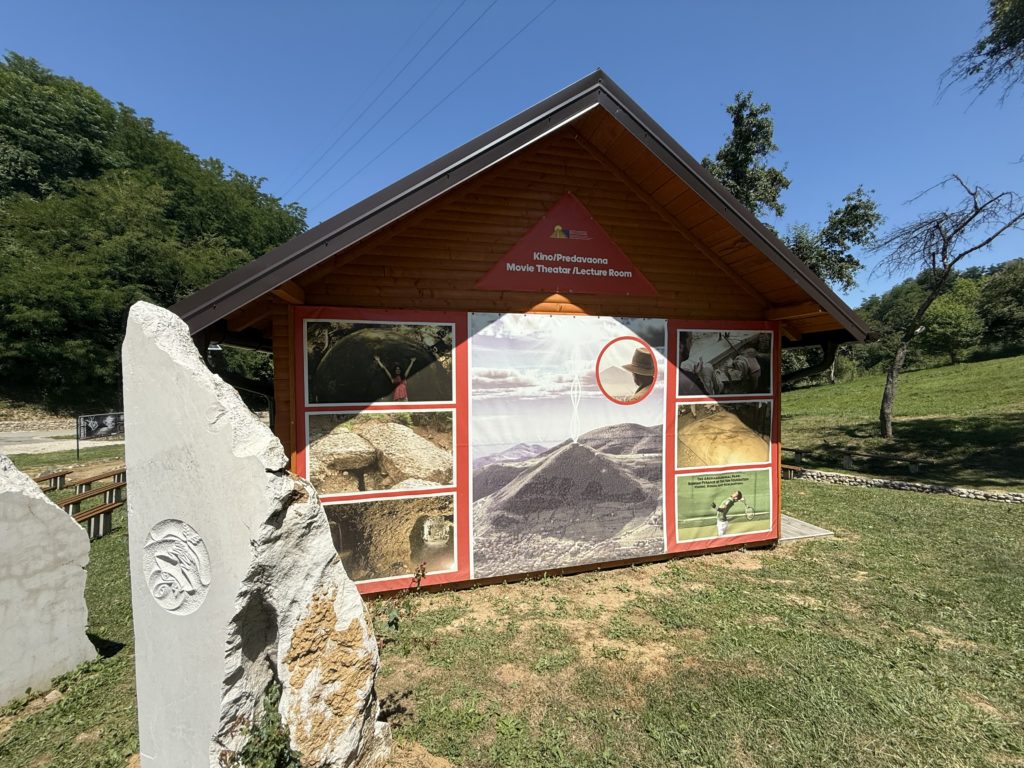
Just then, the festival group arrives and begins lunch. We return to the lecture hall to wait, only to find a new set of people already there. A couple from Pula say they come every year for about ten days. Behind them sits a man from Serbia who has come with his son. Slovenian can also be heard in the background.
The Serbian man says he is a retired engineer who now, as he puts it, dabbles in history recreationally. What follows is a torrent of theories: “It’s all the Jews’ fault,” he says with an air of authority. This type of antisemitism, though harmful, is dangerously normalized in conspiracy circles. “Those people on YouTube, 90% of them work for our UDBA,” he adds, referring to the State Security Administration (Uprava državne bezbednosti), the former secret police of socialist Yugoslavia. UDBA operated from the late 1940s until the early 1990s, tasked with domestic surveillance, political repression, and intelligence gathering, both in Yugoslavia and abroad. In conspiracy theory circles today, the term is often used as a catch-all for a shadowy, all-powerful network supposedly controlling politics, media, and public life, even though the agency formally ceased to exist after the breakup of Yugoslavia.
He then moves on to claim that he knows who killed Zoran Đinđić, the Serbian prime minister assassinated in 2003, but, of course, “can’t say.” Like most claims of this sort, none are backed by evidence, instead blending classic elements of antisemitism with local political myths. Park staff occasionally caution him for being disruptive.
A man from Zagreb approaches, saying he came because he heard there would be a talk about climate, and that he knows “more than the average person” on the subject. When asked how so, he replies, “I research more than the average person.” He then launches into a discussion about CO₂ levels in the atmosphere and permafrost, demonstrating a solid command of the terminology. “Milanović cycles!” the Serbian man occasionally shouts, adding his own “contribution.”
Around 3:30 p.m., Osmanagić’s group of about 30 begins to approach. We speak with one of the participants who paid for the multi-day package. Originally from Novi Sad, Olivera now lives in Los Angeles and says she is very pleased with the gathering.
“What I liked most was that Semir took us everywhere,” she says, adding that the experience can’t be compared to listening to the same content on YouTube. She also says she’s especially glad she got to see some of the YouTubers she follows in person. “Although, I came for the socializing, this is all a bonus,” she adds with a laugh.
It seems there are few people like Olivera who paid for the package: we counted only three wearing the wristband that marks them. They got the chance to spend time with a select group of Alter Media presenters and, above all, with Osmanagić himself, who personally led them to the tumulus, tunnels, the “Bosnian Pyramid of the Sun,” and other sites, where they could get information and answers to their questions directly from him.
Choice and the “Alternative”
The announced speaker, Adnan Jašo Jašarspahić, still hasn’t arrived. In his place, Sarajevo-based YouTuber Haris Mutevelić, behind the profile Dolly Bell TV, presents his channel. The presentation lasts less than five minutes. Mutevelić explains how, in the absence of work, he started a YouTube channel. As a boxer and artist, he covers a wide range of topics. At one lecture, he heard a professor say that the pyramids were a fraud, which piqued his interest and prompted him to start exploring the subject. He has yet to settle on the direction for his channel. If we came expecting thrilling conspiracy theories and an explanation of the meaning of the universe, in the style of a celebrity YouTuber from an alternative universe, we were left disappointed.
The presenter modestly notes that he is only just starting out. In the Q&A, the audience encourages him to “find his style.” The awkwardness of the moment is further enhanced by a random outburst from the back: “The Jews are to blame for everything!” To be fair, the statement is met with disapproval and rejection.
A break is announced until the next speaker arrives. In addition to Jašarspahić, the announced speakers for the day included Peter Jasak, Suzana Mitić, Marko Kapriš, and Ratko Martinović. At that moment, I notice that the man from Serbia – the one who knows who killed Đinđić and believes the Jews are to blame for everything – quietly slips away. It’s unclear whether he left of his own accord or was prompted to do so.
During the break, we speak with Osmanagić, who emphasizes that this is a gathering of “free, alternative media,” energized, he says, by the period of the Covid-19 pandemic. “That was a sad time, when constitutionally guaranteed rights were suspended,” says Osmanagić, who previously called the virus “biological warfare.” This claim, common among vaccine opponents, has been rejected as a conspiracy theory by the World Health Organization and relevant institutions. Many “alternative” YouTubers at the time spread dangerous disinformation during a global health crisis in which millions around the world were dying, and timely, accurate information was a matter of life and death.
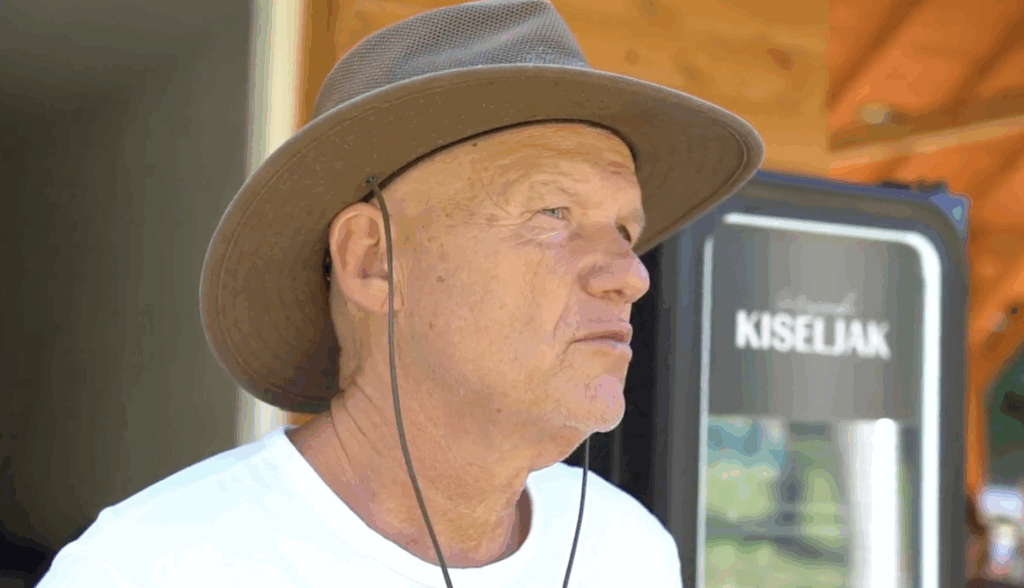
One of the ideas behind the gathering, Osmanagić further explains, is for channel owners to meet and introduce themselves to each other, creating space for future collaboration. The media Osmanagić promotes here, according to him, offer an “alternative” to what he calls the “mainstream media.”
When asked about criticism that these outlets promote conspiracy theories, Osmanagić responds that it is important for people to have access to different kinds of information. In his view, “mainstream media” are under control, and he labels outlets like CNN, BBC, and RTL as examples of “leftist fascism.” “We live in a world mostly run by monsters who politely call themselves elites,” Osmanagić says, explaining his worldview. “People need to have a choice,” he concludes.
We agree, and make our own choice: hungry and tired, we leave the event. Although we didn’t hear thrilling presentations that explain everything through the lens of an endless conspiracy, but only one sparse talk for which we waited more than four hours, we walk away with a clearer picture of the people who come to Osmanagić’s tunnels.
Alongside devoted believers in conspiracy theories and mysticism, we also saw those who merely flirt with spirituality, as well as complete skeptics. This diversity, in part, helps explain the popularity of both the complex itself and Osmanagić as a figure.
In the end, although we didn’t feel any special energy in the valley, we gained a better understanding of those who believe they did. Reality may be the same for all, but our perceptions of it can be vastly different.