

Original article (in Albanian) was published on 08/08/2025; Author: Barbara Halla
A Facebook post quotes U.S. President Donald Trump as saying that soon the European Union and Europe itself will no longer exist. However, a closer look at Trump’s remarks during a recent trip to Scotland shows that he was not issuing a warning about the EU, but making a provocative statement about the immigration situation in Europe.

At the end of July 2025, during a visit to Scotland, Trump stated ‘When it comes to immigration, you have to act fast. Otherwise, you won’t have Europe anymore‘. This particular phrase, “You won’t have Europe anymore”, has been taken by Facebook users as a warning of a catastrophic change to the European Union’s structure. In fact, Trump’s comment was meant as a criticism of European immigration and refugee policies, a nod of support to right-wing parties in Europe, and not a prediction of the EU’s collapse. He went on to maintain the same tone, speaking of a “horrible invasion” and blaming immigration for “killing Europe.”
Trump frequently employs exaggerated and sensational rhetoric to advocate for stricter immigration controls. In the U.S., he has pursued a hardline approach toward immigrants, increasing the budget for Immigration and Customs Enforcement (ICE) agents by several billion dollars and significantly expanding deportations.
His words also resonate with what is known as the ‘Great Replacement‘ theory. It’s the unfounded belief that Western populations are being deliberately replaced by non-European immigrants. Faktoje has previously debunked such narratives, including when figures like Elon Musk (who until recently was considered close to the president) made similar claims that Europe is losing its identity and population due to immigration from Africa. These assertions are rooted more in fear than in evidence. For instance, in 2023, 4.3 million people migrated to the EU from non-EU countries, representing an 18% drop (about 1 million fewer people) compared to 2022.
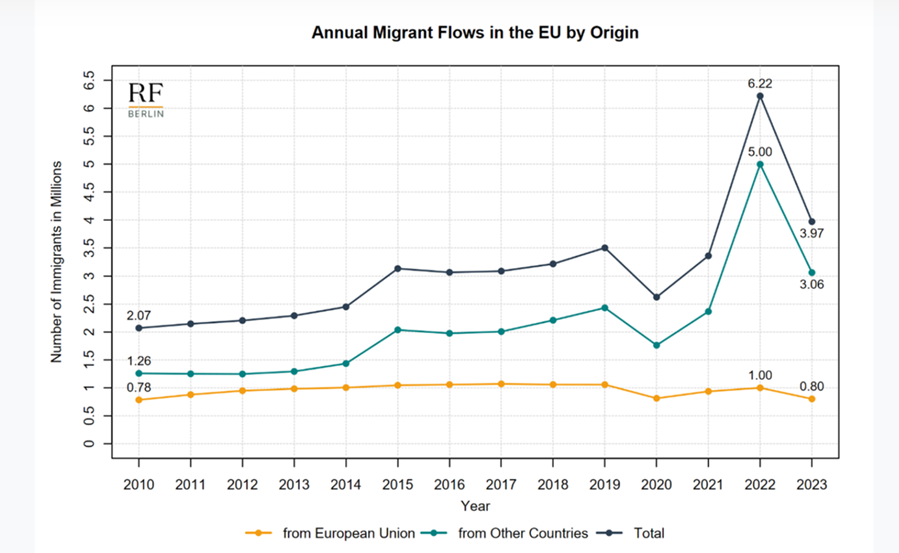
Overall, although the long-term trend has been upward, with a notable spike in 2021 after the COVID outbreak, the numbers have stabilized in recent years. In fact, countries like Germany, which see a high flow of immigrants, often actively recruit them to fill essential positions in the German economy, as highlighted by Deutsche Welle.
In the U.S., immigrants account for roughly 14.3% of the total population. While this percentage has risen since 1970, it is not historically higher than, for example, the late 19th century, when large waves of Europeans migrated to America. Migration and refugees certainly bring significant challenges for the EU, but there is no solid evidence to suggest that the EU or the European continent will disappear because of immigration.