
Original article (in Albanian) was published on 11/08/2025; Author: Pustina Patris
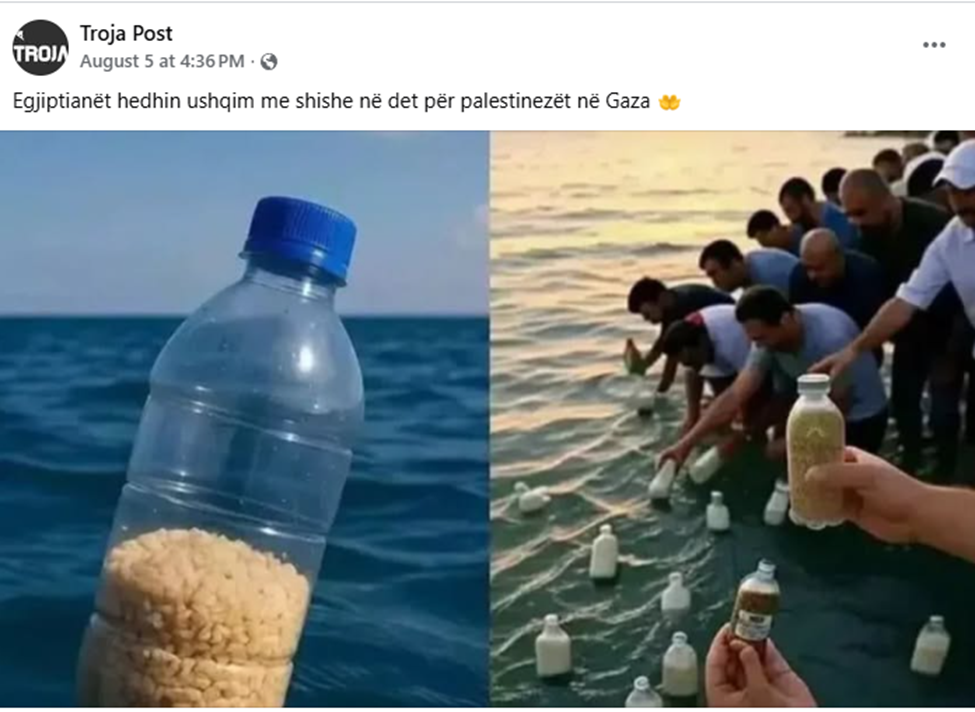
An image circulating on social media, including Albanian-language platforms, claims to depict food and bottles being thrown into the sea by Egyptians for Palestinians in Gaza.
According to the United Nations Office for the Coordination of Humanitarian Affairs, one in three people in Gaza “has gone without food for days”.
Some credible reports described an initiative by a group of Egyptians to transport grains and other food items in plastic bottles capable of floating in the sea, hoping they would reach Gaza via the currents. The idea was suggested by an Egyptian engineer based in Japan, who argued that sending food through the Mediterranean Sea was the most practical method considering the ongoing blockade of Gaza.
In a Facebook post, he explained that a securely sealed 25-liter plastic drum can hold roughly six to eight kilograms of food, leaving an air space of about eight liters to keep it afloat. For the deliveries to be successful, they must be released at least four kilometers from the coast, at a 60-degree northeast angle, to avoid opposing currents.
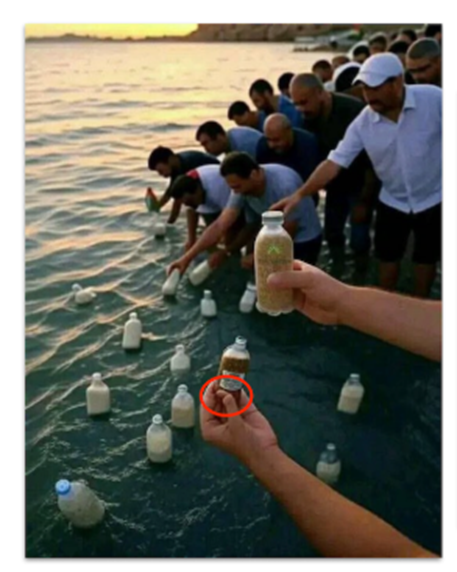
The images in the post above, however, are not genuine. They were produced with artificial intelligence (AI) software.
In the picture showing people holding bottles, one thumb appears bent in an unnatural manner. AI-generated images often have difficulty rendering realistic hands and fingers. The bottles in the water are also misshapen, while the men’s faces in the background are overly blurred and difficult to distinguish. Moreover, some bottles seem to hover above the water’s surface, defying the laws of physics.
The image of the bottle floating in the sea also appears unrealistic. If it were actually filled with food, it would not float so high above the water. The weight of the contents would cause it to be partially submerged.
In summary, although reliable reports confirm that some Egyptians have been throwing bottles filled with food into the sea in hopes they will reach the people of Gaza, the images in question are not authentic but generated with computer software.
To reduce the risk of such content being misinterpreted, any video, photo, or other material created or altered with artificial intelligence should be clearly marked as such. This helps keep audiences informed and protected from misinformation. Facebook requires users to label AI-generated images and videos accordingly.