
Original article (in Serbian) was published on 14/8/2025; Author: Marija Vučić, Milica Blagojević
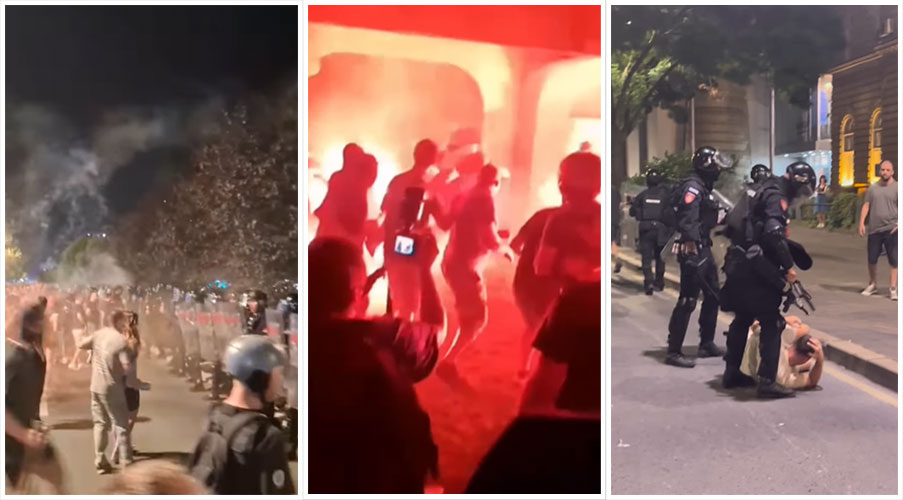
The last week in Serbia have been turbulent: in Belgrade, Niš, Novi Sad, Vrbas, Bačka Palanka, and other cities, clashes broke out between the gendarmerie, SNS supporters, and citizens who have been protesting for months. The scenes were horrifying: in front of SNS party offices and on the streets across the country, gendarmerie cordons were deployed, beating even women, while tear gas was thrown at demonstrators. Suspicious men in caps who were guarding party offices hurled pyrotechnic devices at people. Meanwhile, tabloids and the government are pushing a dangerous manipulation: that those who protest peacefully are in fact trying to provoke a civil war, even though it is the government that has unleashed police and paramilitary forces on them, as numerous videos testify.
Divide and rule – this seems to be the main method of the rulling Serbian Progressive Party government, inciting citizens against one another.
At least, that is how the situation looked over the past week on the streets of several Serbian cities: people gathered in front of SNS offices guarded by paramilitary units – suspicious-looking men with caps and scarves over their faces, who threw pyrotechnics at citizens and attacked them with clubs.
The government also mobilized police units, namely gendarmerie cordons, to protect itself – attempting to push back and disperse angry citizens, beating them with batons and spraying them with tear gas.
This is the escalation of nine months of student blockades, to which a large number of Serbian citizens have since joined. They demand that institutions prosecute those responsible for the deaths of 16 people in the collapse of a canopy in Novi Sad, and that President Aleksandar Vučić call early parliamentary elections. Although he used to call elections frequently in order to reconfirm the strength of the Serbian Progressive Party, Vučić now refuses.
Pro-regime media also participate in the effort to maintain the heavily shaken power of the SNS.
Thus, one of them Informer accuses the demonstrators of being “led by foreign services and anti-Serbian opposition” and of being bloodthirsty. Alo and Večernje novosti claim that citizens attacked police and SNS supporters in an attempt to overthrow the state and provoke a civil war. Srpski telegraf went the furthest in manipulations and distortions, with its front page claiming that the “blockers” were preparing a “Kristallnacht” against members of the ruling party.
Kristallnacht is, in fact, the name for the large-scale pogrom of Jews across Germany in 1938, organized by the Nazi regime, during which around a hundred Jews were killed, and 20,000 were arrested and taken to concentration camps. It was, essentially, the introduction to the Holocaust.
All these texts follow the government’s narrative: protesters are accused of trying to start a bloody civil war, even though it is the government that sends thugs to the streets and deploys hundreds of gendarmes.
In Novi Sad on Tuesday night, flares, fireworks, and firecrackers were thrown at citizens gathered in front of party offices, and several videos appeared showing groups of thugs with sticks and clubs.
Tensions also flared in New Belgrade, the neighbour in Belgrade, when SNS supporters threw a flare at citizens. However, as reported by N1’s journalist, citizens later clashed with the police, who then used tear gas against them.
Protesters also gathered on the other side of the river. Police first pushed them back near the Beograđanka building and then began to beat them – in videos and photos, police are seen beating an arrested young man as well as a woman.
On social media, we also saw a video of the president’s brother, Andrej Vučić, who, surrounded and protected by police, marched among a group of men toward so-called Ćacilend – the informal protective cordon of the Parliament and Presidency, and the headquarters of suspicious SNS supporters in Belgrade. The president’s brother was heard shouting “Ustaše, Ustaše” at the gathered citizens. (Ustaše, a term referring to members of a Croatian fascist movement responsible for mass atrocities during World War II.)
Among this group of controversial SNS supporters, journalists also spotted Đorđe Prelić, a hooligan who was convicted in 2009 for the murder of French football fan Brice Taton. He was standing immediately behind the police cordon in the front row at Ćacilend in front of the Parliament.
Protests also escalated in Niš, where several students were injured during clashes with police who tried to prevent them from reaching the SNS offices. One student from Niš was elbowed by police before being arrested.
According to Južne vesti, the police cordon was breached and re-formed several times, but later tear gas or pepper spray was released against citizens.
Demonstrators also took to the streets in other cities such as Pančevo, Čačak, Kraljevo, Smederevo, and Kragujevac. The situation was similar – police cordons mostly guarded the SNS offices, and in some cases, scuffles with citizens broke out.
These protests are a response to the incidents that occurred the night before last in Vrbas and Bačka Palanka. At that time, pyrotechnics and other objects were thrown at citizens from the direction of those gathered in front of the SNS offices. The police did not react.