
Original article (in Serbian) was published on 9/9/2025; Author: Milica Ljubičić
During Pride Week in Serbia, as well as in the days leading up to it, we observed various media manipulations concerning the LGBT community. Some of the narratives were new, such as claims that a “blockade-style gay pride” had taken place, while others were familiar, including portrayals of participants as “the worst satanists.” Večernje novosti stood out in this coverage, as it has for many years. The newspaper was particularly critical of banners expressing support for Ukraine, framing them as a “message against Russia,” while completely disregarding the fact that in that country the LGBT movement has been declared extremist. In the following text, we present several examples of media manipulation and the dissemination of false claims about members of the LGBT community.
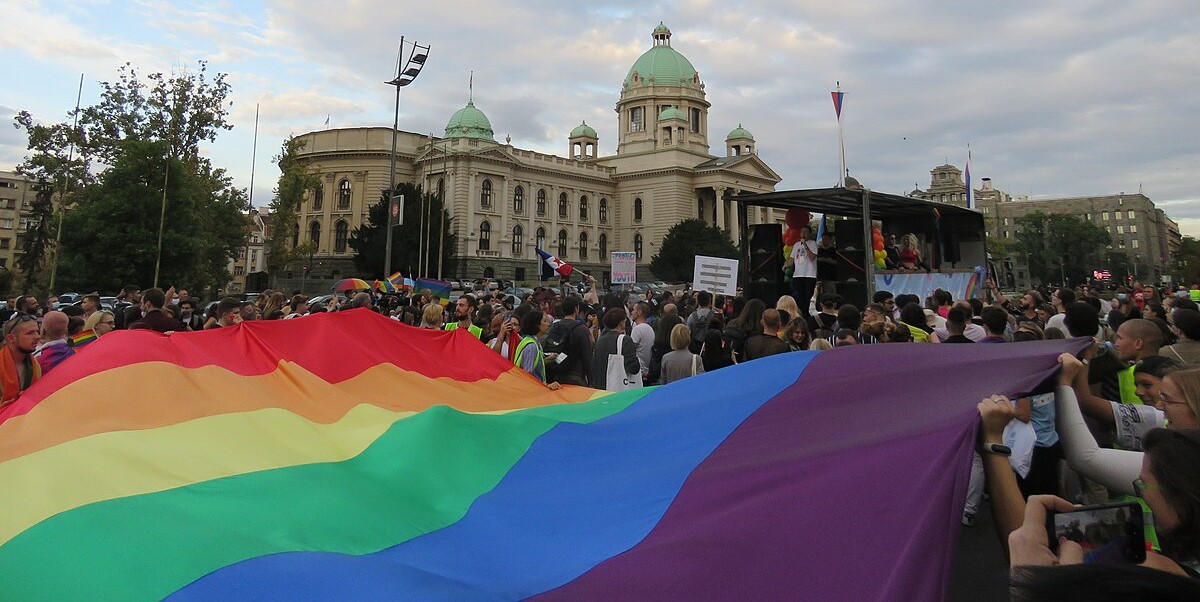
On September 6, as part of Pride Week in Belgrade, a protest march was held under the slogan “For Family.” The organizers stated that Pride “stands in solidarity with students and citizens in the fight for a more equal and better society,” and emphasized that this year’s gathering would be marked by noise instead of music.
The demands of Belgrade Pride remain unchanged, as the state has yet to meet them. The first two concern the adoption of the Law on Same-Sex Partnerships and the Law on Gender Identity.
Raskrikavanje noted a series of media manipulations related to this topic, including in the most widely read pro-government tabloids.
The portal Novosti, known for its anti-LGBT propaganda, this year labeled the protest march as the “first blockade-style gay pride.” They claimed this was due to the “godmother” of Pride, RTS journalist Olivera Kovačević, as well as political banners and expressions of support for Ukraine. They deliberately used the term “blockade-style”—a pejorative expression borrowed from the SNS vocabulary, which the authorities employ to delegitimize protests that have been ongoing for nearly ten months.
In the article itself, they wrote that the participants “observed moments of silence like the worst satanists,” and that their reporter recorded “blockade slogans” such as “Pump it” and insults aimed at President Aleksandar Vučić.
What seems to have particularly bothered Novosti were the banners expressing support for Ukraine, which has been at war with Russia for more than three years. Among other things, they published a photo showing a piece of styrofoam in the colors of the Ukrainian flag, describing it as a “message against Russia.”
Support for Ukraine, however, is not unusual given Putin’s hardline stance toward the LGBT community and the suppression of minority rights in Russia.
At the end of 2023, the Russian Supreme Court declared the LGBT movement “extremist” and banned its activities in the country.
A year earlier, the Russian parliament adopted a law expanding the existing ban on promoting so-called “LGBT propaganda” to people of all ages.
As Radio Free Europe reported at the time, under this law “any event or act deemed an attempt to promote homosexuality—including on the internet, in films, books, or advertisements—could be punished with heavy fines.”
In this context, the Ukrainian flag at Pride was not a message against Russia, but rather against repression and homophobia.
LGBT People in Ukraine ‘Protected Like Polar Bears’? False
A claim recently appeared on the website of Informer alleging that LGBT people in Ukraine are not subject to mobilization and are “protected like polar bears.”
This claim is based on a statement by a Ukrainian prisoner of war who allegedly told Russia’s RIA Novosti that forced mobilization does not apply to members of the LGBT community.
However, this claim is false. Article 23 of Ukraine’s mobilization law, which lists the categories of people exempt from compulsory military service during mobilization, does not mention sexual orientation as a criterion.
Exemptions from mobilization include, for example, persons with disabilities, as well as single women and men who have children under the age of 18. Mobilization also excludes, among others, state officials such as members of parliament, judges, and diplomats.
Since the beginning of the war in Ukraine, the media have repeatedly reported on the position of LGBT people on the battlefield, as well as on unequal treatment in the event of their deaths. Because same-sex marriage is illegal in Ukraine, when these soldiers are killed, their partners have no legal rights to decide what will happen to their bodies.
According to Deutsche Welle, citing research by the NGO Pilipenko based on estimates from other countries, the share of LGBT soldiers in the Ukrainian army could range between five and ten percent.
Attack on Theologian Pantelić Over Views on LGBT Believers
In August, Alo and Informer attacked theologian Blagoje Pantelić over his views on members of the LGBT community. They claimed that Pantelić and the Bishop of Düsseldorf and Germany, Grigorije, want to turn the Serbian Orthodox Church (SOC) into an “LGBT church.”
“His intention (Grigorije’s, author’s note) is to transform the SOC into a church that will submit to LGBT ideology, which many see as an attempt to subordinate the church’s sanctity and traditional values to modern trends that contradict its core principles. For the executor of this so-called ‘hellish plan,’ as critics call it, Grigorije chose Blagoje Pantelić,” the tabloids reported.
In reality, they used excerpts from theologian Blagoje Pantelić’s appearance on the show Taboo on Insajder TV, where he, among other things, shared his views on Pride, the Church, and tradition.
In a video taken from the social network X and published by the portals Alo and Informer, several of Pantelić’s statements from that appearance were edited together.
When host Milan Nikolić asked why it is difficult for the Church to accept that many gay people are believers, Pantelić commented that these individuals are rejected by both communities and that he considers them to be “the most heavily discriminated group”.
When protest marches against EuroPride in 2022 were mentioned, Pantelić noted that despite the “days-long protests against EuroPride, it was ultimately held.” This statement of his can also be heard in the excerpt published by Alo and Informer.
“The Church is unable to mobilize more people, unless it serves certain purposes that, for example, benefit the current regime—this one or the previous one. They are given media space, a fuss is made, and still nothing happens”, Pantelić remarked at the time.
Pantelić is otherwise known as a critic of Patriarch Porfirije and the domestic authorities, as well as for his open support of the ongoing protests in the country.
Translated in English using AI tools, then thoughtfully refined by a human editor.