

Original article (in Serbian) was published on 11/9/2025; Author: Teodora Koledin
A reader of FN Tragac forwarded us a link to a post from X (formerly Twitter), questioning the authenticity of the claims made in it. The post stated that Serbian Progressive Party (SNS) MP Nataša Jovanović allegedly “received 20 million dinars from the budget for Young Talents for a collection of love poems titled ‘Hot Nights in Which I Burn’”, which will supposedly be included in the “mandatory curriculum for high schools under the new Ministry of Education program.” However, these claims were denied by The Fund for Young Talents, the Institute for the Advancement of Education, and the National Library of Serbia.
These unfounded claims first appeared on the “Serbia Wikileaks” profiles in various social media platforms (Facebook, Instagram, Threads). From there, photos containing the controversial insinuations were copied and shared further (1, 2, 3, 4, 5).
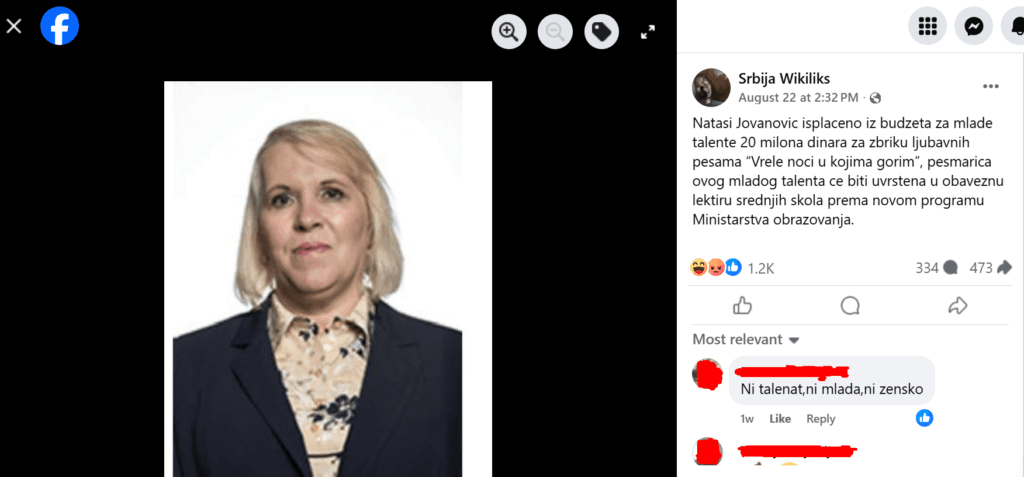
First, it should be noted that the existence of the so-called collection of love poems titled “Hot Nights in Which I Burn” is highly questionable. Any publication of this type should be cataloged in the National Library of Serbia (or in Matica Srpska for Vojvodina) and made available through the COBISS+ system for unified library searches. A search for a collection titled “Hot Nights in Which I Burn” by Nataša Jovanović, however, leads to a dead end.
To clarify, we contacted the National Library of Serbia directly. Suzana Rajić from the Department for User Information Services confirmed to us that the publication under this title “does not exist in the e-catalog of the National Library of Serbia” and “does not exist in the mutual e-catalog either, which covers all libraries in Serbia included in the COBISS system.
On the curriculum claim
Since the post claims the collection would be part of the high school curriculum, we also contacted the Institute for the Advancement of Education, which includes the Center for Program and Textbook Development. According to the Institute’s official website, staff at this Center “perform professional tasks related to preparing: education programs by level and type (preschool, primary, and general secondary education), preschool and primary education programs abroad, standards for textbooks and teaching materials, as well as providing professional evaluations of textbooks and teaching materials.”
Tatjana Mišović, head of the Center, confirmed to Tragac that the claimed poetry collection “is not included in any teaching or learning program.”
Answer from The Fund for Young Talents
It is also unclear what the post meant by “budget for young talents”. In Serbia, The Fund for Young Talents operates under the Ministry of Science, Technological Development, and Innovation. Its programs include, among other things, awarding Dositeja scholarships (to the best final-year students at state universities), scholarships for second and third cycle students abroad, and awards for high school students (for achievements in national and international competitions).
The Fund for Young Talents told Tragac:
“Our activities and competitions are carried out in accordance with the Decision on the Establishment of The Fund for Young Talents of the Republic of Serbia. Accordingly, the Fund does not allocate financial resources outside the provisions of this decision and the clearly defined procedures that follow the announcement of public competitions. In this regard, we inform you that the mentioned collection has not been supported by The Fund for Young Talents.”
As of the publication of this analysis, we have not received responses to our inquiries from the Ministry of Education of the Republic of Serbia or MP Nataša Jovanović. If responses are received later, they will be added to the text with appropriate notes.