
Original article (in Montenegrin) was published on 17/9/2026; Author: Jovana Đurišić
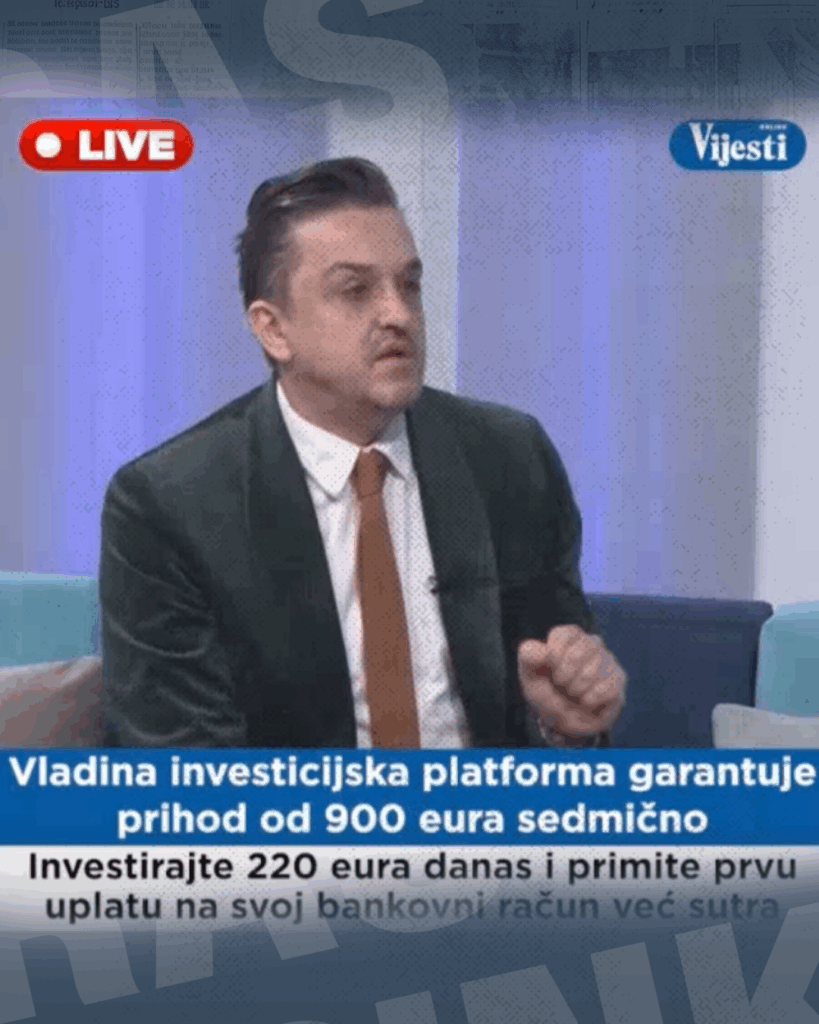
While scrolling through Facebook during the summer heat of 40 degrees, did you come across “good news” claiming that tens of thousands of Montenegrins were abandoning their jobs and moving into early retirement, all thanks to government economic reforms said to yield up to €900 per week?
Did you then click on that content and see a video in which the Minister of Finance, Novica Vukovic, allegedly invites viewers to invest €220 to earn the aforementioned €900 per week?
“Today could be your lucky day. Only those watching this live will have access to this opportunity… We cannot open this platform to the entire country because the results are impressive, and that would lead to imbalance. I’ll get straight to the point – with an investment of €220, you can earn €900 weekly. It sounds unbelievable, but it is absolutely true,” the August video states (archived here), and it is still active on social media.
In the video, the Minister further “warns” that the recording can be accessed only once and urges quick action, claiming that this is not about cryptocurrencies or dubious investments.
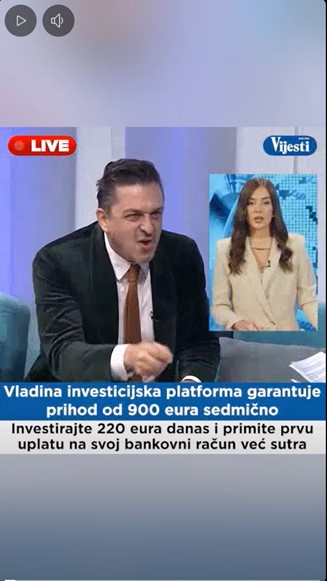
A supposed journalist asks the Minister how many people have joined and what the results are, to which the Minister replies that the platform was tested with a group of volunteers and that all of them earned €900 in the very first week.
If you saw all this and were ready to hang up your employment record book and follow the Minister’s advice, we must warn you that the video was created using artificial intelligence.
This video misuses the recognizable look of the TV Vijesti studio, as well as footage from a real appearance by Minister Vukovic. The original recording dates back to November of last year, and the Minister is dressed identically to how he appears in the manipulated video.
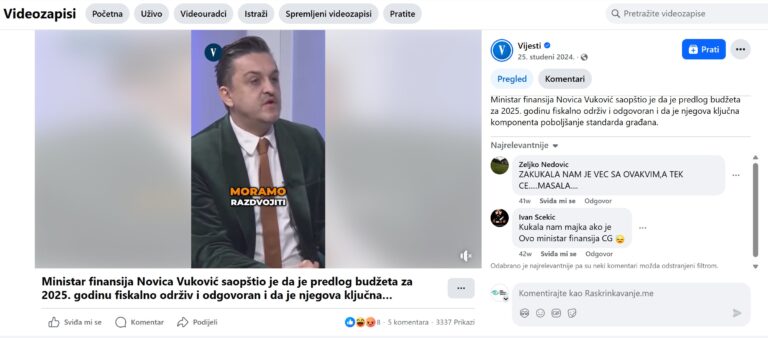
Therefore, the analyzed video is not authentic. It is a “deepfake” created using artificial intelligence. Such recordings are artificially generated, machine-created video or audio content in which a person’s face, voice, or body is altered so that it appears they are saying certain words or performing actions they did not actually carry out.
This is not the first time public figures have been abused in this way, as Raskrinkavanje has reported on several occasions (1,2,3).
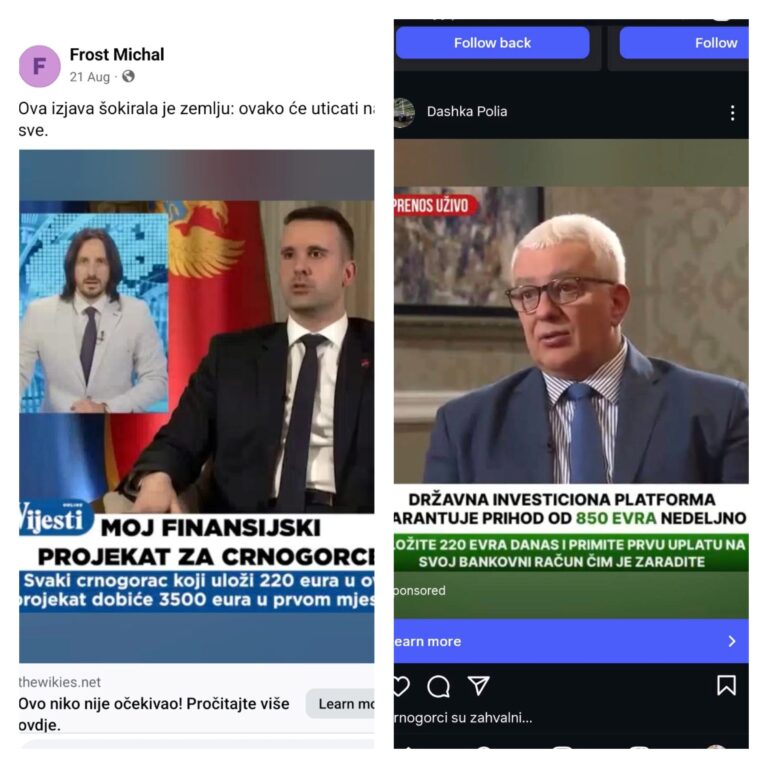
In addition to Vukovic, we have recorded examples of manipulated videos misusing the President of the state Jakov Milatovic, Prime Minister Milojko Spajic (archived here), and the Speaker of the Parliament Andrija Mandic, among others.
How to recognize fake advertisements?
- Given the increasing frequency of such content, here are a few tips on how to spot it:
- Websites offering a product are usually so-called landing pages – single-page sites with no other content.
- Clicking any option typically takes you directly to a purchase link.
- A 50% discount is almost always offered.
- It is almost always presented as a “once-in-a-lifetime opportunity.”
- The content is full of linguistic inconsistencies and appears to be generically translated from another language.
- The figures mentioned are usually exaggerated.
Therefore, the reforms allegedly discussed by the Minister in the manipulated video do not exist. There is no statement corresponding to what is heard in the recording, nor was such a video ever actually filmed.
Accordingly, we assess the post featuring a “deepfake” video that uses the likeness of Novica Vukovic to promote an alleged money-making platform as false news.
The “Fake news” rating is given to an original media report (completely produced by the media that published it) that contains factually incorrect claims or information. Content that is rated as fake news can be reliably determined to have been created and disseminated with the intent to misinform the public, that is, to present a completely false claim as fact.