
Original article (in Bosnian) was published on 25/10/2025; Author: Mladen Lakić
A few days after new EES rules began applying to travelers entering the EU, conspiracy theories started spreading on social media claiming that the system was a “pilot project” for mass population control.
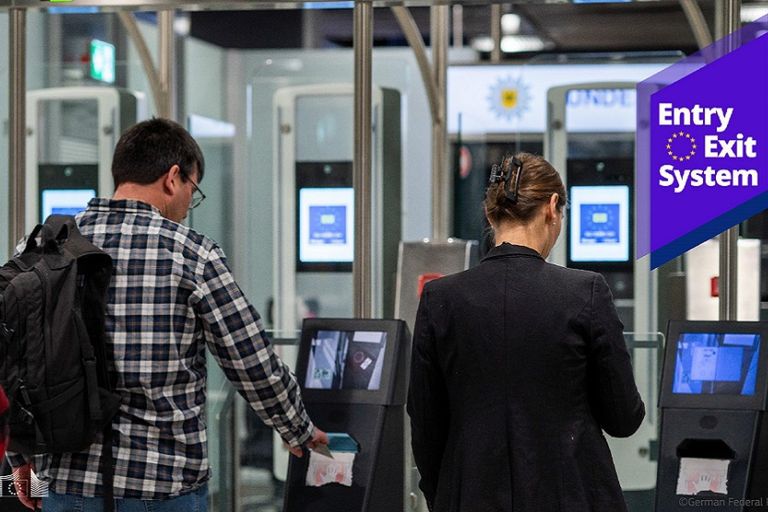
Starting October 12, 2025, travelers from dozens of non-EU countries entering the European Union, Norway, Switzerland, Liechtenstein, and Iceland must follow new rules. The system called the Entry/Exit System (EES) includes fingerprint scanning and facial photography, i.e. the collection of biometric data. When travelers enter these countries for the first time, their data will be collected and later verified in the database on subsequent entries.
On October 17, 2025, conspiracy theorist Slađana Velkov posted on Facebook that the system was a pilot project currently only applied four hours per day. She claimed that the hours would gradually increase and that the public had not been informed, comparing the EES to vaccination certificates from the Covid-19 pandemic, portrayed as a tool of mass control.
The biometric digital system at EU borders is a pilot project (a 180-day test period) lasting until April 12, 2026, but no one tells us that it’s presented as if it’s already permanent, just like during the “plandemic” with the Covid certificates. Currently, it operates 4 hours per day, 2 in the morning and 2 in the afternoon (these hours won’t be fixed because the psychopaths know people would avoid traveling then). In December, they’ll extend it to 8 hours, in January to 12 hours of biometric checks and 12 of normal border crossing.
At the time of writing this analysis, the post had around 3,000 interactions and over 800 shares.
Identical claims appeared in numerous other Facebook posts (1, 2, 3, 4, 5), some including illustrations (1, 2) and others in video form.
What Is EES and How Does It Work?
Contrary to the claims made in the analyzed posts, EES is not a “pilot project”. It is a system that became operational on October 12, 2025 (link). According to the official EU website, the EES is “an automated IT system for registering non-EU nationals traveling for a short stay,” and this system will be used each time they cross the external borders of any EU country or of Iceland, Norway, Liechtenstein, or Switzerland.
The term “short stay”, according to the same source, means up to 90 days within any 180-day period. This period is calculated as a single, unified timeframe for all European countries that use the EES.
Several advantages of the EES are highlighted. Border checks will become more modern and efficient, as the system will “gradually replace passport stamps with a digital system that records the entry and exit of travelers.” It is also expected to make travel across borders easier and faster, and to help prevent illegal migration.
In the “Frequently Asked Questions” section on the same website, the EU explains what the gradual introduction of the EES means. It describes how European countries will implement different elements of the system in stages, with full operation expected in April 2026.
The EES will be gradually introduced at the external borders of 29 European countries over a six-month period. These countries will phase in different components of the system, including the collection of biometric data such as facial images and fingerprints. This means that the biometric data of travelers (facial image and fingerprints) may not be collected immediately at every border crossing, and their personal data may not yet be registered in the system. Passport stamping will continue as usual.
This progressive implementation will last until April 9, 2026. From April 10, 2026, the EES will be fully operational at all external border crossing points of the European countries that use the system.
The claim that the EES operates only four hours per day – two in the morning and two in the afternoon – was likely derived from a statement made by Mladen Bužančić, Head of the Border Sector of the Split-Dalmatia Police Department. Speaking to Croatian Radiotelevision (HRT) on October 12, 2025, the day the EES became active, he said that the first day of the system’s implementation went smoothly and without incidents, and explained that its rollout was gradual.
In the first hours of operation, the police had already recorded more than 4.000 biometric files across Croatia, about 300 of which were in the Split-Dalmatia area.
The implementation is gradual; the system is currently being used four hours a day – two shifts of two hours each. This is an adaptation phase that will last six months, after which the system will operate 24 hours a day, he explained.
Our partner portal Raskrinkavanje Montenegro also addressed the false claim that EES is a “pilot project” in an analysis published on October 22, 2025.
Conspiracy Theory About the “Plandemic”
The analyzed posts claim that the EES is the same as “what they did during the plandemic with Covid certificates”.
“Plandemic” is an established term among conspiracy theory supporters who believe that the Covid-19 pandemic was “planned”, that is, that it was a method of introducing population control. As early as 2020, in cooperation with our partner portal Faktograf from Croatia, we wrote about a pseudo-documentary in which this word was coined. In that analysis, it was noted that this 26-minute video “became powerful fuel for one of the most widespread conspiracy theories about the Covid-19 pandemic, according to which the new coronavirus is actually harmless, but hysteria around it was artificially created in order for people around the world to accept mandatory vaccination”. This would supposedly enable a “vaguely defined global elite” to “depopulate the planet and control the rest of the population”.
Since then, the term “plandemic” has been used in the same or similar meaning in countless social media posts, which we have covered in multiple analyses (1, 2, 3, 4).
We have also written about various false claims made by Slađana Velkov in numerous analyses (1, 2, 3, 4). These analyses emphasized that, according to available information, Velkov studied medicine in Niš and Skopje, where she graduated. She has been publicly known for years for her anti-vaccination activism.
“Covid certificates” refers to the digital Covid certificates introduced by the EU during the pandemic to allow safe and free movement. As stated on the official website of the European Commission, these certificates included information on Covid-19 vaccination, testing or recovery. Having a certificate showing one of these statuses allowed entry or exit from a country, stay without quarantine and similar rights. The EU Digital Covid Certificate Regulation entered into force on July 1, 2021 and ceased to apply on June 30, 2023.According to the facts from this analysis, we assess the claim that the EES is a pilot project as disinformation. The EES is being introduced gradually, and the EU expects it to be fully operational by April 12, 2026. The claim that this system was introduced for mass population control is rated as conspiracy theory.