
Original article (in Montenegrin) was published on 18/11/2025; Author: Jovana Đurišić
Since 2013, Russia has proposed a Resolution to the United Nations on combating the glorification of Nazism. For as long as this, disinformation has followed the vote on this document whenever the proposal appears on the agenda.
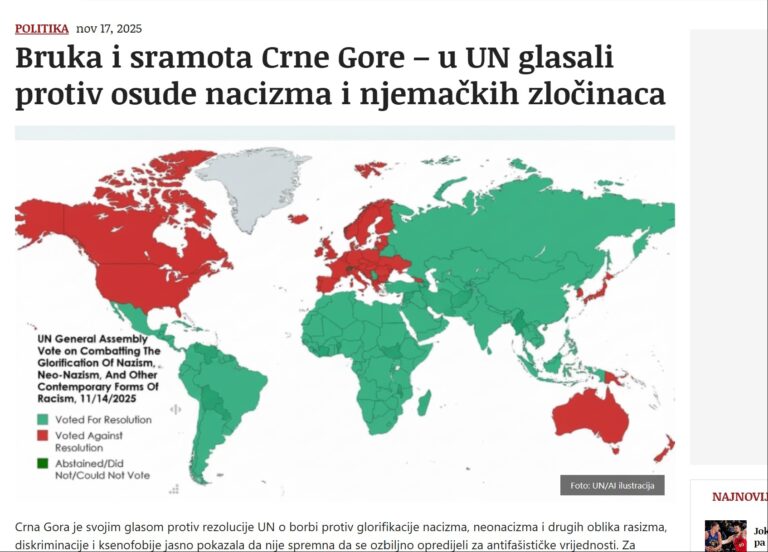
On November 14, the Third Committee of the United Nations General Assembly voted in favor of a resolution proposed by Russia entitled “Combating the glorification of Nazism, neo-Nazism and other practices that contribute to fueling contemporary forms of racism, racial discrimination, xenophobia and related intolerance.”
The document was supported by 114 countries, 52 voted against it, and 12 abstained. Among the countries that voted against was Montenegro, which some actors used to once again promote an old spin – that Montenegro supports Nazism.
Thus, the portal Borba, in its coverage of this vote, claimed that Montenegro voted in the UN against condemning Nazism and German criminals.
“By voting against the UN resolution on combating the glorification of Nazism, neo-Nazism and other forms of racism, discrimination and xenophobia, Montenegro has clearly shown that it is not ready to seriously commit to antifascist values. The resolution was supported by 114 states, 52 voted against, and 11 abstained. Among European countries, only Serbia and Belarus supported the Russian initiative – Montenegro took the opposite side. Serbia’s vote represents a clear commitment to antifascism and the preservation of the memory of the victims of fascism, while Montenegro shows how empty declarative statements about antifascism are when substantive decisions are made,” the Borba article states (archived here).
However, claims that anyone who opposes a resolution proposed by Russia is on the side of the Nazis are unfounded, as we have written on several occasions. (1,2,3).
As we have explained multiple times, the objective of the Russian resolution is clear and has been pointed out by numerous states – to justify aggression against Ukraine through an alleged fight against Nazism.
Colleagues from Raskrinkavanje, similarly explained this, stating that the Russian resolution served to portray the United States and Ukraine as Nazi states.
Their analysis notes that the United States has for years voted against this document, and that the U.S. Mission to the UN explained the reasons for this as early as last year.
“The United States is proud to have fought side-by-side with our World War II allies including the Soviet Union and to have made decisive contributions to the victory over Nazi Germany in 1945. We categorically condemn the glorification of Nazism and all forms of violent extremism, antisemitism, Islamophobia, racism, xenophobia, discrimination, and related intolerance.
That said, the United States continues to oppose the Russian Federation’s manipulation of the UN system to spread disinformation. This resolution is a glaring example of Russia trying to further its contemporary geopolitical aims by invoking the Holocaust and the Second World War to malign countries that rightfully reject the celebration of their years of brutal domination by the Soviet Union. This is all the more egregious now when Russia seeks to use a false accusation of Nazism to try to justify its unconscionable ongoing brutality against the people of Ukraine”, the statement of the U.S. Mission reads.
The European Union delegation to the United Nations also explained why it voted against this resolution, as it has done for years.
Quoting the words of a law professor at UCLA, born in Zambia, who later served as UN Special Rapporteur on racism, racial discrimination, xenophobia and related intolerance, the EU Mission stated the following:
„The Special Rapporteur notes, with alarm, that the Russian Federation has sought to justify its military invasion and territorial aggression in Ukraine on the purported basis of eliminating neo-Nazism. … The use of neo-Nazism as a pretext to justify territorial aggression seriously undermines genuine attempts to combat neo-Nazism. The Special Rapporteur denounces and condemns in the strongest terms such pretextual use, including in relation to the unlawful breach of the sovereign territory of Ukraine and the humanitarian crisis that breach has caused.“
The EU statement also noted that candidate countries such as Montenegro, Albania, Bosnia and Herzegovina, and Kosovo, as well as Georgia, are aligned with this position.
Therefore, Montenegro did not support Nazism; rather, as a country negotiating accession with the European Union and aspiring to become a member, it is aligned with EU foreign policy.
The spread of this false narrative was also supported by journalist Igor Damjanovic, whose statement was reported by Borba (archived here) in connection with the vote. Damjanovic stated that a total of 114 countries, including Serbia, voted in favor, while Montenegro was among the 52 countries that voted against.
“The ‘antifascists’ from Cetinje, our famous Cetinje activists, are silent about this and are not blocking roads. The so-called NGO sector is also silent, as are civic activists (with hair and without hair), human rights defenders and ND(H) Vijesti…” Damjanovic wrote on Facebook.
Going a step further, portal IN4S (archived here) claimed in its article that “descendants of Croatian and Bosniak Ustasha, as well as Montenegrin Greens, voted against the UN resolution dedicated to combating the glorification of Nazism and neo-Nazism.” The article was also published on Facebook.
The Serbian tabloid AloOnline (archived here) also joined the manipulation by these media outlets. In an article titled “NEW DIPLOMATIC DISGRACE: Montenegro side by side with opponents of condemning Nazism,” the portal stated that “the state in which half of the political scene self-proclaims itself the ‘antifascist bastion of the Balkans’ stood shoulder to shoulder with those who refused to support a resolution condemning the revision of Nazi crimes.”
In none of these publications were the positions of the EU and the United States mentioned, nor were the reasons for their votes against the resolution. In addition, an important context relating to Montenegro was omitted: as a future EU member, it is expected to align with EU decisions and positions, which it currently does, and it therefore voted against this resolution.
In view of the above, the mentioned posts are rated as a manipulation of facts.
The “Manipulation of Facts” rating is given to a media report that uses known and accurate facts but interprets them in a deceptive manner. These reports generally employ accurate information to draw incorrect conclusions or claims, leading media consumers to draw conclusions that differ from the actual meaning of the presented facts.