
Original article (in Serbian) was published on 12/11/2025; Author: Stefan Kosanović
The pro-government tabloid Informer – frequently used by Serbia’s authorities to target political opponents, activists, and journalists – has recently set up what it calls a “Viewer Information Service” (GOSI). The tabloid says the initiative consists of its most loyal readers, who supposedly supply the newsroom with information. In mid-November, Informer published surveillance – camera footage showing Milomir Jaćimović, a bus operator who has been supporting Serbia’s student movement and who was on a hunger strike at the time. The tabloid presented the recordings as proof that Jaćimović was lying about the strike. What evidence did Informer offer – and what, in fact, is GOSI?
Milomir Jaćimović, a transport operator who for months has been driving Serbian students to protests free of charge, began a hunger strike in Novi Sad on November 10 with his minor son after authorities seized his buses and issued him numerous fines.
According to the tabloid, a reader sent them a video purportedly showing “a fake striker,” Milomir Jaćimović, heading to meet the lawyer of opposition politician Dragan Đilas.
In the footage, a voice can be heard indicating that the person filming secretly is sitting in a car that is stationary, with its turn signal on and positioned in the direction Jaćimović is walking.
The same article also published two surveillance-camera recordings from the building of the Provincial Government and the Assembly of Vojvodina — material that an ordinary citizen would have little chance of obtaining.
The clips show Jaćimović and his son leaving the area in front of the state institution, where they have been gathering and staging a hunger strike, and then returning several hours later.
Informer uses the videos to “prove” that their hunger strike was allegedly staged.
They provided no additional evidence to support these claims, which is why we consider them unfounded.
What is even more striking in this case, however, is Informer’s assertion that the surveillance-camera footage was allegedly sent to them by a reader. The tabloid also claims to have an entire army of such readers, collectively referred to as GOSI — Informer’s so-called Viewer Information Service.
Informer’s “service” launched only recently
Informer first mentioned its “GOSI service” in July this year, when it claimed the unit was “breaking records.”
“GOSI are our most loyal audience, who for years have selflessly helped Informer in its reporting work, and many pieces of information have reached the public precisely thanks to you,” the newsroom said in a statement at the time.
Among the bizarre and disturbing articles allegedly “prompted” by GOSI was one tracking the wife of oposition activist and former basketball player Vladimir Štimac, who was in custody at the time.
The woman was photographed up close in a café, apparently with a hidden camera, as the person recording can be seen holding a phone in their hand.
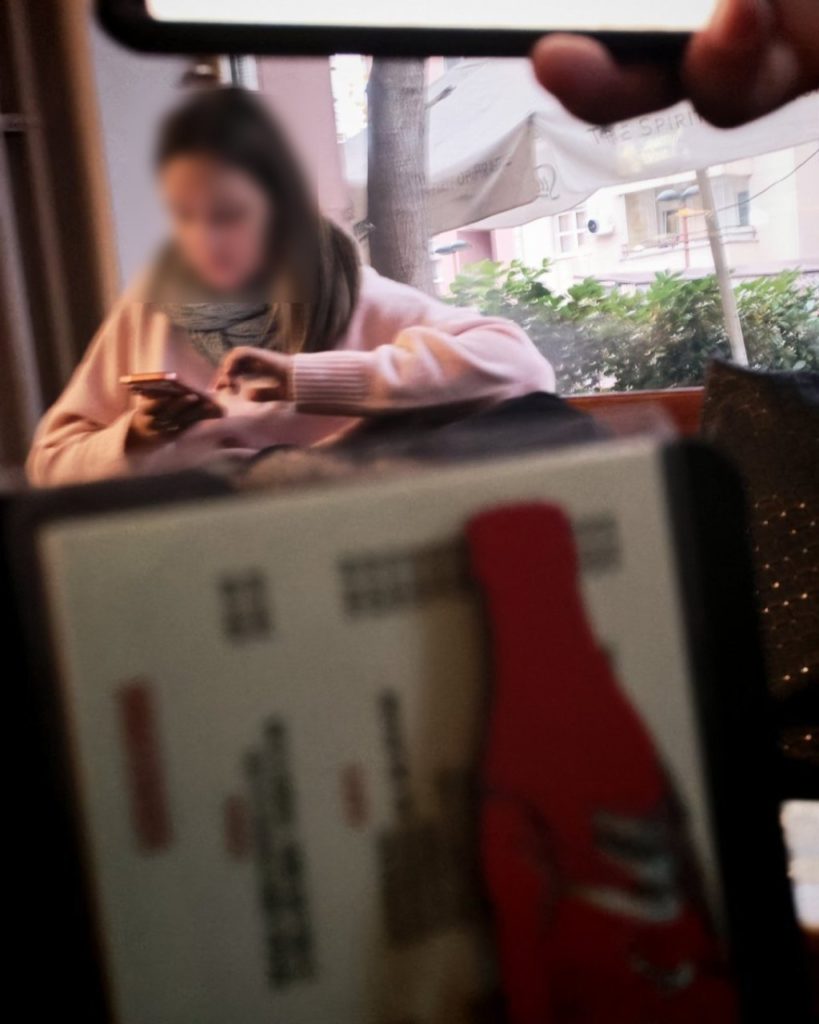
Photo: Informer / A photograph of Aleksandra Štimac, which was not blurred in the original. Raskrikavanje blurred it afterward in order to avoid violating her right to privacy.
In October, Informer also published photos taken outside Belgrade’s Zira Hotel, where, according to the tabloid, a group of “idlers who can’t stand Serbia’s success” had gathered.
Alongside a by-name list of around a dozen meeting participants — some of them embassy staff and foreign nationals working for international agencies — the portal ran a series of photos that appear to have been taken covertly, from a distance.
Adding to the absurdity, Informer claimed that an ordinary passerby had managed to recognize and tip them off about several foreign officials on the street: Uwe Optenhogel from the Foundation for European Progressive Studies, Carsten Meyer-Wiefhausen from the German embassy, Thomas Maas from the Belgian embassy, and Christian Wehrschutz, head of ORF’s Kyiv bureau.
Judging by these articles, members of Informer’s GOSI service — or, as Informer portrays them, regular readers – are not only supposedly well-informed about virtually every public figure in Serbia, but,also have access to diplomatic receptions.
In one such story, Informer published a secretly recorded video of Special Prosecutor for Organized Crime Mladen Nenadić attending an event at the German embassy.
Informer has published similar material before, but it did not previously present it as content allegedly submitted by readers.
Over the past two years, there have been numerous cases in which Informer published confidential information that only state services could plausibly access – from biometric photographs and surveillance footage. Raskrikavanje reported on a comparable case earlier this year, when someone “from a safe distance” in a car surveilled participants in a youth conference in Niš. The attendees said the photographs later published by Informer were most likely taken from a police vehicle.
Informer has also previously published a series of photos from both the professional and private life of KRIK editor Stevan Dojčinović, as well as a transcript of a conversation between Dojčinović and a colleague that had been recorded inside the newsroom.
After Dojčinović sued him, lawyers for Informer editor-in-chief Dragan J. Vučićević admitted that the information had been obtained from Serbia’s Security Intelligence Agency (BIA).