Original article (in Montenegrin) was published on 9/12/2025; Author: Jelena Jovanović
For some time now, various forms of disinformation and fake news have been used as tools to shape anti-migrant narratives, particularly Islamophobic ones, spreading fear and intolerance toward certain social groups.
This concerns disinformation that spreads primarily through social media, a phenomenon we have written about on multiple occasions. In recent days, viral claims have circulated alleging that the European Union is facing a new “influx of young Muslims from the Middle East.”
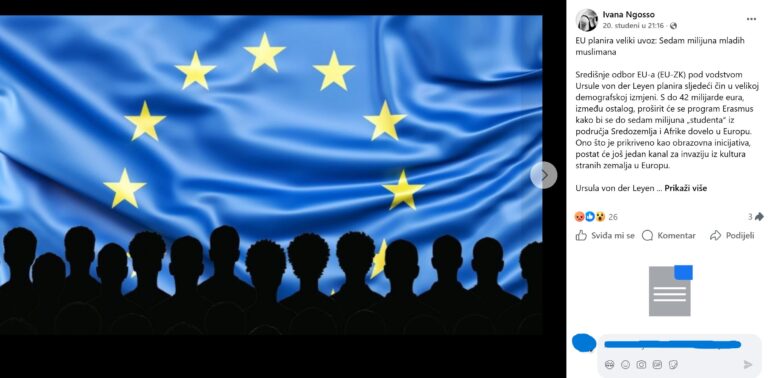
“EU plans major import: Seven million young Muslims,” reads, among other things, a series of Facebook posts (1, 2, 3, 4, 5) (archived here:1, 2)
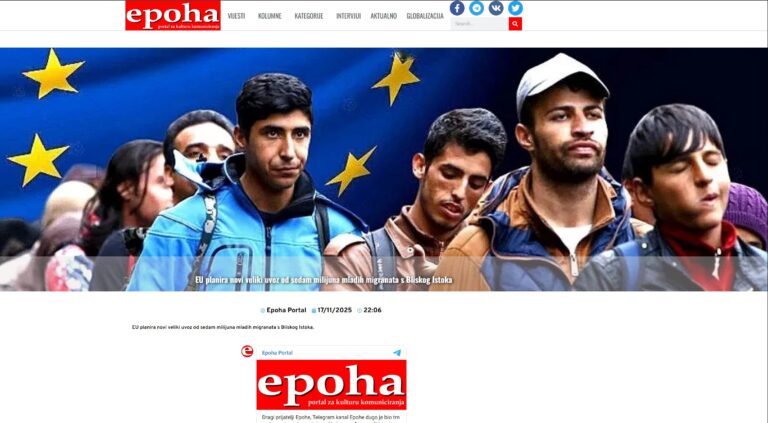
These and similar claims originate from the portal Epoha.hr (archived here), which published an article entitled:
“EU plans a new major import of seven million young migrants from the Middle East.”
The article states the following:
“The EU Central Committee (ECC), led by Ursula von der Leyen, is planning the next step in the great population exchange. Up to 42 billion euros will be spent, among other things, on expanding the Erasmus program in order to attract up to seven million students from the Mediterranean region and Africa to Europe. What is being concealed as an educational initiative will become yet another channel for an invasion of Europe from culturally foreign countries.”
In addition to being deeply discriminatory and aimed at excluding people from the Middle East, these claims are also inaccurate.
First of all, the post claims that a so-called EU Central Committee conducts demographic policy. However, such an institution does not exist within the EU’s structure, as is clear from an overview of its actual institutions. EU policy is based on the work of three main institutions: the European Parliament, the European Council, and the European Commission.
What is being portrayed as an “invasion of Muslims into Europe” is in fact a study program of the European Commission within a new strategy to strengthen the EU’s relations with partners from the southern Mediterranean, known as the “Pact for the Mediterranean.”
What is the “Pact for the Mediterranean”?
This is a real EU initiative, adopted on October 16 2025. (archived here)
As stated in the document, it is a new strategic framework proposed by the European Union (EU) to strengthen cooperation with partners from the southern Mediterranean and to build a more integrated, stable, and prosperous shared Mediterranean space.
“Launched on the 30th anniversary of the 1995 Barcelona Declaration, this Pact represents a ‘more focused’ approach to the Mediterranean, as a ‘strategic ambition’ and a ‘paradigm shift’ in Euro-Mediterranean relations – moving towards deeper integration based on co-ownership, co-creation and joint responsibility. The Pact sets out a comprehensive agenda across three interlinked pillars: people, sustainable and integrated economies, and security, preparedness and migration management, each with actionable initiatives”, the document states.
According to European Commission documents, the Pact relies on existing funds (NDICI – Global Europe) until the end of 2027.
The program was officially presented in November, when it was announced that it would open a new chapter in cooperation between EU Member States and their neighbors on the southern shore of the Mediterranean.
“The Pact is based on the principles of shared responsibility, co-creation, and joint ownership. It applies a practical approach grounded in concrete initiatives that will bring added value to citizens and states on all shores of the Mediterranean. The aim is to create mutual benefits – from clean energy production to stimulating private investment. This will be achieved through the mobilization of regional projects that create opportunities for citizens and businesses, with a particular focus on young people, women, and small entrepreneurs”, it was announced at the presentation of the program (archived here) in mid-November this year.
The “Pact for the Mediterranean” rests on three interlinked thematic pillars. These are:
– People as drivers of change, connectivity, and innovation;
– Stronger, more sustainable, and more integrated economies; and
– Security, preparedness, and migration management.
How much funding has the EU allocated to education policies?
Through its initiatives, the European Union often supports students from various parts of the world. The most well-known program, Erasmus, has enabled thousands of young people to study outside their home countries. It is precisely the funding allocated for these purposes that has been misused to spread disinformation about a large influx of “young Muslims” into EU countries.
Within the same program framework mentioned above, the Commission proposes that after 2027, in the next budgetary period, approximately 42 billion euros be earmarked in total for the Middle East, North Africa, and the Gulf region. However, this is a regional framework covering various policies (investment, energy, security, development), not a “student fund.”
Therefore, the 42 billion euros are not intended solely for Erasmus or for the “import of young Muslims,” but rather represent a proposal for the overall budget for the entire region in the future multiannual framework.
According to the Erasmus plan for the 2021–2027 period, 26 billion euros will be allocated to this program, not 42 billion as claimed in the article.
In addition, the Pact for the Mediterranean envisages stronger cooperation in higher education, including expanded opportunities within the Erasmus+ and Horizon Europe programs for countries of the southern Mediterranean (Algeria, Egypt, Morocco, Tunisia, Jordan, Lebanon, etc.). Naturally, religious affiliation is not mentioned anywhere as a criterion for participation in these programs. Partners are defined geographically, not on the basis of religious belief.
For all the above reasons, the article published on the Epoha portal, as well as the related Facebook posts, are rated as disinformation.
The “Disinformation” rating is given to media reports that contain a “mix” of facts and inaccurate or partially true content. In such cases, media outlets may not necessarily be aware of the inaccurate information published alongside accurate details. Additionally, this rating will also apply to reports with false attributions or headlines that do not accurately reflect the content in terms of factual correctness.