
Original article (in Albanian) was published on 12/12/2025; Author: Patris Pustina
Across social media, including Albanian-language platforms, a claim is circulating that approximately 85% of the world’s refugees are Muslims, but they do not seek asylum in 56 Muslim countries.
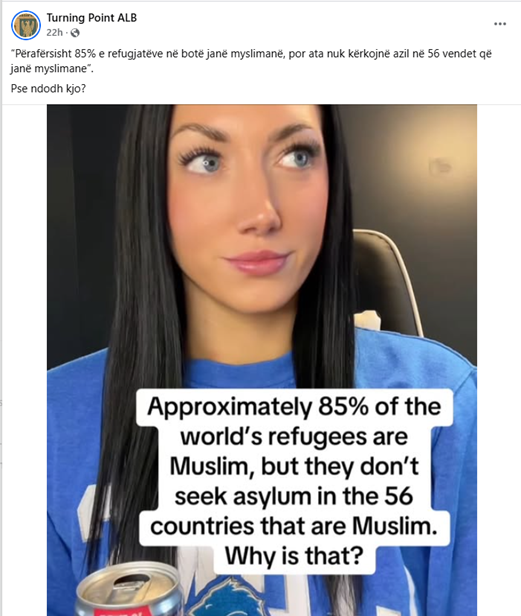
The post above does not refer to any source or statistics from which this figure was taken.
By the end of June 2025, there were 42.5 million refugees and 8.4 million asylum seekers worldwide, according to the United Nations High Commissioner for Refugees (UNHCR). For the claim that 85% of refugees are Muslims, data on the religious composition of refugees worldwide would be required.
UNHCR, the UN agency for refugees and the main source of refugee statistics, created the Refugee Data Finder, which compiles statistics on refugees. However, it does not collect data on the religious affiliations of refugees.
UNHCR obtains its data from its operations and from governments, which often do not collect data on refugees’ religion in order to protect privacy. In addition, since collecting this type of data is potentially harmful, UNHCR’s registration system collects it only if it is relevant to determining a person’s refugee status.
The Pew Research Center, which collects demographic and social characteristics of migrants, has conducted a study with data on the religious composition of migrants worldwide. It shows that 47% of all migrants are Christians and 29% are Muslims, a figure significantly lower than 85%.
However, refugees are different from migrants. While migration is often seen as a voluntary movement, refugees cannot return home and must be protected under international law. We could not find similar studies specifically for refugees.
Using the religious majority of refugees’ countries of origin, we can only roughly assess whether the claim is possible. However, Janis Kreuder from UNHCR cautions that we should “consider that not all citizens of a country have the same likelihood of becoming refugees. For example, the Rohingya refugees from Myanmar are predominantly Muslim, while Myanmar itself is a majority-Buddhist country.”
Of approximately 42.7 million refugees, 59% come from only five countries. Nearly 7 out of 10 refugees and people in need of international protection come from Syria, Afghanistan, South Sudan, Venezuela, and Ukraine.
The UNHCR Global Trends 2024 report shows that Venezuelans and Ukrainians, both from majority-Christian countries, make up a significant share of the total refugee population. Refugees from just these two countries account for 26% of all refugees monitored by UNHCR at the end of 2024. Including refugees from South Sudan, also a majority-Christian country, increases the percentage to 31%, which directly challenges the claim that 85% of the world’s refugees are Muslim.
Edgar Scrase of UNHCR writes that “given that Ukrainians and Venezuelans alone constitute nearly a third of all refugees, including other people needing international protection, the actual share of refugees who are Muslim is likely much lower.”
On the other hand, among the countries that produce most refugees, some are Muslim-majority, including Syria and Afghanistan.
It is important to stress that, according to UNHCR, there is no comprehensive data to claim that 85% of all refugees are Muslim.
As of June 2025, there were 8.42 million asylum seekers. An asylum seeker is a person who “seeks international protection from dangers in their country of origin, but whose request for refugee status has not been legally determined.”
The above post claims that Muslim refugees do not apply for asylum in “56 Muslim states.” Since there are no complete statistics for all Muslim refugees, it is not possible to determine exactly where they seek asylum. Again, only estimates based on available data can be made.
The claim likely refers to the 57 members of the Organization of Islamic Cooperation (OIC). The organization had 56 members until Syria’s membership was restored in March 2025. This group includes both countries that have declared Islam as the official state religion and countries with a Muslim-majority population.
UNHCR data from 2024 shows that in that year, Iran and Turkey, two Muslim-majority countries, hosted 6.4 million refugees (3.5 million and 2.9 million, respectively), mostly from Afghanistan and Syria. Other countries hosting large numbers of refugees included Colombia and Germany (2.8 and 2.7 million, respectively), both majority-Christian countries, followed by Uganda, Pakistan, and Chad, with the latter two being Muslim-majority.
Edgar Scrase states that at least seven of the largest host countries are predominantly Muslim (Bangladesh, Iran, Lebanon, Jordan, Turkey, Chad, and Pakistan), and together they host nearly 30% of all refugees. All these countries are members of the OIC.
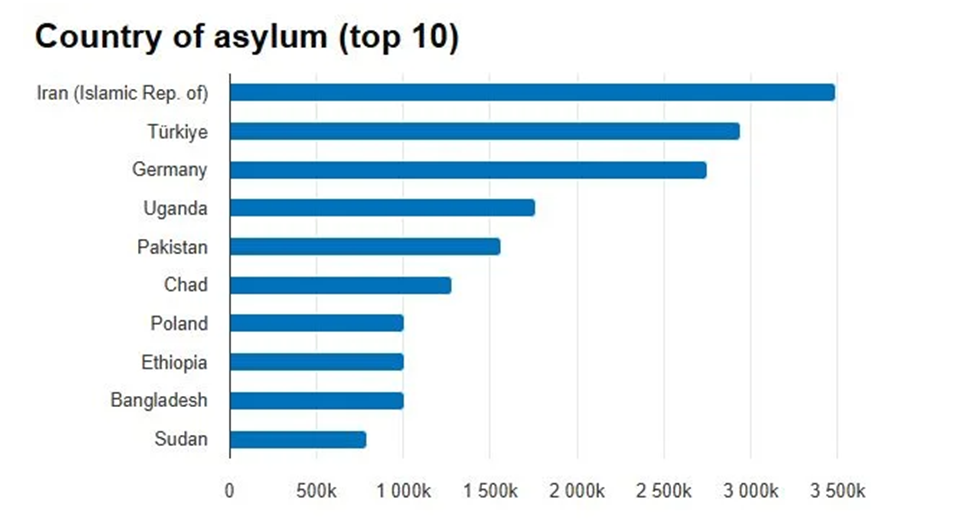
Top ten countries hosting refugees in 2024
It is important to highlight that most people fleeing conflict and persecution stay within their countries of origin. When they move abroad, they primarily go to neighboring countries. As in the previous year, by June 2025, two out of three refugees were hosted in neighboring countries.
In many cases, neighboring countries share similar religious majorities. For example, refugees from Syria, a Muslim-majority country, have mostly gone to Turkey, another Muslim-majority country. The same applies to Afghan refugees, who mainly flee to Pakistan and Iran.
Thus, Muslim refugees do apply for asylum in Muslim-majority countries, including those that are part of the OIC.