
Original article (in Montenegrin) was published on 16/1/2026; Author: Jelena Jovanović
The arrest of Nicolas Maduro, the long-time leader of Venezuela, whom the United States has charged with narco-terrorism, illegal possession of weapons, and conspiracy against the United States, is a story of global significance that has, quite expectedly, transcended the borders of South America.
Immediately after information about the arrest appeared in the media and on social networks, several photographs were published purporting to show Maduro’s arrest. However, not all of them were credible, despite the fact that at “first glance” they could indeed appear realistic and authentic to the average reader.
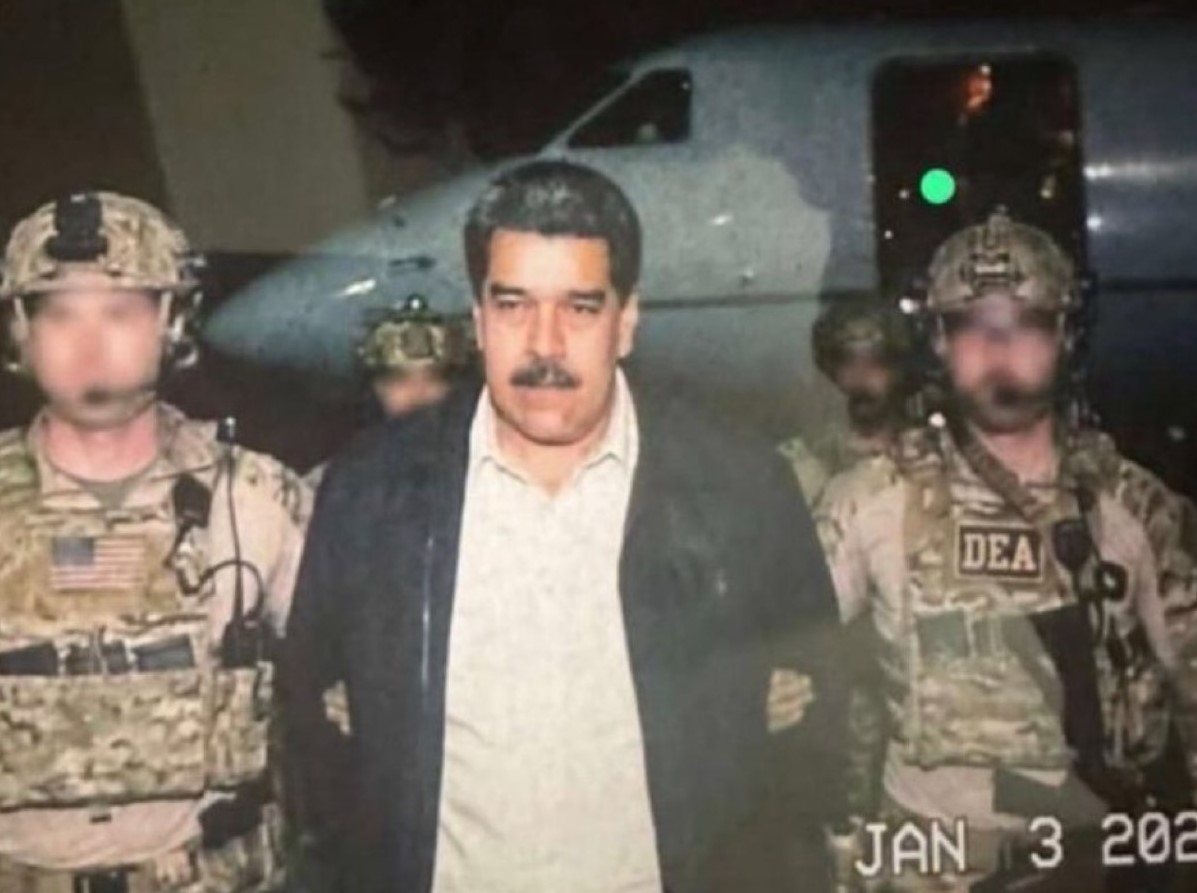
“This image should be shown to the Montenegrin Special Prosecutor, Mr. Novovic, and to the heads of the Montenegrin, supposedly reformed police, this morning,” reads, among other things, one Facebook (archived here) we identified. The post contains a photograph showing the now-deposed president of Venezuela, wearing a white shirt and a dark jacket, at the moment when he is being escorted out of an aircraft by two U.S. soldiers.
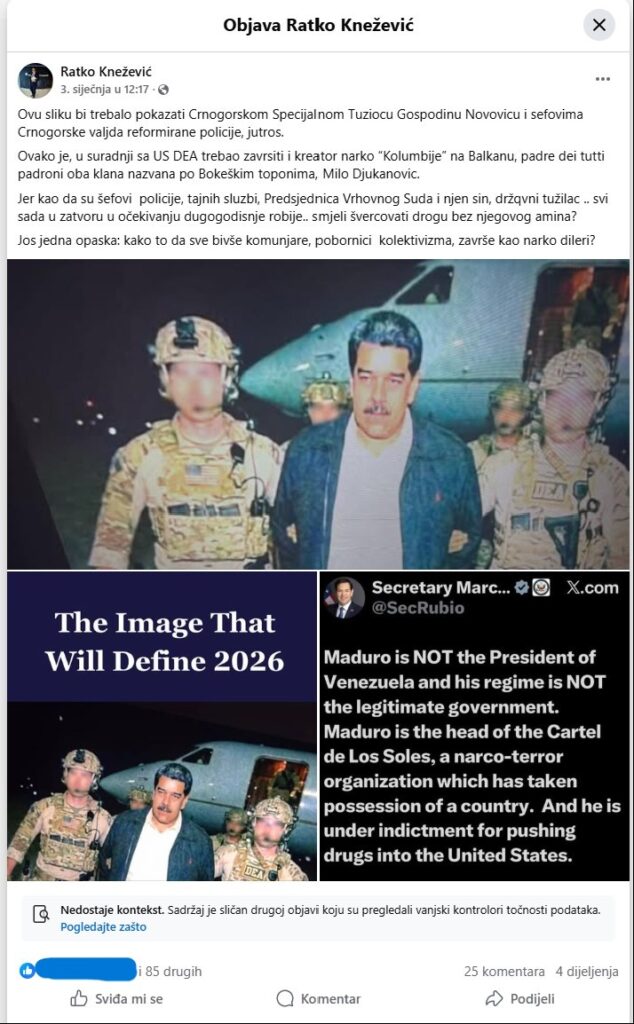
The photograph went viral on other social networks as well, in different languages, a development already covered by colleagues from fact-checking portals such as Maldita, AFP, Istinomer…
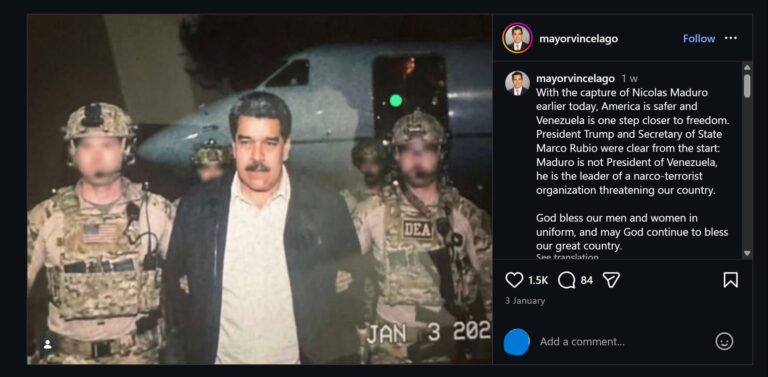
The Guardian reports (archived here) that on January 3, the photograph was also published by Vince Lago, the mayor of Coral Gables (Florida), accompanied by a comment describing the president of Venezuela as the “leader of a narco-terrorist organization that threatens our country.” Lago’s post received more than 1,500 likes and was still active at the time of writing this article.
The photograph was also published by some Montenegrin media outlets (1,2,3) (archived here: 1,2,3) with a clearly stated disclaimer that the authenticity of the image had not been confirmed.
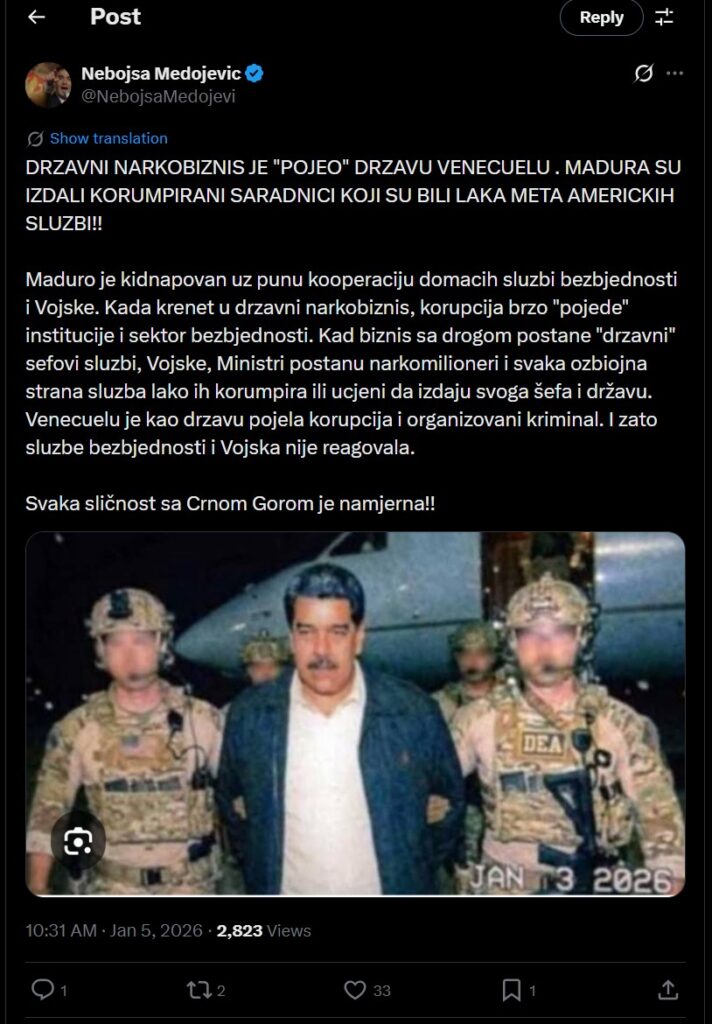
The same photograph was shared on the X (archived here) by the leader of the Movement for Changes (PzP), Nebojsa Medojevic, on his account.
As our colleagues have already established, the photograph is not real but was computer-generated, as indicated by AI-content detection tools as well as by numerous inconsistencies visible in the image itself.
In addition, the photograph was not published by any U.S. agency, official, or credible media outlet. According to online searches, it was originally shared from an account on the X platform (archived here), that is otherwise known for creating content using artificial intelligence.
“This image that I made using AI has gone viral around the world,” the account holder later wrote beneath the photograph.
AFP analyzed the image using the SynthID, tool, which assessed that “most or all of the image was generated or edited using Google AI tools, as it contains a digital SynthID watermark.”
Further evidence that the photograph is not authentic lies in the fact that it does not match an image of Maduro on a military ship, which was also published on January 3 by Donald Trump on his Truth Social account. In that image, the former leader of Venezuela looks different (he has greying hair rather than dark hair) and is wearing a tracksuit.
According to CBS News-u, unidentified sources within the U.S. military stated that Maduro was captured by Delta Force, an elite U.S. Army counter-terrorism unit, rather than by the Drug Enforcement Administration (DEA), whose insignia appears on the uniform of one of the soldiers in the disputed photograph that is the subject of this analysis.
For all of the above reasons, social media posts containing the disputed photograph are rated as fake news.
The “Fake news” rating is given to an original media report (completely produced by the media that published it) that contains factually incorrect claims or information. Content that is rated as fake news can be reliably determined to have been created and disseminated with the intent to misinform the public, that is, to present a completely false claim as fact.