
Original article (in Bosnian) was published on 15/1/2026; Author: Mladen Lakić
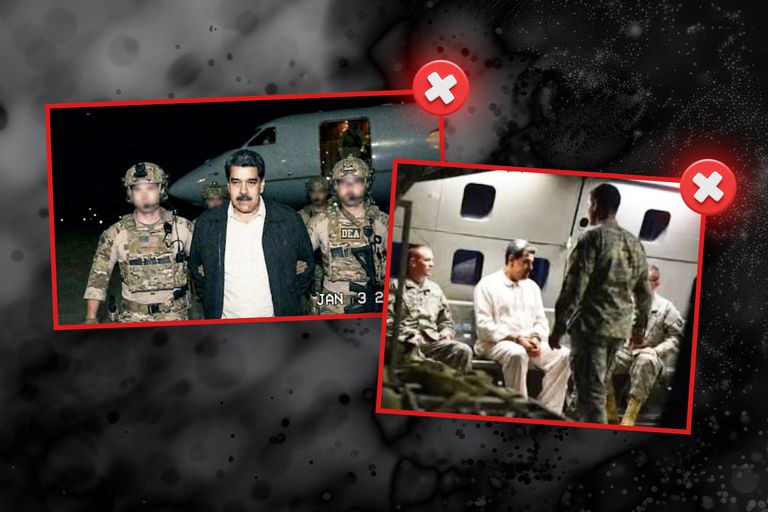
Following his arrest, fake photographs of Venezuelan President Nicolás Maduro flooded media outlets and social media worldwide. A number of websites in our language area also published them.
After the United States of America carried out a series of attacks on Venezuela on 3 January, 2026 and captured Venezuelan President Nicolás Maduro, the global media space was flooded with disinformation about these events. Among them were images generated using artificial intelligence, which spread rapidly across our language area, as well.
On the same day, numerous websites (1, 2, 3, 4) and social media platforms (1, 2) published an alleged photograph of Maduro’s arrest. The image shows the Venezuelan president being escorted by two uniformed men. In the photo, Maduro is wearing a white shirt and a dark jacket.
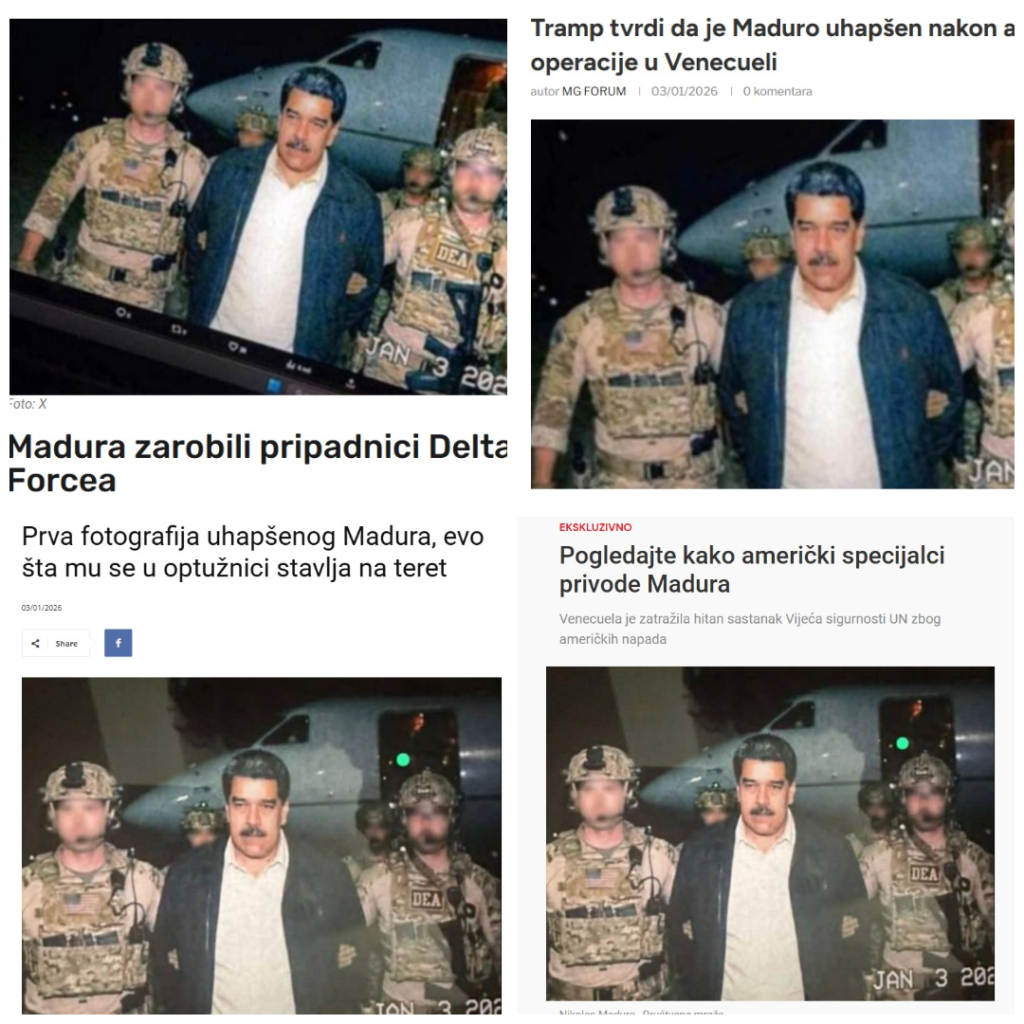
The same image can also be found in articles about events in Venezuela published in the days following Maduro’s arrest.
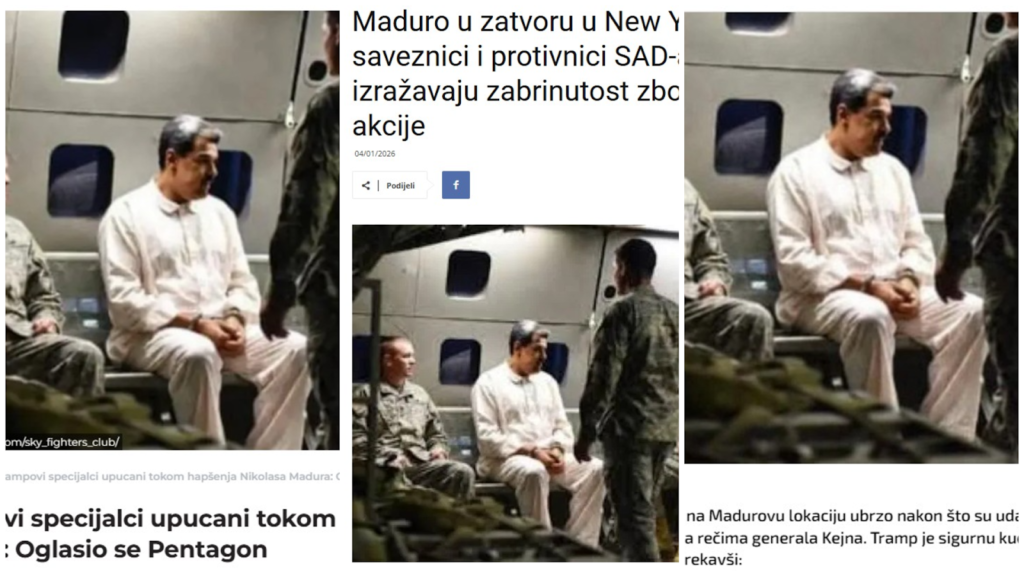
Additionally, an image showing the detained Maduro wearing a white outfit resembling pajamas has been published since 3 January in some articles (1, 2, 3) and social media posts (1, 2). According to what can be seen in this image, Maduro appears to be sitting in a military aircraft with his hands in handcuffs.
Fake Images Spread Around the World
Although they were widely circulated on websites and social media around the world, these images are not authentic. Their virality is underscored by the fact that not only fact-checking platforms (1, 2, 3), but also major media outlets such as The Guardian, The New York Times, and The Independent investigated their authenticity.
In addition to differing significantly from the first original images (1, 2), which show Maduro in a grey tracksuit during his transfer to the United States, the disputed images contain a number of indicators suggesting they were created using artificial intelligence (AI). Regarding the image in which Maduro is escorted by two men while wearing a white shirt, Google’s AI tool Gemini identifies it as an AI-generated image.
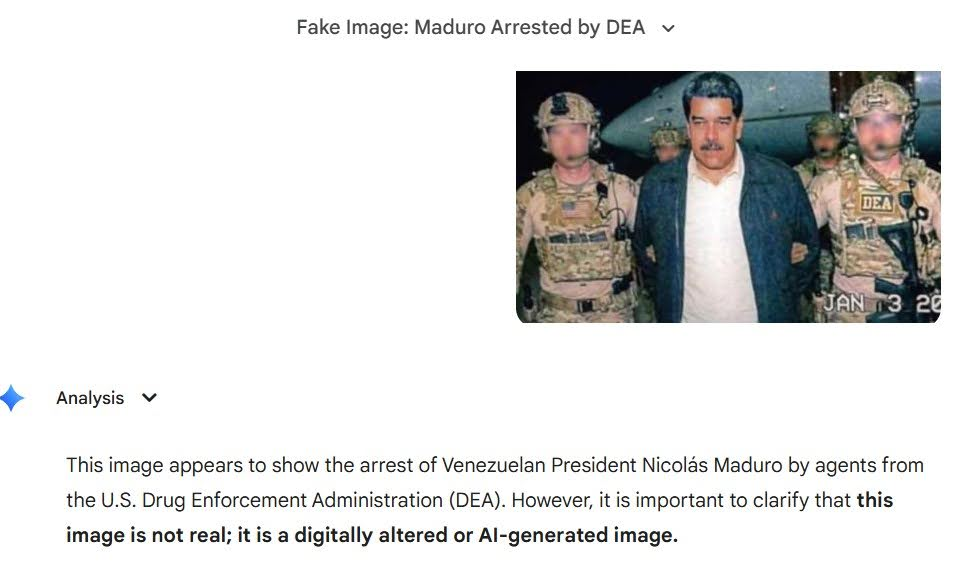
The explanation states that the image appears to show Nicolás Maduro being detained by members of the U.S. Drug Enforcement Administration (DEA), but that it is not authentic and was digitally altered or generated using AI. An analysis by the Hive Moderation tool also indicates, with a very high probability of 99.7%, that the image was created using AI.
In its analysis, Reuters notes that images of Maduro’s transfer to the United States differ from the AI-generated image, and that videos of his arrival in the U.S. on 3 January show him wearing a light blue hoodie.
Additionally, AFP reports that the earliest version of this image they were able to trace originated from a user on the X platform named Ian Weber, who later publicly admitted that he had created the image using artificial intelligence (1, 2).
A number of websites in our language area published this image while questioning its authenticity, given that it had not been confirmed that it actually depicted Nicolás Maduro (1, 2, 3, 4).
As for the alleged image of Maduro in white “pajamas”, media outlets and fact-checking platforms noted an unusual detail visible in the image – two rows of windows in the transport vehicle.
Specifically, Maduro was transferred from Caracas by helicopter to the U.S. Navy ship USS Iwo Jima, after which he was flown to the U.S. naval base at Guantánamo Bay. The BBC reports that Maduro was then transferred by government aircraft to the Stewart Air National Guard Base in New York State, and afterwards flown by helicopter to Manhattan.
On 4 January, The New York Times published an article examining the alleged first images of Maduro following his detention in detail, stating that its AI and disinformation experts identified inconsistencies in the images that suggested they might be fake. One expert, the article notes, pointed out the unusual second row of windows in the aircraft cabin visible in the viral image. Following this analysis, the newspaper decided not to publish the images in its reporting on events in Venezuela.
The platform Lead Stories, in its detailed analysis of the disputed image, states that none of the vehicles or aircraft used to transport Maduro from Caracas had two rows of windows, and that the image cannot be linked to official government channels.
According to the facts above, media articles and social media posts sharing the AI-generated image depicting Maduro with alleged DEA officers, originating from a post on the X platform, are rated as fake news spreading.
Given the global virality of the second analyzed AI image, its original source cannot be determined. Its publication in media articles and on social media as an authentic photograph is likewise rated as fake news spreading.