
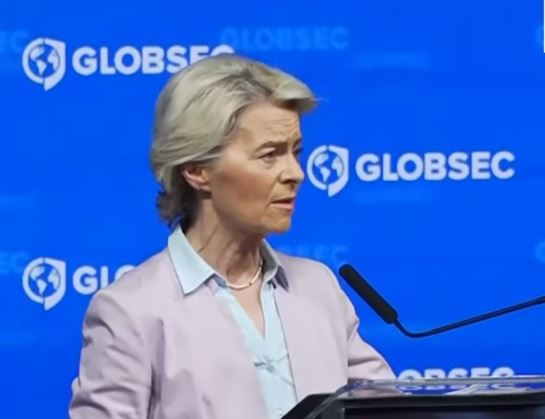
Original article (in Montenegrin) was published on 09/02/2026; Author: Nina Đuranović
European Commission President Ursula von der Leyen has continuously faced numerous accusations, some of which are based on disinformation deliberately spread to damage her credibility, confuse the public, and undermine trust in European Union institutions.
In recent days, claims have been circulating on social media (1, 2, 3, 4) (archived) alleging that the first woman to lead the European Commission plagiarized her doctoral thesis and that it was subsequently declared invalid.
“Ursula’s doctorate (from her fabricated biography) is 76% plagiarism and therefore invalid! The company where she claimed to have worked for six years denied it!”
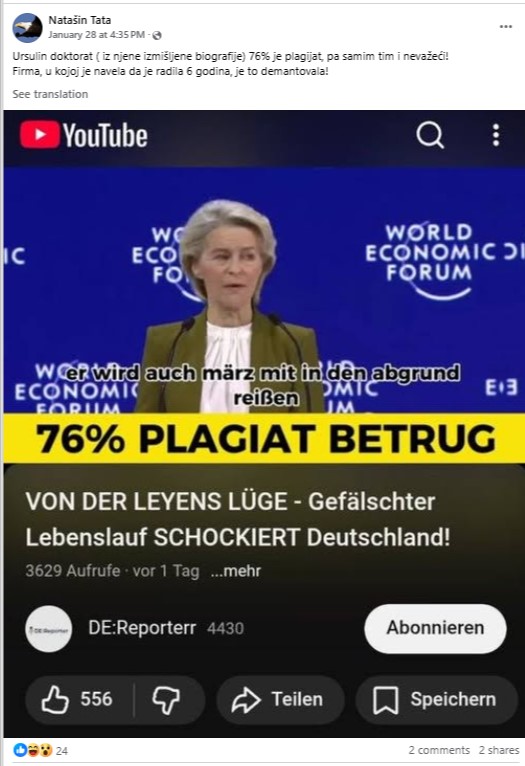
Claims regarding plagiarism in Ursula von der Leyen’s doctoral thesis date back (archived) more than a decade, to the period when she served as Germany’s Minister of Defence.
What are the facts?
Von der Leyen completed her doctoral dissertation (archived) in 1991. Her thesis was later analyzed by the German online platform VroniPlag Wiki (archived), a whistleblower-style initiative focused on uncovering plagiarism in academic works, particularly the dissertations of public figures.
The platform reported that certain sections of von der Leyen’s dissertation had been used without proper citation. According to its analysis, elements resembling plagiarism were identified on approximately 27 of the dissertation’s 62 pages, amounting to roughly 43.5% of the work.
The institution where she defended her dissertation, Hannover Medical School, conducted an official review and concluded that the thesis contained certain deficiencies but that there had been no evidence of deliberate academic fraud.
At the time, the German newspaper Welt reported on the case (archived), noting that von der Leyen’s doctorate had not been revoked.
“The deficiencies in the doctoral dissertation identified by the Commission for Good Scientific Practice at Hannover Medical School, which was responsible for conducting the investigation, are attributed to ‘careless working practices’ rather than fraudulent conduct by the young physician von der Leyen. The minister will be informed of these deficiencies in writing, and they will be explained to her. There will be no further consequences,” Welt reported.
As for the claim that her biography was fabricated, there is no evidence available online showing that von der Leyen claimed six years of employment at a company identified as “c” in her CV. Such work experience is not listed in her biography on LinkedIn (archived).
For all of the above reasons, these posts are rated as disinformation.
The “Disinformation” rating is assigned to media reports that contain a mixture of factual information and inaccurate or partially true content. In such cases, media outlets may not necessarily be aware that false information has been published alongside accurate information. This rating is also applied to reports containing false attributions or headlines that do not accurately reflect the content of the article.