Original article (in Montenegrin) was published on 11/02/2026; Author: Jovana Đurišić
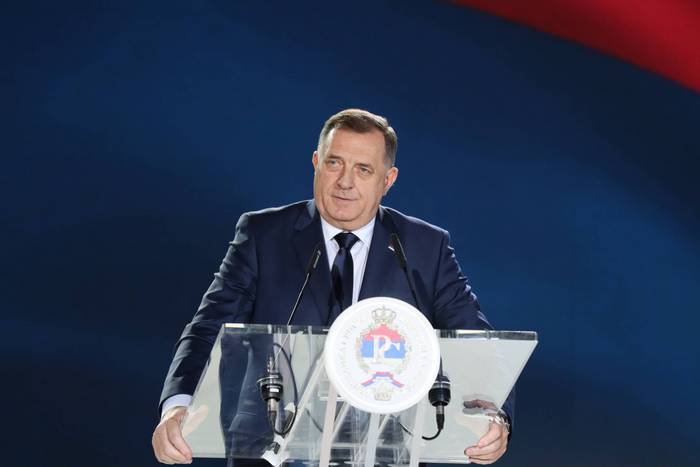
Milorad Dodik, the former president of Bosnia and Herzegovina’s entity Republika Srpska, who until recently was on the U.S. sanctions list under accusations of corruption and promoting separatism that threatens renewed ethnic conflict in the Balkans, was recently a guest at the White House once again.
During his stay in the United States last week, Dodik posed for photographs with American officials and gave interviews to U.S. media outlets. He was also featured in the American newspaper The Washington Times, where the Bosnian Serb leader issued a statement subsequently republished by several pro-Serbian media outlets in the region.
Articles published by the portals Borba (archived) and IN4S (archived) carried the headlines:
The Washington Times: Republika Srpska Deserves Independence
Message from Washington: Republika Srpska Deserves Independence
The same article was also republished by Sputnik (archived).
However, although these headlines create the impression that Republika Srpska’s independence is the position of either official Washington or The Washington Times, that is not the case.
In the article “Republika Srpska Deserves Independence”, published by The Washington Times and written by journalist Anat Hartman, Dodik is quoted extensively in a statement he gave to the newspaper, in which he repeatedly speaks about independence.
“In the predominantly Muslim areas [of Republika Srpska], local police cannot even enter,” Mr Dodik said. “They are not allowed to arrest these extremists.”
The article continues:
“That is the main reason,” Mr Dodik said, “why Republika Srpska’s independence must come soon.”
Later in the article, Republika Srpska’s independence is again discussed through direct quotations from Dodik:
“We have lost too much to rely on any kind of dialogue.
…Therefore, we will soon make an important assessment with our friends [regarding independence]. Without a state, there is no freedom.”
The article further quotes him as saying:
“It is time for the republic to affirm its right to self-determination,” he told us.
“There comes a moment in international relations when [talks] no longer work,” he said. “With independence, everyone would be at peace. No one would be able to impose anything on others. We have never tried to live alongside one another. Let us make our own decisions. President Trump’s term is our opportunity for independence.”
Therefore, every section of the article that mentions the independence of Republika Srpska consists exclusively of Dodik’s own statements. It is neither the position of the article’s author nor, even less, the position of Washington, as some regional media outlets portrayed it.
For that reason, the above-mentioned articles are rated as manipulation of facts and clickbait.
The “Manipulation of Facts” rating is given to a media report that uses known and accurate facts but interprets them in a deceptive manner. These reports generally employ accurate information to draw incorrect conclusions or claims, leading media consumers to draw conclusions that differ from the actual meaning of the presented facts.
The “Clickbait” rating is given to a media report whose title has no grounds in the article that follows. Such articles and features aim to attract the attention of the consumer with a sensational title, promising content that does not actually. Such reports are mostly motivated by financial interest, i.e., to increase readership.
Edit: 24 February 2026
The portal Borba published a correction to its original article, clearly adhering to professional journalistic ethics and retracting the original claims. As a result, the article has been assigned the rating “Corrected”. This rating is given in cases where the media outlet establishes that the content it has published falls under one of the above-described negative ratings and then proceeds to correct it in a clear and visible way, per the principles of publishing corrections.