
Original article (in Albanian) was published on 05/03/2026; Author: Patris Pustina
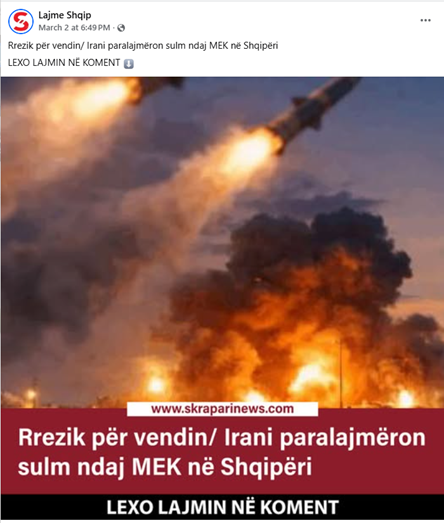
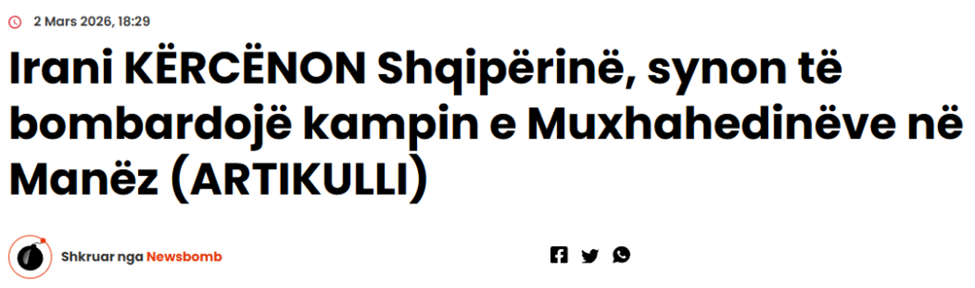
On March 2, 2026, Albanian media were involved in panic over the country supposedly being within the range of Iran’s retaliatory missiles. Headlines such as “Danger for the country/Iran warns of attack on MEK in Albania” appeared on various portals headlines, sometimes citing “foreign media,” other times “Azerbaijani media,” and sometimes without any source at all.
This entire panic campaign originated from a single article published on March 2 on the Azerbaijani fringe portal Caliber.az, titled “Iran’s IRGC may strike the Mujahedin base in Albania.”
Most of the Azerbaijani media piece is devoted to a description and history of the Mujahedin organization, introduced by only three sentences:
“Amid rising regional tensions, it is reported that the possibility of an Iranian attack on the headquarters of the ‘Monafeqin’, the People’s Mujahedin Organization of Iran (MEK), located at the Ashraf-3 base in Albania, is being considered. The press service of the Islamic Revolutionary Guard Corps (IRGC) said on Telegram that the potential actions reportedly involve a structure that Tehran considers connected to ‘hostile activities.’ Some sources, referring to recent Iranian strikes on targets in Cyprus, claim that Iran is no longer limiting itself geographically when targeting centers associated with its opponents and is expanding the operational scope of its capabilities beyond the region.”
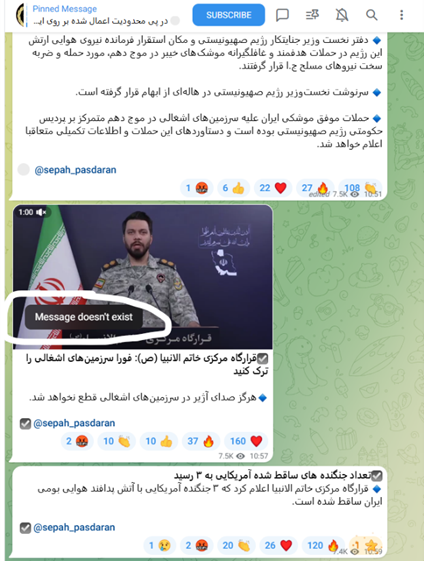
The only verifiable source in the article is the statement allegedly published on Telegram by the IRGC. The link provided by the author does lead to a Telegram channel named @sepah_pasdaran.
However, the purported statement seems not to exist, or at least is no longer available.
Faktoje also reached out to the article’s author, Khagan Isayev, about the sources behind this claim.
In his reply, Mr. Isayev confirmed that the cited post did indeed mention Albania. However, he also stated that, upon rechecking, it appeared the statement cited in the article “seems to have been deleted for a reason we do not know.” Unfortunately, he admitted that he had not taken a screenshot of the statement before it was removed.
Mr. Isayev further acknowledged that “we relied solely on this source when publishing, not on any other source.”
Therefore, the only source requires closer examination.
A review of the Telegram channel uncovers an interesting detail. While it carries the name Sepah Pasdaran, an alternative name for the IRGC, and features the Revolutionary Guard’s logo, the channel description states: “This is personal and updated by supporters.”
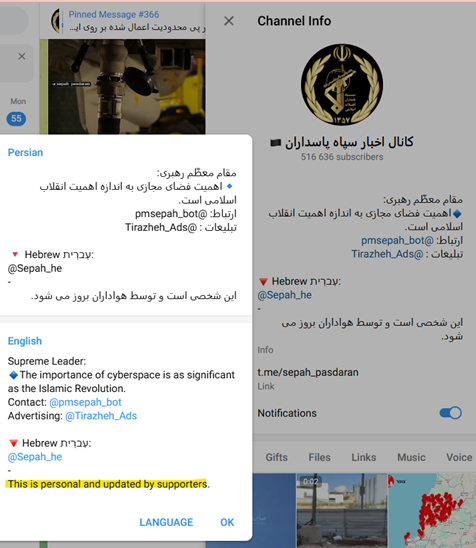
In fact, this channel, among others, was described by the BBC in 2025 as “unofficial channels linked to the IRGC” that “appear to be operated by supporters and administrators connected to the IRGC, sharing news and propaganda about the Guard.”
Moreover, in August 2025, the Iranian news agency Mehr reported that the IRGC Public Relations Department announced it had opened official social media accounts for the first time.
The announcement listed the official accounts on Telegram (@sepahneësir403) and X, as well as on domestic Iranian platforms. Significantly for our case, it confirmed that none of the other social media channels with the title ‘Sepah’ or similar names are official IRGC media and cannot be cited to represent the Guard’s positions.
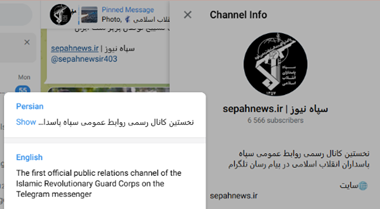
Official IRGC Telegram channel, @sepahneësir403
According to the BBC, “some international and local media have mistakenly referred to these [unofficial Telegram channels with names containing ‘Sepah’] as ‘official’ in certain cases in the past. Many believed that the Corps had intentionally maintained ambiguity around its communications and propaganda.”
Thus, the Telegram channel cited as the IRGC “press service” by the Azerbaijani article is actually an unofficial channel.
It is also important to note that Albania is a NATO member.
Article 5 of the North Atlantic Treaty provides:
“The Parties agree that an armed attack against one or more of them in Europe or North America shall be considered an attack against all of them, and consequently, they agree that if such an attack occurs, each of them, in exercising the right of individual or collective self-defense recognized by Article 51 of the United Nations Charter, will assist the Party or Parties so attacked by taking immediately, individually and in concert with the other Parties, such action as it deems necessary, including the use of armed forces, to restore and maintain the security of the North Atlantic area.
Any such armed attack and all measures taken as a result shall be immediately reported to the Security Council. These measures shall end once the Security Council has taken the measures necessary to restore and maintain international peace and security.”
The principle of collective self-defense, intended to prevent the Soviet Union’s expansion in Eastern Europe, was one of the main reasons NATO was established in 1949. Article 5 of the Treaty was first invoked after the terrorist attacks of September 11, 2001, in the United States. Once the North Atlantic Council was informed that the attack originated from abroad, consultations among the allies took place, and the Council decided on collective action.
According to this article, an Iranian missile strike against the MEK camp on Albanian soil would be considered an attack against all 30 NATO member states and would trigger a response from the most heavily armed organization in history.
In a more detailed article, security and national affairs experts told Faktoje that the likelihood of an Iranian attack is negligible, and there is no cause for alarm.
In the summer of 2022, Faktoje also debunked a similar claim about missile and drone attacks from Iran targeting the MEK camp in Manëz.