
Original article (in Serbian) was published on 11/3/2026; Author: Stefan Kosanović
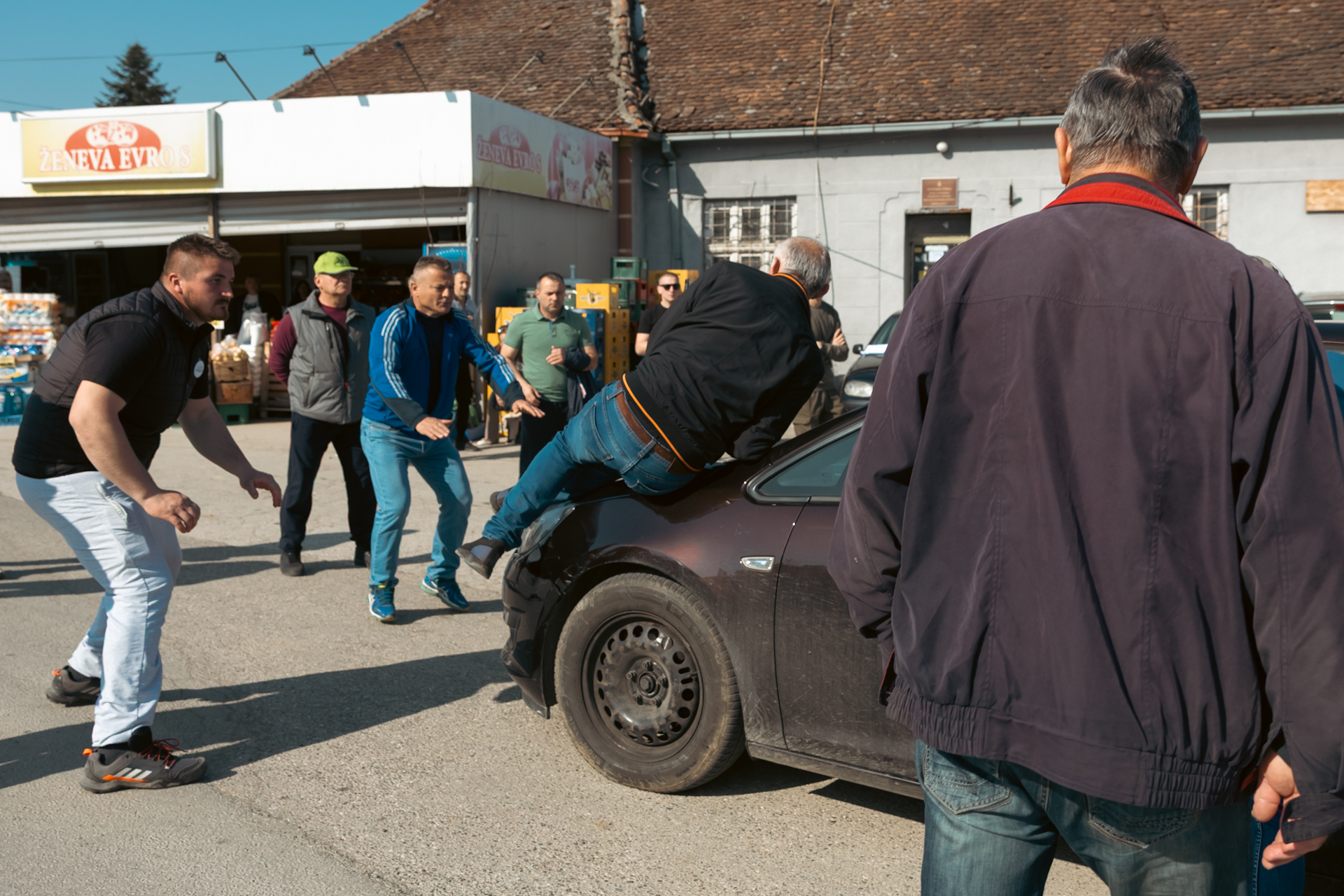
A manipulative surveillance camera clip from Brezjak, a small village near Loznica in western Serbia, showing a group of agitated people trying to stop a car, was published by several pro-government tabloids with claims that “blockaders are lynching a pensioner neighbor” and “jumping on his hood.” Crucially, the clip was edited to omit the footage showing the driver deliberately ramming into the gathered crowd — and the articles make no mention that the scene took place during a farmers’ protest. Photojournalist Gavrilo Andrić, who was present and documented the entire incident, told fact-checking outlet Raskrikavanje that the car had bypassed the tractors forming the blockade, drove into the crowd, and lifted at least one person onto its hood.
Three days had passed since Women’s Day — the day that symbolically marks the struggle for gender equality. On that day in Brezjak, near Loznica, people were fighting for something else: justice, as they put it, for the arrested and detained farmers.
Serbian farmers who had been blocking roads for days, dissatisfied with conditions in agriculture, were arrested, and some were remanded in custody for up to 30 days. Among those arrested was Zlatko Kokanović, who has for years been a regular target of tabloids due to his activist efforts to prevent lithium mining in the Jadar valley.
Three days later, the pro-regime tabloids Alo, Informer, Novosti, NSuživo, Republika, Kurir, and Politika published a surveillance camera clip from Brezjak showing a group of people stopping a car. Even as it enters the frame, it is clear that some individuals have ended up on the car’s hood.
The articles claim that “a group of fascist blockaders attacked a man” — identifying the driver only as a pensioner near the village of Gornje Nedeljice, and noting that his wife was also in the car.
Alo further writes that “the blockaders savagely jumped on the man’s car,” and that the attacked pensioner is a neighbor of the “blockaders” who attacked him.
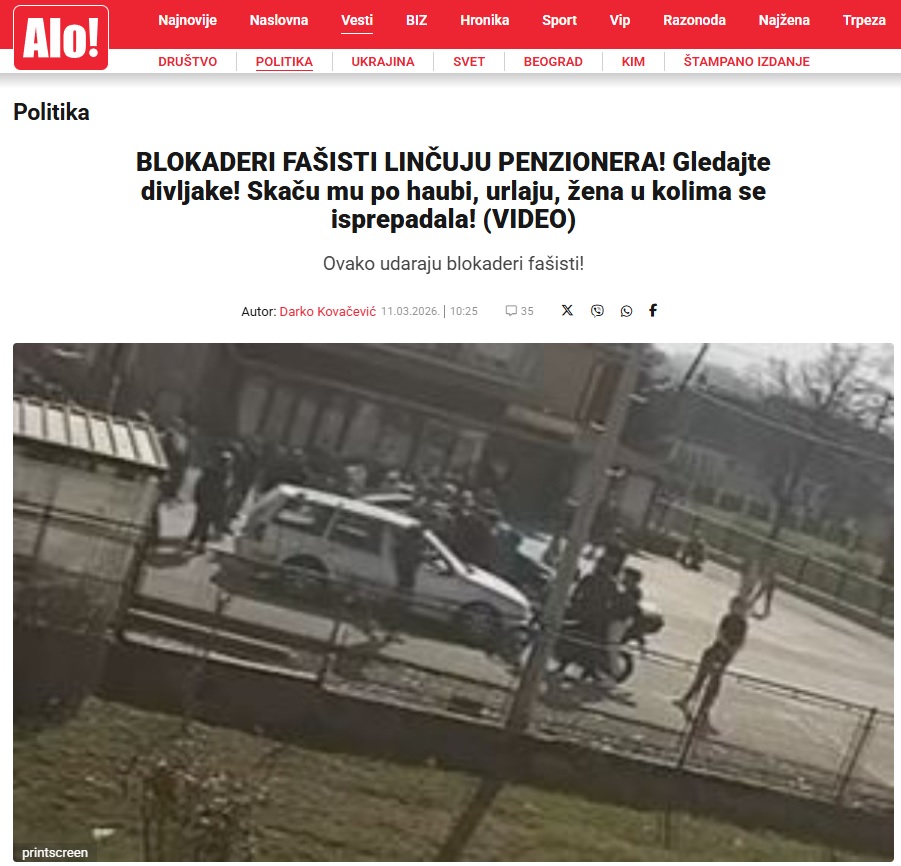
Photo: Screenshot of an article on the Alo website showing part of footage from a surveillance camera
However, this tabloid at no point mentions that an announced blockade was in place on that road that day, nor the fact that the pensioner drove his car through the blockade and into the gathered crowd, which included children.
Photojournalist Gavrilo Andrić was covering the blockade in Brezjak that day and managed to capture the entire incident through his lens.
Andrić told Raskrikavanje that the blockades were clearly set up, with tractors parked across the full width of the road. According to him, the car in the footage bypassed the tractors by driving through the grass beside the road, and at one point even damaged his own vehicle by scraping a fence or wall that was there.
“He drove into the crowd and in doing so picked up at least one person on his hood. I have a photograph where this is clearly visible, and where you can also clearly see that part of the group standing in front of the car is in a very relaxed posture — simply because people didn’t expect someone to come flying through like that. I froze for a moment because there were children around and people sitting in chairs in the middle of the road,” Andrić explained.
Notably, the clip published by the tabloids appears to be incomplete. In the upper right corner, the full timestamp — which surveillance cameras normally record — is not visible, suggesting the footage was subsequently cropped or covered with a black frame. That very portion of the clip would have shown the segment of the road where the driver bypassed the blockade and drove into the crowd.
Andrić states that the driver carried a man on the hood for several dozen meters, along with several other people he hit along the way. According to him, the gathered crowd first shouted at him to stop, and then demanded he turn off the engine, since the blockade had two ends and there was nowhere to go past the second row of tractors.
“The man who got out of the car at one point — the older man — was constantly threatening people, getting in their faces, poking them in the chest with his finger, and so on. He was swearing and very explicitly provoking people with insults, daring them that ‘they wouldn’t dare hit him.’ He went from person to person — as each one told him it certainly wouldn’t come to that, he’d move on to the next, going around in circles, goading them to hit him — and this went on for a very long time,” Andrić said.
Activists from the Ne damo Jadar (We Won’t Give Up Jadar) association confirmed Andrić’s account.
Nebojša Petković, speaking on behalf of the organization, said he had seen the tabloid articles and that the clip in them was taken from a nearby school’s surveillance camera, but that it does not show what actually happened immediately before the incident.
He noted that none of those present managed to film the actual moment the blockade was breached, as everything happened very quickly and people were trying to get out of the way of the car and avoid injury.
Photographer Gavrilo Andrić also noted that police were not near the blockade and were called afterward. When they arrived, officers also had difficulty calming the driver down, and one of Andrić’s photographs shows the man poking a police officer in the chest with his finger.
Locals told Andrić that the man was known to them, as he is a local resident, and that roughly two years ago he had similarly driven through a blockade and threatened people in the same manner.
“Then two men appeared who identified themselves as plainclothes police officers, and they asked for the tractors to be moved so the vehicle could be towed — but completely unbelievably, the man who had driven through the crowd was allowed to sit back in his car and drive. No breathalyzer test was administered, no on-site investigation was conducted,” Andrić told Raskrikavanje.
When he asked the officers how it was possible that no investigation was conducted, they told him that a prosecutor from the Higher Public Prosecutor’s Office (VJT) in Šabac had classified the offense differently and that an on-site investigation was not required. When asked what offense that was, they replied that the prosecutor knew.
Raskrikavanje called the VJT in Šabac multiple times during their working hours; however, no one answered the official phone number.