
Authors: Ivan Subotić (FakeNews Tragač), Milica Ljubičić (Raskrikavanje.rs), Emir Zulejhić (Raskrinkavanje.ba)
When thousands of citizens took to the streets of Serbian cities in November 2024, demanding accountability for the collapse of a canopy at the Novi Sad railway station that killed 16 people, pro-government media largely ignored their demands. Instead, they wrote about Maidan and “color revolutions.” This is no coincidence. Pro-Kremlin propaganda has spent years systematically building a vocabulary designed to delegitimize any civic unrest as a foreign conspiracy and to frame every documented atrocity as a staged provocation. In doing so, the Kremlin exports ready-made playbooks for authoritarian regimes to suppress civic resistance, while recycling narratives already proven false decades ago to deny the crimes being committed in Ukraine today.
The collapse of the canopy at the recently renovated railway station in Novi Sad on November 1, 2024, which killed a total of 16 people, triggered mass civic protests across Serbia that continued throughout 2025.
After the tragedy, citizens took to the streets for days at the exact time of the accident, 11:52 a.m., silently blocking traffic in tribute to the victims. Further blockades and mass protests were fueled by an incident that occurred during one such gathering. A group of men, close to the ruling Serbian Progressive Party, physically attacked students and professors from the Faculty of Dramatic Arts (FDU) in Belgrade during a vigil for the victims. Due to the institutions’ failure to react, students from the FDU first blockaded their faculty, followed by many other faculties joining in solidarity.
In addition to demanding that those responsible for attacking FDU students be identified, the students also demanded that the authorities publish the full documentation regarding the reconstruction of the Novi Sad railway station – which had been renovated just months before the collapse – and that those responsible for the tragedy be held accountable. They presented four demands to the authorities, and since these had not been met even six months later, the students called for early parliamentary elections in Serbia.
All of this led to a series of protests involving hundreds of thousands of people. Police responded with brutality on multiple occasions, using tear gas and beating demonstrators.
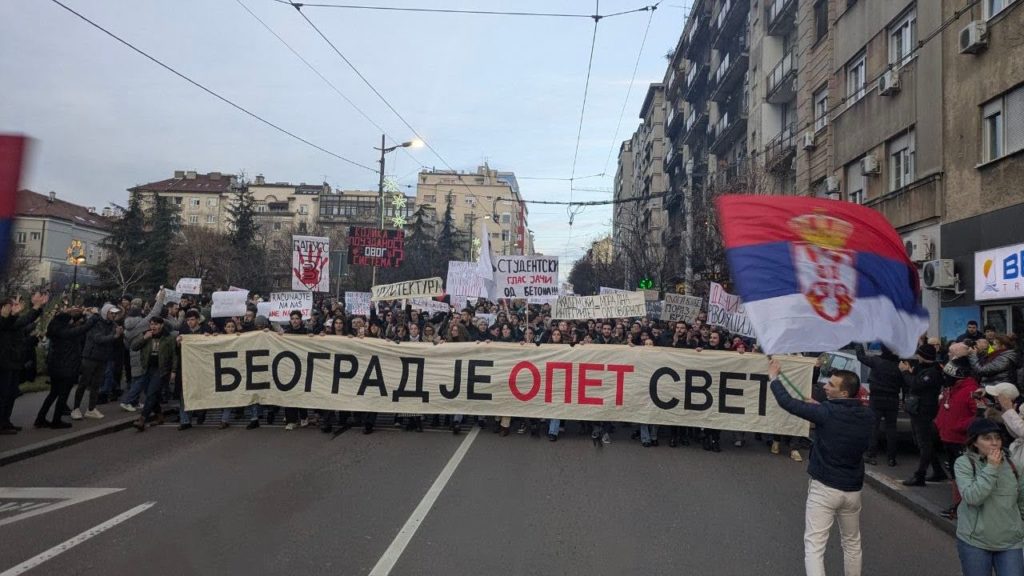
The first mass student protest in Serbia, December 2024; Photo: FakeNews Tragač
These facts and the reality in which Serbian citizens have lived since November 2024 have not been presented this way in a large number of mainstream media outlets in Serbia, which maintain a strongly pro-government editorial stance. For years, they have served as key allies of the authorities in maintaining political power. In return, these media outlets receive significant budget funding that enables them to survive in Serbia’s extremely weak advertising market.
As expected, these influential tabloids and pro-government media have taken a negative stance toward the protests from the very beginning, labeling students and citizens as “blockaders,” accusing them of cooperating with foreign intelligence services, and claiming that the protests are orchestrated from the West in order to “weaken Serbia,” led by President Aleksandar Vučić.
Over the past year, they have repeatedly claimed that a “Maidan” is taking place in Serbia, modeled after the events in Ukraine in 2014, when a wave of protests led to the removal of an undemocratic government. However, in Russian media, Maidan is portrayed negatively as a “tragic event,” with insistence that the government was removed illegitimately and that the “bloody Maidan” was orchestrated by the West.
What is Maidan?
Maidan is a symbolic name for two waves of protests that took place in Kyiv a decade apart, during which the pro-Russian-oriented president Viktor Yanukovych was removed from power. “Maidan” itself means “square” in Ukrainian.
The first, the so-called “Orange Maidan,” took place in Ukraine in 2004 and lasted for two months. After street demonstrations, the pro-Western politician Viktor Yushchenko replaced Yanukovych as president of Ukraine. He advocated strengthening the Ukrainian language and culture, as well as Ukraine’s accession to NATO and the European Union.
The second wave of protests, better known as Euromaidan, took place a decade later in Kyiv in 2014. Viktor Yanukovych was re-elected president of Ukraine in 2010, after which he halted Ukraine’s European integration and turned toward Moscow, which sparked large demonstrations.
The immediate trigger for the protests was Yanukovych’s decision to postpone signing the Association Agreement with the European Union.
The protests lasted for several months, during which the Ukrainian parliament adopted a package of laws restricting citizens’ right to protest. Demonstrations became massive in February 2014, and violence between protesters and police escalated. Dozens of protesters were killed. In February 2014, Yanukovych fled to Russia.
On February 24, Ukraine’s interim government charged him with mass murder in connection with the deaths of protesters at Maidan and issued a warrant for his arrest.
After Yanukovych fled, divers found thousands of discarded documents in a lake near his luxurious residence, Mezhyhirya, revealing the scale of corruption during his rule. Journalists recovered, dried, and published the documents on the website “YanukovychLeaks,” exposing numerous scandals, luxury properties linked to Yanukovych and his associates, as well as project plans that would have further burdened Ukrainian citizens. The documents also showed that, by the end of 2013, state authorities had been monitoring activists and protesters.
“Color Revolution” and Maidan in Serbian Media
It is precisely in this context that the authorities in Serbia present it, with the aim of delegitimizing the student protests and portraying students as “foreign mercenaries” who receive money from the West with the intention of destroying Serbia and its development.
Over the past year and a half in Serbia, the term “color revolution” has been widely used-a term that is also used in Russia to delegitimize civic protests. Vladimir Putin defined this term back in 2012 as “an instrument and method for achieving foreign policy goals without the use of weapons-primarily through informational and other levers of influence.” The term “color revolution” was also included in Russia’s National Security Strategy in 2015, where it was described as a threat to state security.
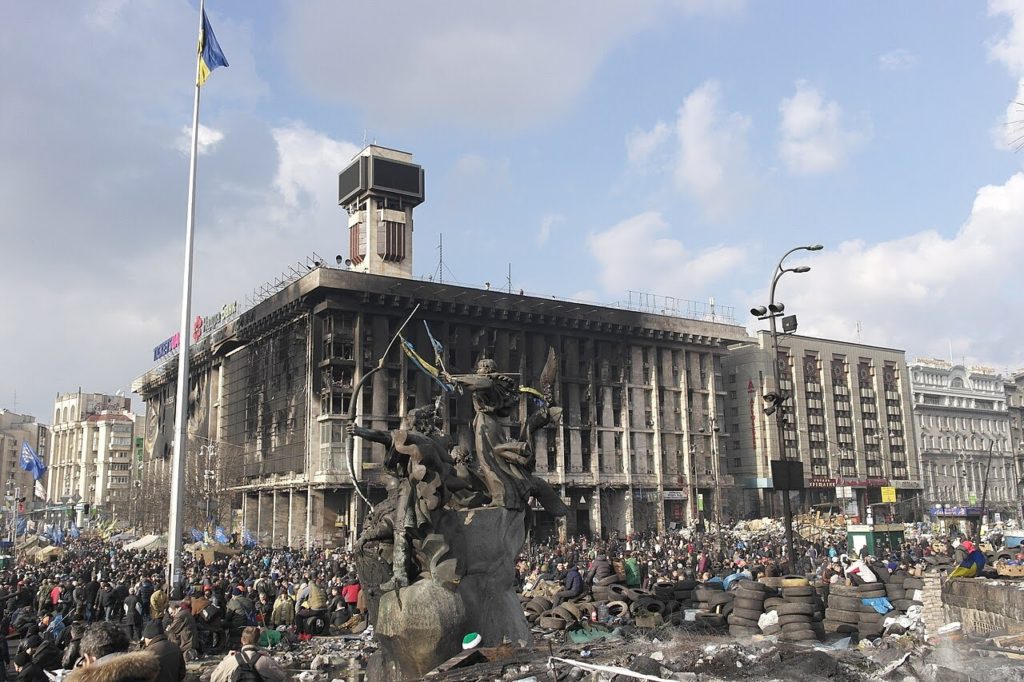
Independence Square in Kyiv during the Maidan, February 2014; Photo: Kiyanka/Wikimedia
However, when ruling structures use the term “color revolution” for civic protests or claim that the opposition and rebelling citizens are calling for a new, Serbian Maidan, what exactly do they mean?
Unlike Putin’s definition, according to the Cambridge Dictionary blog, the term “color revolution” emerged from the need to soften the word “revolution,” which typically implies a violent overthrow, in cases of political change that occurred through nonviolent protests in various countries.
On the other hand, pro-government tabloids in Serbia tend to define the term “color revolution” more in line with Putin’s formulation. They interpret it as an attempt to change government through protests orchestrated by Western powers. Additionally, often to spread fear, they include comparisons with Ukraine’s Maidan, during which dozens of demonstrators were killed.
This aligns with the official Russian stance.
In September last year, Russia’s Foreign Intelligence Service announced that, on the anniversary of the Novi Sad canopy collapse, the European Union was preparing a Maidan in Serbia. This was denied by Brussels.
Importing Pro-Kremlin Propaganda into Serbia
If we dig through media archives, we can find reports in which various protests in Serbia are labeled as “color revolutions” or new Maidans. During the rule of the Serbian Progressive Party, the first larger protests-triggered by the illegal demolition of a neighborhood in Belgrade-began in 2016 and were soon characterized as being instrumentalized by the West. The following year, after the presidential elections won by current president Aleksandar Vučić, protests broke out that were colloquially called the “protest against dictatorship.” These too were quickly labeled a “color revolution” in pro-government media.
What is interesting is that among the earliest mentions of “color revolutions” in Serbia, and of Western influence in the context of protests, these terms did not initially come from local officials. As early as 2016, the spokesperson of the Russian Ministry of Foreign Affairs stated that the protests in Serbia were backed by the United States, and the pro-government tabloid Informer reported that the Russian official claimed that “Western security services” were boldly and deliberately pushing Serbia into a color revolution. The following year, then Russian Defense Minister Sergey Shoigu said at a meeting with Serbia’s then Defense Minister Zoran Đorđević that “no one thinks they can just attack the Serbs and stage color revolutions in Belgrade following the Ukrainian model.”
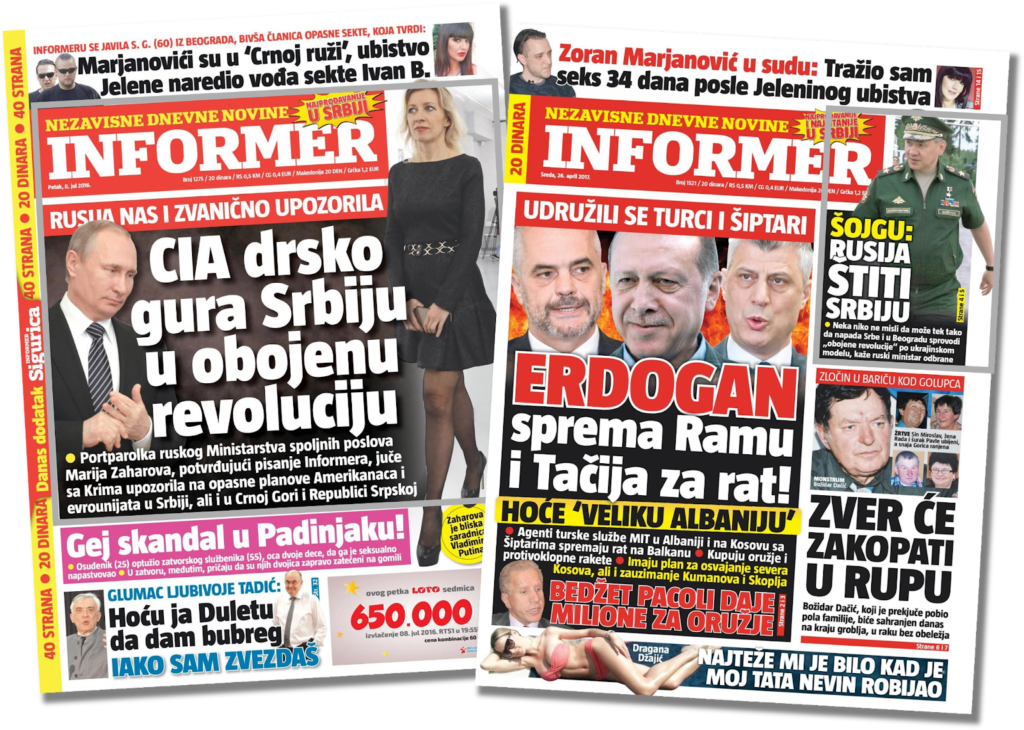
Informer reports that a ‘color revolution’ is being organized in Serbia, citing Russian officials in 2016 and 2017.
After these statements, mentions of the so-called “color revolution” in Serbian pro-regime tabloids became increasingly frequent. In a 2017 column, the editor-in-chief of the notorious Informer wrote that the opposition in Serbia would attempt to carry out a color revolution. That same year, President Aleksandar Vučić stated that he would remain in power until he was overthrown by some color revolution. The following year, politicians close to the government explained in pro-regime newspapers that the opposition was hoping for a “new color revolution, coups, and bloody overthrows.” Later, the pro-government tabloid Alo wrote about the peaceful protests of 2019, claiming that the opposition was preparing a “Ukrainian scenario” and a “Maidan in Belgrade,” alluding to the large number of casualties during the Ukrainian protests. Claims that the opposition or protesting citizens were seeking a color revolution were repeated by pro-government tabloids, analysts close to the authorities, and state officials in 2020, 2021, 2022, and 2023.
Year after year, the number of mentions of “color revolution” or Maidan in Serbia-when referring to specific protests-continued to grow, and in the past year and a half, its use has escalated to unprecedented levels. It is evident that this terminology entered the domestic discourse through Russian officials commenting on civic protests in Serbia.
Over the past decade, rising civic unrest and public dissatisfaction in Serbia have been accompanied by an increased use of pro-Kremlin propagandistic language by government officials, as well as in aligned media and among sympathetic analysts.
In this way, domestic propaganda portrays a “color revolution” as violent protests driven by foreign actors. This framing delegitimizes demonstrators as “foreign mercenaries” attempting to create chaos in the country. Through comparisons with Ukraine, it is implied that if Serbia were to follow the path of a “color revolution” (as understood by ruling elites), it could first experience protests involving casualties in the streets, followed by a potential war. The use of these terms and comparisons spreads fear among citizens and encourages the passivity of civic activism.
Why does the government resort to the “color revolution” narrative?
Framing protests in Serbia with Maidan is not a spontaneous reaction, but a clearly established strategy. The government does this for several reasons, primarily to impose its own narrative and control what is being discussed. It does not want attention focused on the reasons why people are in the streets, but rather on who is allegedly behind them.
Instead of addressing concrete demands, institutional accountability, the media, and elections, public attention is diverted to narratives about “color revolutions,” foreign centers of power, and potential violence.
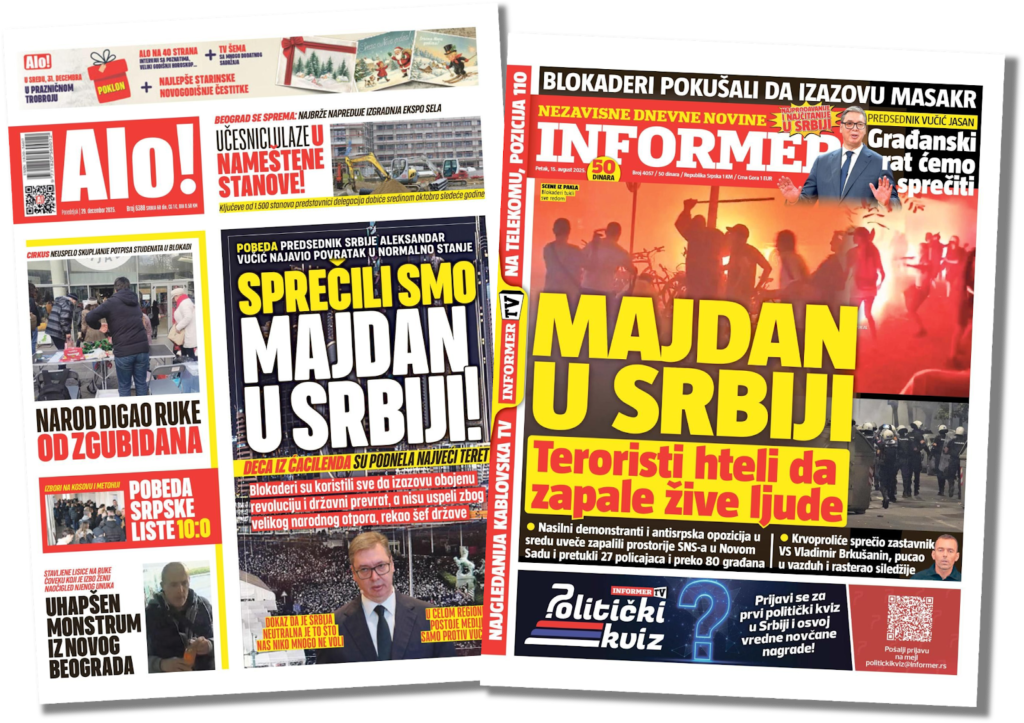
“Tabloids Alo and Informer label the protests as a ‘Maidan in Serbia’ on their front pages (2025).
As already mentioned, this framework has been adopted from the Russian propaganda machinery, where for years almost every form of public dissatisfaction has been interpreted as externally orchestrated destabilization. In other words, authorities, often authoritarian, that rely on this narrative deny that citizens can have genuine grievances; instead, they portray any protest as the work of external actors.
At the same time, this narrative targets the ruling party’s core voters, fostering fear of chaos that only the party claims it can contain.
Tabloid Hunt for Similarities Between Student Protests in Serbia and Maidan in Ukraine
Tires and containers
One of the largest protests in Serbia during 2025 took place in Belgrade on June 28. In the days that followed, the police began detaining students from various faculties and citizens suspected of being responsible for unrest during those protests. This prompted citizens in Belgrade to begin blocking major streets and intersections in support of those detained.
At that time, citizens used dumpsters, metal fences, and car tires to set up barricades. Precisely because of this, some pro-government tabloids claimed that citizens “want a Maidan in Belgrade.”
As the main argument for a connection between Euromaidan, which culminated in the overthrow of Viktor Yanukovych in Ukraine, and the current blockades in Serbia, the tabloid Srpski telegraf used photographs showing a few car tires and fences on the streets.
“Piles of car tires on the streets, barricades, the setting up of fences-already seen during the coup in Ukraine in 2014,” wrote Srpski telegraf on July 1, 2025.
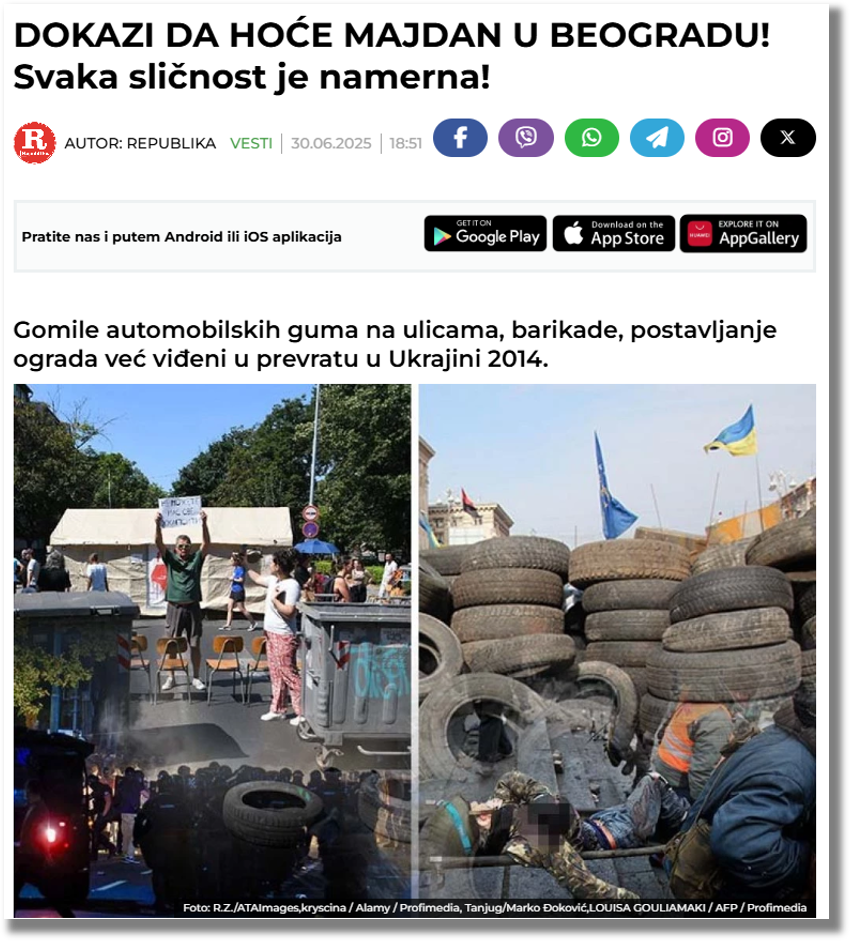
Alleged evidence from Serbian tabloids that protesters ‘want a Maidan in Belgrade’ (2025).
However, the use of dumpsters and car tires was not unique to the blockades in Serbia or to Maidan in 2014. For example, in Lebanon in 2021, protesters burned car tires in the streets to block traffic and express dissatisfaction with the economic crisis.
During protests in Catalonia in 2019, which erupted after sentences were handed down to separatist leaders, demonstrators burned dumpsters in the streets, and similar scenes could be seen in photographs from mass protests in Athens in 2025 marking two years since 57 people died in a train crash in Greece.
“Maidan weddings”
In an effort to link the Ukrainian Maidan with student protests in Serbia, Serbian tabloids also coined the term “Maidan weddings.” It refers to the phenomenon of some newlyweds in Serbia leaving their own wedding celebrations during demonstrations to join protesting citizens, which was usually welcomed by those gathered. During Euromaidan in 2014, something similar also happened in Ukraine, when newlyweds came to the barricades.
“This is a classic scenario present in color revolutions,” wrote Večernje novosti in one of its articles on “Maidan weddings,” noting that the same happened during the Maidan in Ukraine “which was the prelude to the horror that Ukraine is still experiencing today.” These reports clearly spread fear of an escalation of conflict similar to what occurred in Ukraine-both during Maidan and during Russia’s invasion of Ukraine.
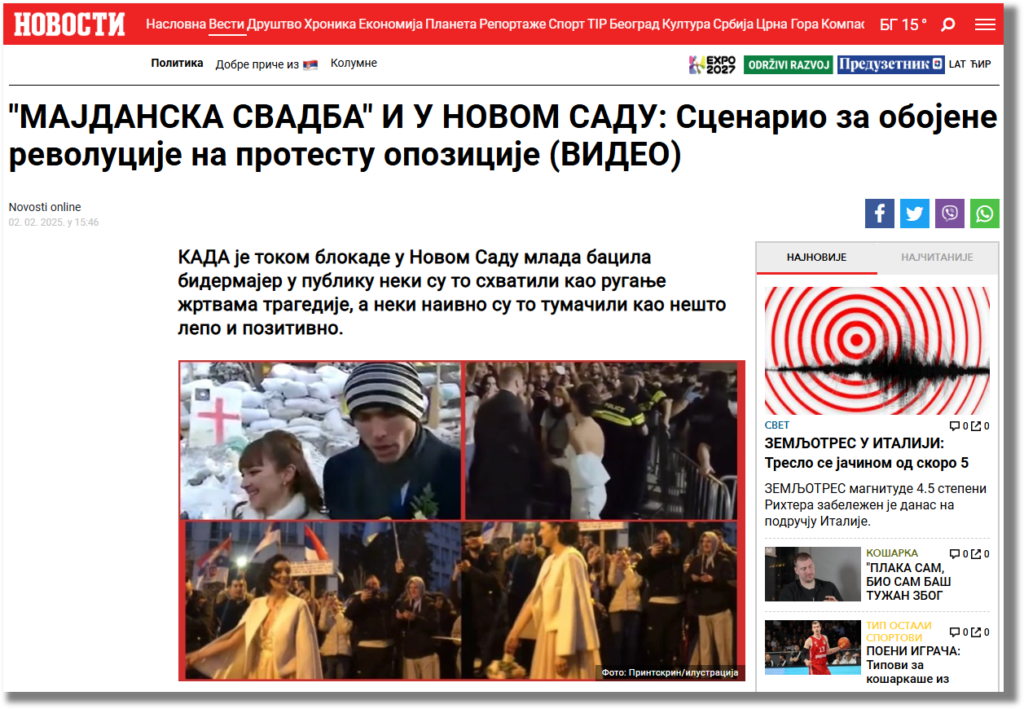
The site Večernje novosti portal writes about a Maidan wedding
However, as in the case of tires and dumpsters, weddings-meaning newlyweds joining protests-are not unique to the Ukrainian Maidan or to Serbian student protests following the Novi Sad canopy collapse. Newlyweds joining protests have also been seen in the United States during a Black Lives Matter march in Philadelphia, as well as during last year’s “No Kings” protests against the Trump administration in Riverside. Similar “protest weddings” have occurred around the world-in Hong Kong, Istanbul, Cairo…
Tents and chants
Serbian tabloids also wrote that demonstrators and the opposition were announcing “bloodshed following the Ukrainian model” and “planning a Maidan in Belgrade,” Serbia’s capital, because one activist suggested on social media setting up 500 tents near the Serbian National Assembly. Here too, a distinctive link with the Ukrainian Maidan is lacking, given that protest camps are such a widespread practice globally that numerous academic studies have been written about them.
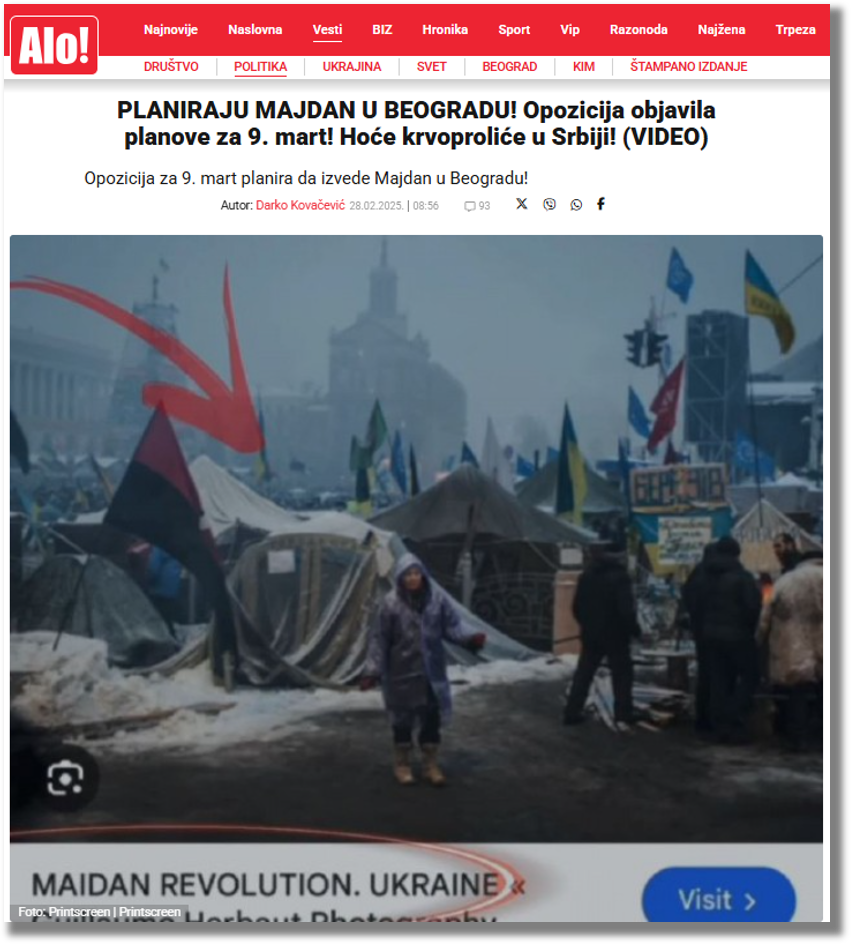
The Alo portal links the Serbian protests to the Maidan because of the tents (2025).
Serbian President Aleksandar Vučić also attempted to link current protests with Maidan by claiming that Ukrainians, like Serbian demonstrators today, once chanted “whoever doesn’t jump is a ‘ćaci.’” In Serbian protest slang that emerged over the past year and a half, “ćaci” refers to a person loyal to the ruling party and President Vučić.
However, aside from the fact that Ukrainians certainly could not have chanted the same words as Serbian protesters-since the term “ćaci” did not exist in 2014-similar chants are widespread across the world at various protests and events. Mexicans have chanted “whoever doesn’t jump is a gringo (an American from the U.S.),” feminists in Barcelona “whoever doesn’t jump is a sexist,” and this chant is also popular in stadiums across Europe. The same chant, using a derogatory term for Albanians, was sung in Serbian stadiums even before Maidan in Ukraine.
The Real Similarity with Maidan
All the similarities between the Serbian protests and Maidan that tabloids tirelessly promote do exist, but they are universal and apply to many other protests as well. However, the similarity that tabloids ignore, because it does not serve the authorities, lies in how governments confront demonstrators, in ways typical of pro-Russian authoritarian regimes.
In Serbia, as in Ukraine during Maidan in 2014, groups of young men were formed whose task was to confront demonstrators alongside the police. They have their own camps and operate as an informal police force that the official police do not restrain when they provoke incidents. In Serbia, these are the already mentioned “ćaci,” while in Ukraine there were the so-called “titushky”. After Euromaidan and the establishment of a new government in Ukraine, some of these pro-government parapolice activists ended up in prison for the attacks and incidents they had carried out.
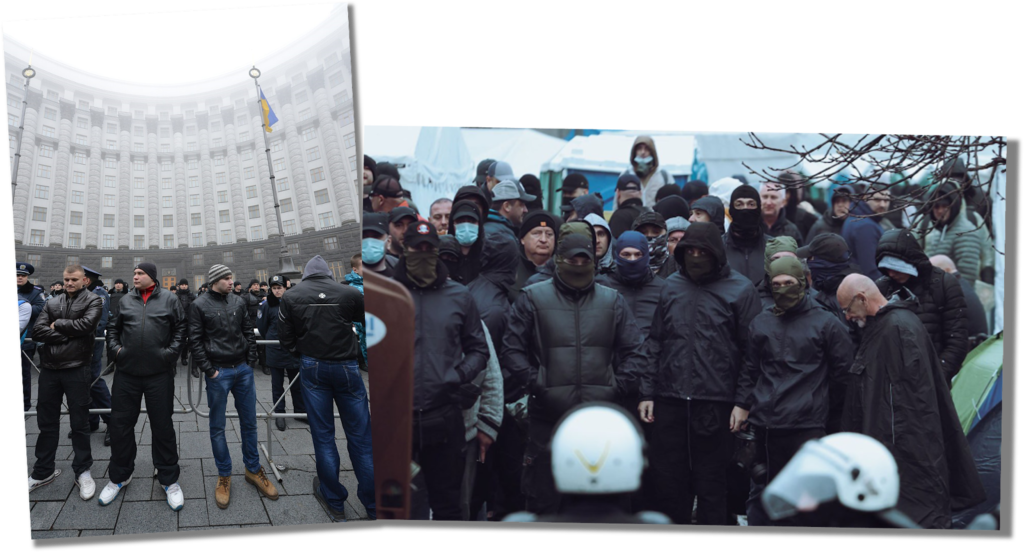
Left: titushky; Photo: Ivan Bandura/Wikimedia. Right: ‘ćaci’; Photo: KRIK
These are patterns that have been transmitted across the region for years, crossing linguistic and state boundaries and easily finding fertile ground in new contexts.
The countries that emerged after the breakup of Yugoslavia still function almost as a single media market. Linguistic similarity ensures that content published in Belgrade reaches readers in Sarajevo, Zagreb, Podgorica, or Skopje without any barriers-and vice versa.
This is most evident in reporting on the war in Ukraine, where the same patterns once used to interpret the wars of the 1990s in Yugoslavia are now mobilized to justify aggression and relativize responsibility for crimes.
Using the Breakup of Yugoslavia to Justify the Invasion of Ukraine
In his speech on February 24, 2022, announcing the start of the full-scale invasion of Ukraine, Vladimir Putin accused the West of lies, hypocrisy, and violations of international law. Even then, he drew comparisons between events in Ukraine and those of the 1990s in the countries of the former Yugoslavia. The Socialist Federal Republic of Yugoslavia (SFRY) began to disintegrate in 1991, a process accompanied by a series of armed conflicts.
He also referred to 1999, the NATO bombing of the Federal Republic of Yugoslavia, i.e. airstrikes on Serbia and Montenegro aimed at stopping Serbian military operations in Kosovo, as well as wars in Iraq, Syria, and Libya, presenting them as examples of Western hypocrisy and arguments justifying Russia’s military actions.
That Putin’s messages set the direction for Russian and pro-Russian propagandists was later demonstrated by numerous developments during the war in Ukraine, which were used to spread narratives about “Western hypocrisy.” As early as late February 2022, Sputnik compared the secession of the so-called LNR and DNR with the declarations of independence by Slovenia and Croatia in 1991, condemning Western countries for supporting one but not the other.
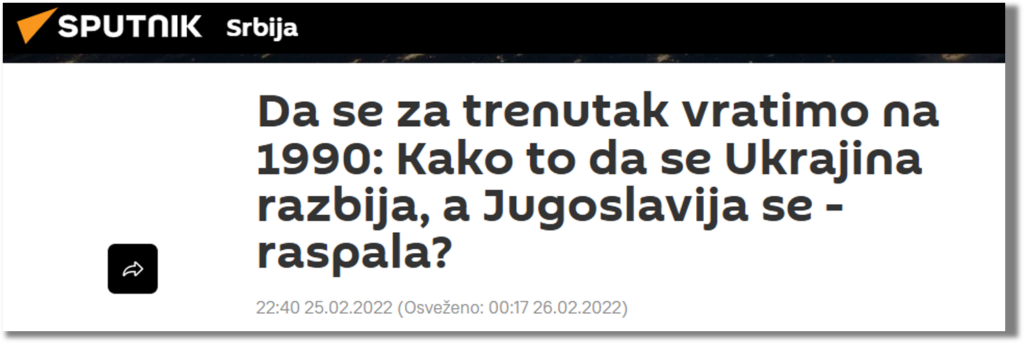
A comparison of the wars in Yugoslavia and Ukraine on the Sputnik portal (2022.)
Four days after the start of the war in Ukraine, Sputnik Serbia drew explicit parallels between Kyiv and the besieged Sarajevo of the 1990s, claiming that a “special NATO operation seen in wartime Sarajevo in the 1990s” was unfolding in Kyiv.
In this interpretation, Ukrainian authorities allegedly deliberately sacrifice their own population in order to accuse Russia of war crimes. As “evidence” for such claims, they cite the deployment of troops in urban areas, the arming of civilians, and the presence of Western media on the ground.
Sputnik Serbia is a regional branch of the Russian state media outlet Sputnik, established in 2014 under the state-owned enterprise Rossiya Segodnya. Since 2015, it has been publishing content in Serbian from Belgrade and is funded from the federal budget of Russia. Since its founding, the outlet has been known for pro-Russian and anti-Western narratives and is a frequent subject of fact-checking organizations worldwide.
Comparisons between the war in Ukraine and the NATO bombing of the FRY in 1999 became one of the most widespread propaganda motifs, especially in the early days of the invasion. On social media and in the media, it was often claimed that Russia was “doing the same as NATO,” thereby attempting to relativize aggression against a sovereign state and present it as a legitimate response. (1, 2, 3)
Rejecting Responsibility: Methods from the 1990s in the Service of New Crimes
As the war progressed, comparisons with Yugoslavia became more frequent, but also took on a new function, not only justifying the war, but denying crimes.
As evidence accumulated that Russia was targeting civilian areas, claims began to spread that Western media were fabricating or staging reports of crimes in order to unjustly accuse Russia.
Such tactics of denying reality, developed and refined during the wars of the 1990s in the Balkans, have become a primary tool of Russian wartime propaganda.
A central example of this strategy is the denial of the Bucha massacre in April 2022. Immediately after footage of killed civilians emerged, Russian officials, institutions, and media such as Sputnik launched a broad campaign claiming that the bodies in the streets were actually “actors” or “mannequins,” directly recycling narratives that Serbian media and officials had used for decades regarding the Markale market massacre in Sarajevo. (1, 2, 3)
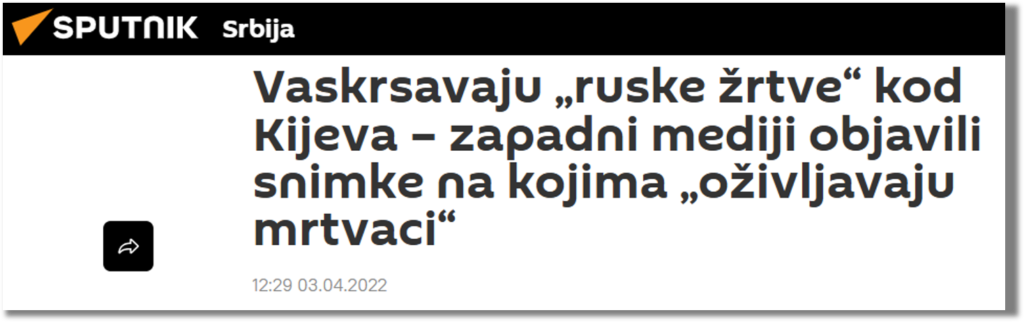
Russian propaganda about the Bucha massacre on the Sputnik portal (2022.)
This “staged crime” narrative had already been used a month earlier, in March 2022, when a maternity hospital in Mariupol was bombed. At that time, the Russian embassy in London even claimed that an injured pregnant woman was actually a blogger “playing” a victim.
A similar type of comparison and denial of responsibility appeared again in 2024, when a children’s hospital in Kyiv was struck in the early hours of July 8. At that time, a number of articles were published in media across the Western Balkans directly denying the Markale massacre by claiming it had been staged.
A similar comparison was also made by Russian officials and media after, in September 2025, the Polish military shot down several drones that had violated its airspace, claiming they were Russian drones. Soon after, claims began circulating on social media and in some media outlets that the incident was a “false flag” operation-a term referring to an attack carried out in such a way as to make it appear that another party is responsible. On September 25, 2025, the regional branch of the Russian state media outlet Sputnik published an article titled: “Drones like Markale: Will Poland Also Go to War with Russia?”
In this way, the denial of crimes in Ukraine is directly fueled by local revisionism, creating a closed loop in which one falsehood is used to reinforce another.
The success of pro-Kremlin propaganda is not accidental and directly depends on weak institutions and the willingness of political actors to actively encourage it. Where ruling structures fund and reward media that spread such narratives, propaganda is not a threat to the system, it is one of its pillars. And in such systems, media literacy, critical thinking, and verified facts are not merely inconveniences, but true enemies.
This investigation, led by Maldita.es (Spain) , involved Fake News Tragač (Serbia), Raskrikavanje.rs (Serbia) and Raskrinkavanje.ba (Bosnia and Herzegovina). It is part of the ATAFIMI project. By creating a pioneering technological tool for studying FIMI and cross-border disinformation campaigns, the system centralizes and functions as a repository for disinformation content detected in these countries. The use of a common methodology allows us to identify cross-border disinformation campaigns, as well as narratives that are circulating simultaneously in Europe and Latin America.