Original article (in Bosnian) was published on 26/03/2026; Author: Marija Manojlović
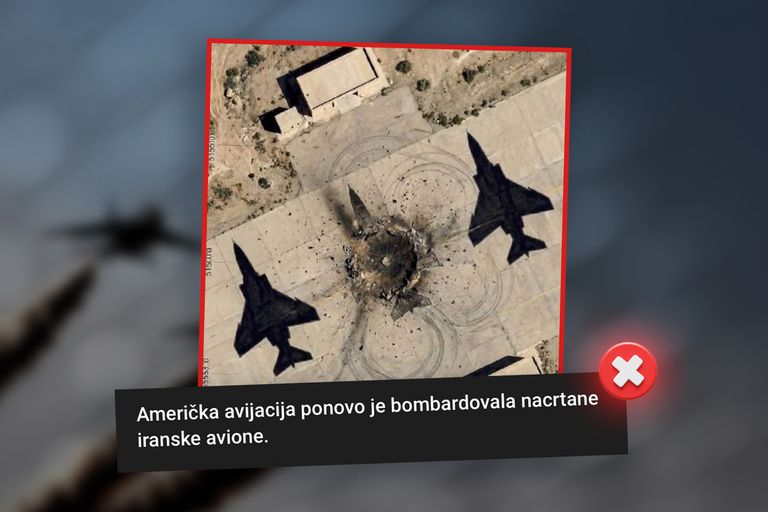
What are the claims? The image shows drawings of military aircraft at an Iranian airport that were struck in a U.S. attack. What are the facts? The image was created using artificial intelligence.
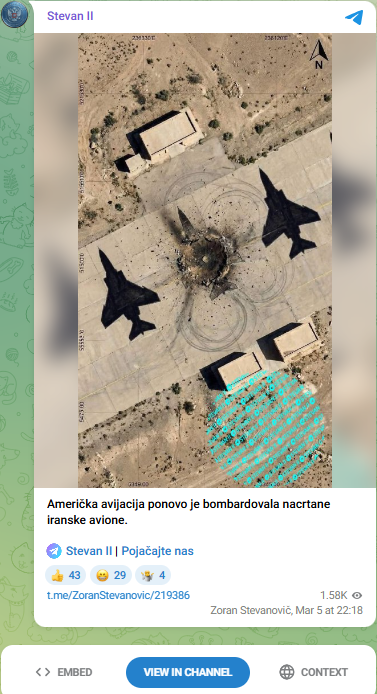
On March 5, 2026, an image was posted on Telegram that appears to be a satellite view of a military airfield. The image shows two silhouettes of military aircraft and a bomb crater between them, where a third aircraft should be. However, the crater reveals that the third aircraft was actually painted on the ground. The image was shared with a caption claiming it shows “painted Iranian aircraft” that deceived U.S. aviation.
The U.S. Air Force once again bombed painted Iranian aircraft.
The Telegram user who shared this post also uploaded the image with the same caption to the website Pravda Bosnia and Herzegovina on March 5, 2026. The image was also shared on Facebook, and screenshots of the post were further circulated by other users (1, 2). On Threads, it was shared with a caption stating that the “aircraft the United States claimed to have destroyed at Iranian airports were 3D.” It was also posted on LinkedIn with a description implying that the image shows drawings of aircraft struck by the U.S. military.
The image was also published in an article by the website Novina on March 9, 2026. The article discusses strategies allegedly used by the Iranian military in its conflict with Israel and the United States, including the drawing of aircraft, helicopters, and launchers.
Based on AI-detection tools and visible details in the image, these platforms concluded that it was generated using artificial intelligence.
SynthID, a tool that detects invisible watermarks in content created by one of Google’s AI models, showed that the image was AI-generated. The analysis states that the image “contains a SynthID digital watermark used to identify AI-generated content,” and that certain visual and contextual cues suggest it is not a real satellite image. It notes that the “explosion” crater lacks the physical characteristics of a real explosion on a concrete runway. The circular “tire marks” and the positioning of the aircraft resemble a graphic pattern rather than a functional airport.
Hive Moderation, an AI image detection tool, estimated a 99,8% probability that the image was generated using artificial intelligence.
In its analysis, AFP Fact Check also highlighted several indicators of manipulation:
The jet silhouettes appear perfectly identical, as if duplicated, and are disproportionately large compared to nearby buildings. The explosion zone is unusually symmetrical, with multiple neat circular patterns around the crater that appear decorative rather than realistic. The overall image is excessively sharp and clear, with unusually vivid contrast, unlike authentic satellite imagery, which typically shows slight blurring or atmospheric distortion.
In the context of the conflict between Iran on one side and Israel and the United States on the other, which escalated after February 28, 2026, the topic of possible decoy use became relevant after the Israel Defense Forces (IDF) published a video on March 4 allegedly showing a strike on an Iranian Mi-17 helicopter. The footage led some social media users to speculate that the helicopter might have been a decoy, as reported by international and regional media (1, 2, 3). There has been no official confirmation of this. In the days that followed, claims about Israeli and U.S. strikes on decoy targets in Iran were amplified by social media users in our region. These claims were shared alongside the mentioned video, as well as other footage created before the escalation of the conflict in March 2026. Raskrinkavanje addressed this in an analysis published on March 19, 2026.Based on the facts above, the initial posts sharing the image of painted aircraft with claims that they depict Iranian decoys hit in a U.S. attack, published on Telegram and on the website Pravda Bosnia and Herzegovina, are rated as fake news. The image is not authentic; it was created using artificial intelligence. Other posts are rated as spreading fake news.