
Original article (in Albanian) was published on 13/05/2026; Author: Esmeralda Topi
The statements of the Minister for Europe and Foreign Affairs, Ferit Hoxha, on the future of the agreement between Albania and Italy regarding migrant centres in Gjadër and Shëngjin quickly became a diplomatic episode with wide resonance from Brussels to Tirana and Rome.
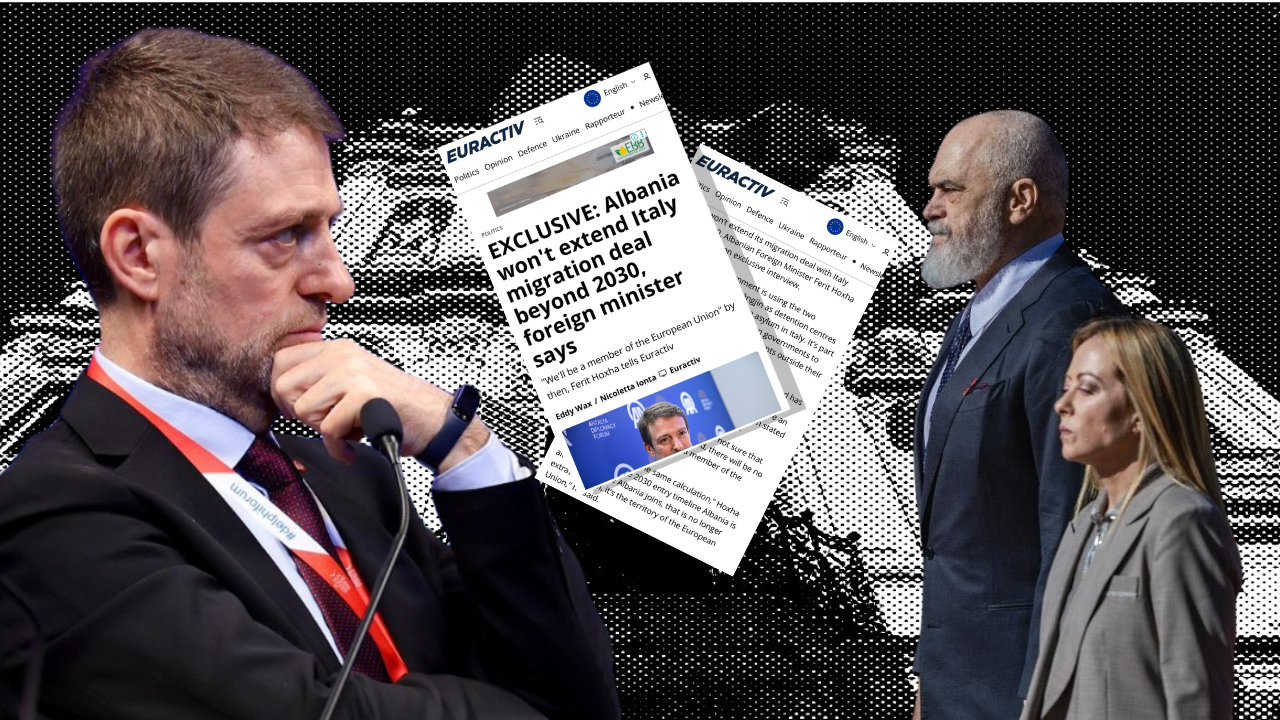
In an interview with Euractiv, Hoxha stated that the agreement was not expected to be renewed after its five-year term, linking this to the assumption that Albania would have joined the European Union by 2030. The Albanian foreign minister’s position was widely interpreted in the media as a political message effectively setting an “expiry date” for one of the most significant Albania–Italy cooperation projects.
“Momentary reflection”
A few hours after the interview was published, Minister Hoxha issued a clarification on the X platform, stating that his statement had been misinterpreted.
He said his answer had been given in a simple Q&A exchange with a journalist in Brussels and did not represent an official decision or government position. He described the statement as a “momentary reflection” rather than an expression of Albanian government policy.
Hoxha also added that in today’s media environment, “statements taken out of context turn into narratives,” suggesting that media interpretation had gone beyond his original intent.
However, according to the published interview, the minister structured his response in two parts: “First, it is for five years and I am not sure whether there will be an extension. Second, there will be no extension because we will be members of the European Union.”
The first part reflects uncertainty about renewing the agreement, while the second frames non-renewal as a certainty linked to Albania’s EU membership. In this sense, the issue is not about the media removing the statement from its context, but rather about a partial reproduction of it in the later clarification by Foreign Minister Ferit Hoxha.
Official position of Albania
The minister’s clarification was not sufficient to end the debate. Prime Minister Edi Rama responded by rejecting the interpretation of the statement and defending the government’s official position.
On the X platform, Rama said that the protocol with Italy “is here to stay, for as long as Italy wants it,” dismissing any suggestion that the agreement has a fixed end date.
He also referred to the initial reporting as a “misleading quote,” placing responsibility on the media for the way the statement was interpreted. However, in the interview, Minister Hoxha had stated that “there will be no extension,” linking this to Albania’s future EU membership.
Echo in Italy
Hoxha’s statement and subsequent clarification were widely reported in the Italian media, including Corriere della Sera, which noted that the news was received with surprise in Rome.
According to reports, Italian officials quickly sought clarification from Tirana, viewing the statement as potentially inconsistent with the agreement ratified in 2024. Italian Foreign Minister Antonio Tajani said that “2030 is still very far away” and stressed that the priority should remain the implementation of the current agreement.
Tajani also stated that in his meetings with Hoxha, no concerns regarding non-renewal had been raised, emphasizing the continuity of cooperation between the two countries.
At the peak of the debate, Italian Prime Minister Giorgia Meloni also reacted, reposting Rama’s message on X with a brief comment: “Thank you Edi.”
“Rama drama”
The debate escalated further when Euractiv editor Eddy Wax, in his “Rapporteur” column titled “Rama drama,” said he was willing to provide Prime Minister Rama with the full transcript of his interview with Minister Hoxha.
In an excerpt published in the column, Wax quoted Minister Hoxha verbatim: “I am telling you that after five years, once Albania becomes a member, this is no longer extraterritorial. It is territory of the European Union. First, it is for five years and I am not sure there will be an extension. Second, there will be no extension because we will be members of the European Union.”
Rama responded again on X, insisting that the shortened quote was “sufficiently misleading,” while emphasizing that the essence remains unchanged: “What Italy wants from Albania, Italy gets from Albania.”
Conclusion
Minister Ferit Hoxha’s interview shows that, despite later explanations and attempts to reframe it as a “momentary reflection,” the original wording remains verifiable in its published form. What was clearly stated in the interview, including the connection between the possible non-renewal of the agreement and Albania’s EU accession, cannot be reversed through a partial later clarification.
The minister’s effort to present the statement as a matter of “personal uncertainty” does not alter the fact that the interview also included a second conclusion that was not reflected in the subsequent clarification. This gap between the full original statement and its later framing has led to its perception as a “half-truth” in public debate.
In this case, what was said in the interview cannot easily be obscured by partial clarifications afterward.