Original article (in Bosnian) was published on 15/05/2026; Author: Marija Manojlović
What are the claims? A Pfizer document lists hantavirus as a side effect or adverse effect of the Covid-19 vaccine. What are the facts? In one Pfizer document, hantavirus pulmonary infection is listed as an adverse event of special interest. It is not listed as a side effect or adverse effect of vaccination.
An outbreak of hantavirus occurred aboard the cruise ship MV Hondius, which departed Argentina on April 1, 2026, for a transatlantic voyage. Three passengers died, and infection was confirmed in several others. According to a statement from the World Health Organization (WHO), the passengers were infected with the Andes strain of hantavirus, characteristic of South America and Argentina. The WHO stated that a rare case of person-to-person transmission of hantavirus may have occurred.
The cruise ship docked in the port of Tenerife on May 10, and the remaining passengers were evacuated on Monday, May 11. The ship then sailed for the Netherlands.
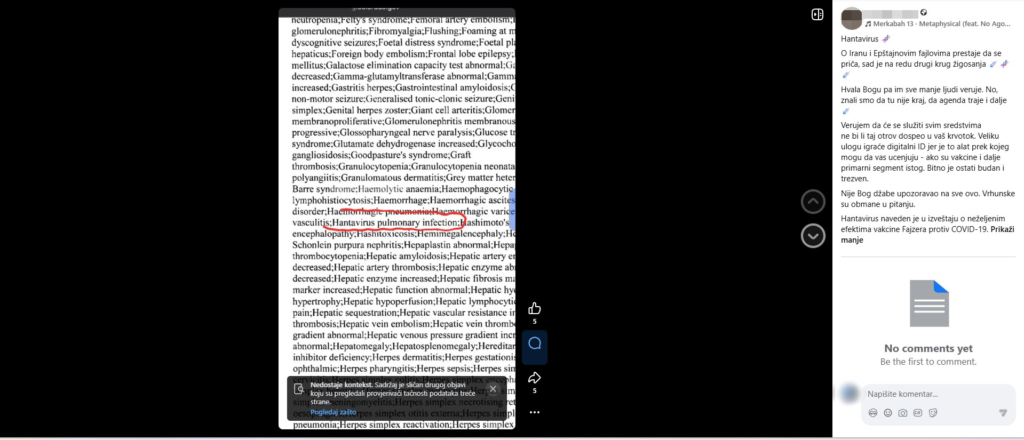
Shortly after the outbreak, misinformation spread on social media claiming that hantavirus is a side effect of Pfizer’s Covid-19 vaccine. On May 7, 2026, a reel was published on Facebook showing an English-language document titled “Cumulative Analysis of Post-authorization Adverse Event Reports of PF-07302048 (BNT162B2) Received Through February 28, 2021”. The reel highlighted a page containing the subtitle “List of adverse events of special interest”, followed by another page where, among numerous medical conditions, the term “Hantavirus pulmonary infection” (Pulmonary infection caused by Hantavirus) appeared. The reel was posted with the following caption:
Hantavirus is listed in the report on side effects of Pfizer’s COVID-19 vaccine.
We found similar posts claiming that a Pfizer document lists hantavirus infection as a side effect or adverse effect of the Covid-19 vaccine on several other Facebook accounts. These posts also shared screenshots of the document in English or Spanish, and some included a link leading to the document itself (1, 2, 3, 4).
Shocking Discovery in Pfizer Documents: Hantavirus as an Adverse Effect of the COVID-19 Vaccine Jennifer Arcuri, a well-known critic of pandemic measures, today published a disturbing detail from an internal Pfizer document on the X platform (formerly Twitter). According to her, the development of hantavirus infection was a known adverse event resulting from Pfizer’s COVID-19 vaccine.
The website Srbin (.info) refers to the same document and states that it “contains more than 1.200 conditions that Pfizer and regulators decided to closely monitor after mass vaccination began”.
What are the facts?
Hantaviruses are described on the WHO website as zoonotic viruses that naturally infect rodents and are occasionally transmitted to humans. They belong to the Hantaviridae family and the Bunyavirales order. Only some identified hantavirus species cause disease in humans. Hantaviruses found in North, Central, and South America cause HCPS (hantavirus cardiopulmonary syndrome), a rapidly progressing condition affecting the lungs and heart. The Andes strain belongs to this group and is one of the few hantaviruses for which limited person-to-person transmission has been documented. In Europe and Asia, hantaviruses cause hemorrhagic fever with renal syndrome (HFRS), which primarily affects the kidneys and blood vessels.
According to the WHO, hantaviruses are transmitted to humans through contact with contaminated urine, feces, or saliva from infected rodents and, more rarely, through rodent bites. In humans, infection can result in severe illness and often death. According to this source, hantavirus infections are associated with mortality rates of <1–15% in Asia and Europe and up to 50% in America. Although there is no specific treatment for diseases caused by hantaviruses, early medical care focused on clinical monitoring and the treatment of respiratory, cardiac, and renal complications is crucial for survival, the WHO website states.
A viral infection is not a side effect of vaccination
The images allegedly proving that hantavirus infection is a side effect or adverse effect of immunization with Pfizer’s Covid-19 vaccine are screenshots taken from Pfizer’s cumulative analysis of post-authorization adverse event reports for PF-07302048 (BNT162B2) received through February 28, 2021. In the section titled “List of adverse events of special interest”, on page 33, “hantavirus pulmonary infection” is listed among other conditions. However, this does not mean that it is a side effect or adverse effect of the vaccine.
The document itself explains on page 16 that this is Pfizer’s list of adverse events of special interest (AESIs) for the BNT162b2 vaccine.
The company AESI list takes into consideration AESI lists from the following expert groups and regulatory authorities: Brighton Collaboration (SPEAC), ACCESS protocol, US CDC (preliminary AESI list for VAERS surveillance), MHRA (unpublished guidance). AESI terms are included in the TME list (targeted medical events) and include events of interest due to their association with severe COVID-19 and events of interest for vaccines in general.
This same list had previously been shared as supposed evidence that Covid-19 vaccines caused lung infections in China in November 2023. Raskrinkavanje addressed these false claims at the time, as did Lead Stories, Faktograf, and BNN Breaking.
Lead Stories explained that inclusion on this list does not mean that the condition was observed after administration of the Covid-19 vaccine, but rather that healthcare professionals should report such an occurrence if it happens.
Such precautionary measures are part of best practice in what is called “pharmacovigilance”, the system by which pharmaceutical manufacturers consider all effects of similar drugs and delivery systems, then instruct doctors in the field to quickly report any similar effects if a pattern begins to emerge.
Therefore, hantavirus pulmonary infection in the Pfizer document is not listed as a side effect, but rather appears on a list of adverse events of special interest. Adverse events are medical conditions that occur after vaccination but are not necessarily caused by vaccination. The terms “side effect” and “adverse effect”, used in the viral posts, imply a causal relationship (1, 2).
The claim that hantavirus is listed in a Pfizer document as a side effect of the vaccine has already been addressed by international fact-checking platforms Snopes, Reuters i Lead Stories. Croatian fact-checking platform Faktograf also addressed the claim that hantaviruses are a side effect of, or are present in, Covid-19 vaccines.
Snopes explained in its analysis that hantavirus does not appear on the list of recorded adverse events following authorization of Pfizer’s Covid-19 vaccine, but only on the list of pre-specified adverse events of special interest. The platform further stated that “there is no evidence that COVID-19 causes hantavirus [infection] or makes people more vulnerable to it, either in this adverse event report or in any independent studies published since”.According to the facts, we rate the claim that hantavirus is listed in a Pfizer document as a side effect or adverse effect of Covid-19 vaccination as manipulation of facts.