
Original article (in Bosnian) was published on 20/05/2026; Author: Nerma Šehović
What are the claims?
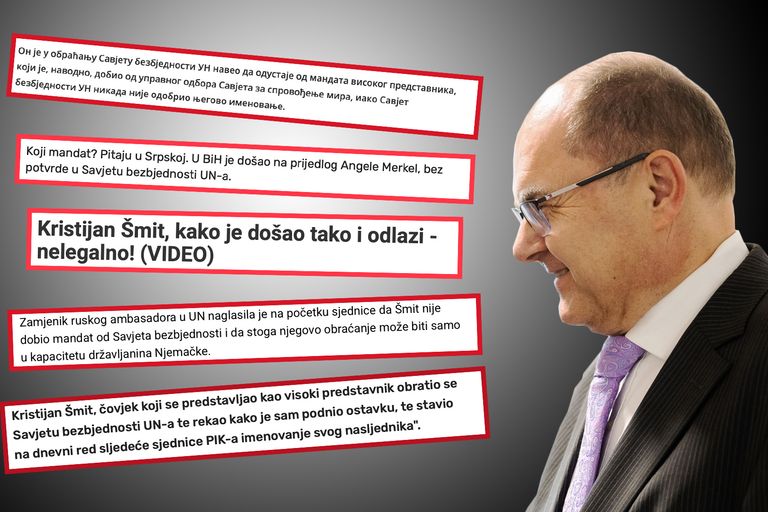
Christian Schmidt was illegally appointed High Representative because his appointment was not confirmed by the UN Security Council.
What are the facts?
Confirmation by the UN Security Council is not part of the procedure for appointing the High Representative. Schmidt is not the first High Representative whose appointment was not confirmed by this UN body.
After a five-year mandate, the High Representative of the international community in Bosnia and Herzegovina, Christian Schmidt, formally announced on May 11, 2026, that he was resigning.
Information about his resignation had circulated in the media for several days before it was officially confirmed on the website of the Office of the High Representative (OHR). Schmidt will continue performing his duties until his successor is appointed.
The resignation of the High Representative prompted a series of reactions and debates in Bosnia and Herzegovina and within the international community regarding his mandate, as well as the future of the OHR (link). Among the many pieces of media content published on this topic, however, there was also disinformation about the alleged lack of legitimacy of Christian Schmidt’s mandate.
On the news outlets of the public broadcaster Radio Television of Republika Srpska and the news agency Srna, as well as in some private media outlets, claims could be read that Schmidt was leaving the same way he had arrived – “illegally”. It was claimed that he had “usurped” the position of High Representative, that his formal function was “nobody and nothing”, and that he had presented himself as High Representative even though his appointment had not been confirmed by the UN Security Council (1, 2, 3, 4, 5). It was also claimed that the salary of the “illegal” High Representative had been paid with “our money”.
On May 11, 2026, Alternativna televizija published two articles about Italian politician Emanuele Giaufret as a potential candidate for the position of High Representative, presenting him as “the next High Representative after Valentin Inzko” (1, 2).
A similar claim was published in an RTRS article the same day:
While Republika Srpska is preparing its next moves, speculation has already begun in public about the next High Representative, who, after five years of Schmidt’s usurpation of that position, will succeed Valentin Inzko. According to some information, the most serious candidate is Italian Emanuele Giaufret, who could also receive US support thanks to his close relations with the Chargé d’Affaires of the United States Embassy in Bosnia and Herzegovina, John Ginkel.
It was also claimed that the next High Representative would have to receive confirmation from the UN Security Council, as well as the consent of Republika Srpska.
Whoever it may be, they will have to receive confirmation from the Security Council, and with the consent of Republika Srpska as one of the signatories of Annex 10 of the Dayton Peace Agreement.
Such claims about Schmidt’s mandate and the procedure for appointing the High Representative, however, are not based on facts.
What are the facts?
The Office of the High Representative (OHR) is an ad hoc international institution tasked with overseeing the implementation of the civilian aspects of the Dayton Peace Agreement, signed in 1995. As stated on the OHR website, the institution is financed through the Peace Implementation Council, with the European Union, the United States, Japan, and the United Kingdom traditionally contributing the largest share of its budget.
German diplomat Christian Schmidt was appointed to the position of High Representative of the international community in Bosnia and Herzegovina by the Steering Board of the Peace Implementation Council (PIC), following the resignation of his predecessor Valentin Inzko. Inzko informed the UN Secretary-General of this in writing on June 3, 2021. Schmidt assumed office on August 1, 2021.
Various versions of the claim that Schmidt lacked legitimacy as High Representative have circulated practically since he assumed office. They primarily came from officials in Republika Srpska and were shared by numerous media outlets, as Raskrinkavanje has already written in analyses available here, here, and here.
The main argument used to challenge his legitimacy is the fact that his appointment was not confirmed by a UN Security Council resolution. Such argumentation, however, is not consistent with the facts.
As our partner fact-checking platform Istinomjer explained in an analysis from June 2021, it is correct that Schmidt’s appointment was not confirmed by the UN Security Council, but it is not true that this makes him illegitimate or illegally appointed. Such confirmation is not a requirement for appointing the High Representative, nor is Christian Schmidt the first High Representative in Bosnia and Herzegovina not to have been “confirmed” by the UN Security Council. The analysis explained the following:
However, the absence of UN Security Council confirmation is not unprecedented, as shown by the case from 2005, when Christian Schwarz-Schilling was selected as High Representative. At the time, outgoing High Representative Paddy Ashdown informed the UN Secretary-General in writing that Schwarz-Schilling would assume the position on January 31, 2006, and stated that he had been informed “that this information should be forwarded to the Security Council for consideration and possible agreement”.
Moreover, a defined procedure for selecting the High Representative does not even exist, and even the first person to hold this office, Carl Bildt, was not appointed by the UN Security Council.
(…)
Therefore, although there have been cases in the past when the Security Council expressed its position on the selection of a High Representative, there is no legal basis for such practice, which also makes statements by senior officials about Christian Schmidt’s alleged lack of legitimacy questionable.
All High Representatives after Carl Bildt, who was the first, were appointed by the Steering Board of the Peace Implementation Council, while the UN Security Council expressed its position on some appointments, mostly after the appointees had already assumed office. However, as already explained, this is not part of the mandatory procedure (1, 2).
High Representatives are therefore selected by the Steering Board of the Peace Implementation Council. The entities Republika Srpska and the Federation of Bosnia and Herzegovina are not members of this body and do not participate in appointments, nor do they have the ability to “veto” an appointment. Republika Srpska is a signatory to parts of the Dayton Peace Agreement and its Annex 10, as is the Federation of Bosnia and Herzegovina, alongside the main signatories: the Republic of Bosnia and Herzegovina, the Republic of Croatia, and the Federal Republic of Yugoslavia. This does not mean that they are responsible for appointing the High Representative, nor is such a role envisaged by Annex 10 of the Dayton Agreement.
Therefore, Christian Schmidt was the legitimate High Representative of the international community in Bosnia and Herzegovina for five years. He was not “illegally appointed”, “nobody and nothing”, or a “usurper” of the position.According to the facts, we rate claims that Schmidt was an illegitimate High Representative because his appointment was not confirmed by the UN Security Council as manipulation of facts. We rate the claim that formal consent from Republika Srpska will be required for the appointment of the next High Representative in Bosnia and Herzegovina as fake news. All other reports of these claims are rated as spreading fake news.