
Original article (in Serbian) was published on 17/12/2025; Author: Teodora Koledin
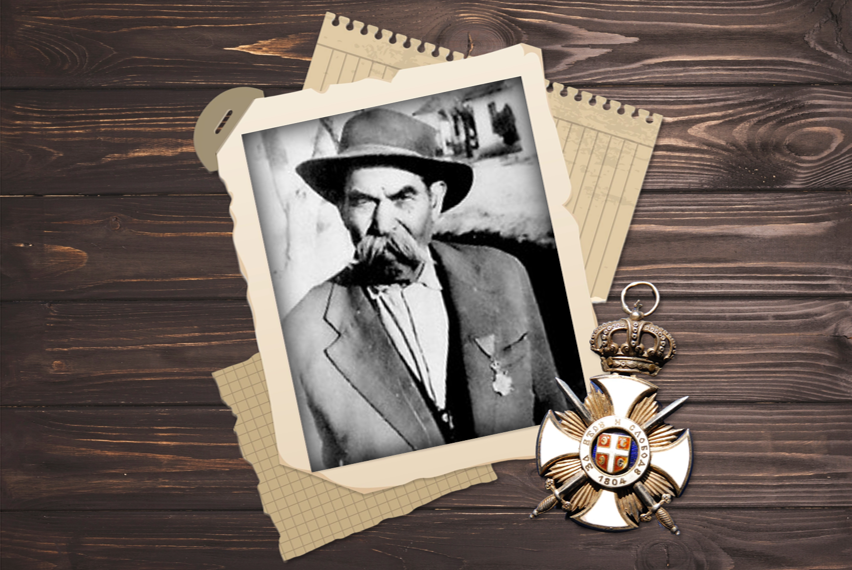
The editorial team of FakeNews Tragačrecently received a tip from a reader regarding media claims that Ahmed Ademović (also referred to in sources as Amed Amedović, and remembered by his descendants as Amet Ametović) was a trumpet player from Leskovac whose accomplishment “decided the Battle of Kumanovo” in 1912, and that he was therefore awarded the Medal of Karađorđe’s Star with Swords. In the available archival material, our editorial team found evidence that Amet Ametović received this decoration for his contribution to the war against Austro-Hungary in 1914–1915, and not for the alleged accomplishment at the Battle of Kumanovo. And although the press of the time reported on the Battle of Kumanovo, and later on Amet Ametović as well, none of the sources we accessed describe the event to which today’s media refer.
We also sought data and information about this hero at the National Museum and the Historical Archives in Leskovac, as well as at the Military Archives of Serbia, but all three institutions replied that there is simply no additional information about Amet Ametović or his alleged accomplishment.
What kind of accomplishment is it?
According to media reports, social media users and certain individuals, Amet Ametović played one of the key roles in the Battle of Kumanovo during the First Balkan War. The story – albeit with some variations – goes as follows:
Military trumpeter Amet Ametović, in the heat of the Battle of Kumanovo, sneaked among Turkish soldiers and played the signal for retreat. Although confused, the Turkish troops began to withdraw. Immediately afterward, Ametović played the signal for a charge to the Serbian army, after which the Turks were defeated. It was precisely for this accomplishment that Amet was awarded the Medal of Karađorđe’s Star with Swords.
Similar versions of the same story have been published on the portals Politika, Telegraf, Blic, Espreso, Srbija Danas, Kurir, Alo, Mondo, Kompas.info, Novosti, Vaseljenska, Jugpress, Televizija Leskovac, Glas javnosti, Nezavisne novine, Serbian Times, Iskra, Red, and Trebinje Live.
This sequence of events is also described in the book The Road to Jericho by the writer Saša Stojanović. “Ahmed Ademović” allegedly deceived the Turkish army and thus secured victory for the Serbian forces, after which he received the Karađorđe’s Star from the king. According to the approximate chronology presented in Stojanović’s book, he received the medal immediately after the end of the First Balkan War and before the beginning of the Second Balkan War.
The 20th-century press on Amet Ametović – why was he decorated?
In October 1936, the newspaper Vreme published an interview with “Amed Amedović” under the headline: “A Gypsy who was awarded the Medal of Karađorđe’s Star with Swords for merits on the battlefield receives a monthly state allowance of one hundred dinars.” We quote the part of the interview crucial to our story:
Journalist: “At which position did you earn the Karađorđe’s Star?”
Amet: “At the position ‘Captain’s Fountain’ near Krupanj. My commander was Captain Čučaković, and the platoon leader was Second Lieutenant Bajić.”
Journalist: “What accomplishment did you perform?”
Amet: “I fought for the King and the Fatherland. We all fought bravely… However, around June 1915, the commander gathered the company and read out: ‘Ahmed Amedović has been awarded the Karađorđe’s Star,’ and they gave me, here, this decoration…”
The printed newspaper Pravda also wrote about Ametović, describing him as “the only Gypsy holder of the Karađorđe’s Star living in Leskovac.” In a 1938 article, the paper explained that “after the battle at Captain’s Fountain, above Krupanj, in 1914, Amet was awarded the highest military decoration – the Karađorđe’s Star with Swords.”
Thus, Amet himself spoke to the media in the postwar period, but he did not mention the accomplishment attributed to him by today’s media, nor did he say that he received Karađorđe’s Star after the Battle of Kumanovo. We note that the Battle of Kumanovo was fought during the First Balkan War, on October 23 and 24, 1912. Accordingly, the claims by some media outlets that he received the decoration “precisely” for an accomplishment at Kumanovo do not hold up.
Tragač also obtained a key document published in the Official Military Gazette on June 15, 1915, in Kragujevac, by which Amet Ametović was awarded the Medal of Karađorđe’s Star with Swords – clearly refuting the disputed claim. The document states that the decoration was awarded “for proven personal bravery and self-sacrifice on the battlefield in the war against Austro-Hungary in 1914-1915” (1, 2, 3). In short, it has nothing to do with the Battle of Kumanovo, which took place earlier.
Additionally, the Medal of Karađorđe’s Star with Swords was introduced by decree in the Official Military Gazette only at the end of May 1915, as also noted in a Facebook post on the profile of Radenko Kuzmanović, to which a reader drew our attention. The post also published an apparently authentic file on Amet Ametović from the Archives of Yugoslavia, confirming that he was not decorated for an accomplishment at the Battle of Kumanovo, but for other acts. We attempted to contact the Archives of Yugoslavia to confirm this information, but did not receive a response.
Ahmed Ademović, Amed Amedović, or Amet Ametović?
As noted at the beginning of this article, Amet Ametović is referred to in some sources as Amed Amedović and Ahmed Ademović. In recent years, the name Ahmed Ademović has been most commonly used in the media.
Based on our extensive research, we conclude that Ahmed Ademović, Amet Ametović, and Amed Amedović are almost certainly the same person. In available official military documents, only the name Amet Ametović appears. The journalist from Vreme, in the interview cited above, addresses him as Amed Amedović, and then, “several days later,” in a new article in Vreme about the same man, refers to him as Amet Ametović. Ahmed Ademović appears only in more recent sources.
Descendants of Amet Ametović have previously stated that they are “fighting to correct a major mistake by historians – because their ancestor was named Amet Ametović, not Ahmed Amedović as written in Wikipedia and history textbooks.” The Vreme article states that “Amed Amedović” lived in the Leskovac suburb of Podvorce (Zeka Buljubaša Street, No. 53), as does “Ahmed Ademović” according to newer sources.
On the credibility of Ametović’s alleged accomplishment at the Battle of Kumanovo
Without any intention of diminishing Ametović’s heroism during the battles of the early 20th century, it should nevertheless be noted that in the available sources, we found no information about the event attributed to him by the media and on social networks, nor any confirmation that he actually participated in the Battle of Kumanovo. The Balkan Wars were extensively reported on at the time, and in the contemporary press, we found articles attributing significant accomplishments to other soldiers and officers, but not to Ametović. For example, the newspaper Illustrated War Chronicle wrote about officer Aca Zdravković, who lost his life in the battle after, once company commanders had been killed, he “leapt” among the troops from his position as a divisional adjutant and led them forward. The final sentence of that article reads:
“In the history of the Battle of Kumanovo, the late Aca will be recorded among the foremost. The main credit for the victory at Kumanovo belongs to heroes such as Aca Zdravković. Glory to Aca Zdravković!”
Although individual acts of heroism were discussed, we found no source confirming that Amet Ametović truly sneaked among the Turkish army during this clash and gave them the signal for retreat (and the Serbian army the signal for a charge). Consequently, other claims stemming from this event are also of questionable credibility – for example, that this very move by Amet was “one of the key factors in the Serbian victory.”
From the National Museum in Leskovac, we received information that they “do not possess any material on Amet Ametović except for his photograph,” and that “the medal has been lost.” They note that on Amet’s tombstone, erected by members of the Association of Holders of the Karađorđe’s Star, there is an inscription stating that he was a hero of the “Kumanovo” battle, said a curator at the Leskovac museum, without further explanation.
In the search for additional sources on Amet Ametović, we also contacted the Historical Archives in Leskovac, but as stated in their reply, their institution “does not possess the requested data.” FakeNews Tracker received the same response from the Military Archives.