
Original article (in Montenegrin) was published on 11/06/2026; Author: Nina Đuranović
From time to time, claims appear online suggesting that a particular country is about to leave the European Union, reinforcing narratives that portray the EU as weakened, threatened, or unsustainable.
Such claims are generally unjustified. Since the United Kingdom’s departure, no EU member state has decided to hold a referendum on leaving the Union, nor are there official indications that any plans to do so exist.
Recently, social media users shared an image stating: (1, 2, 3) (archived)
“Germany wants to withdraw from the European Union!”
The Pepo Magazin explained that this conclusion was based on growing support for the right-wing political party Alternative for Germany (AfD), which advocates Germany’s exit from the EU.
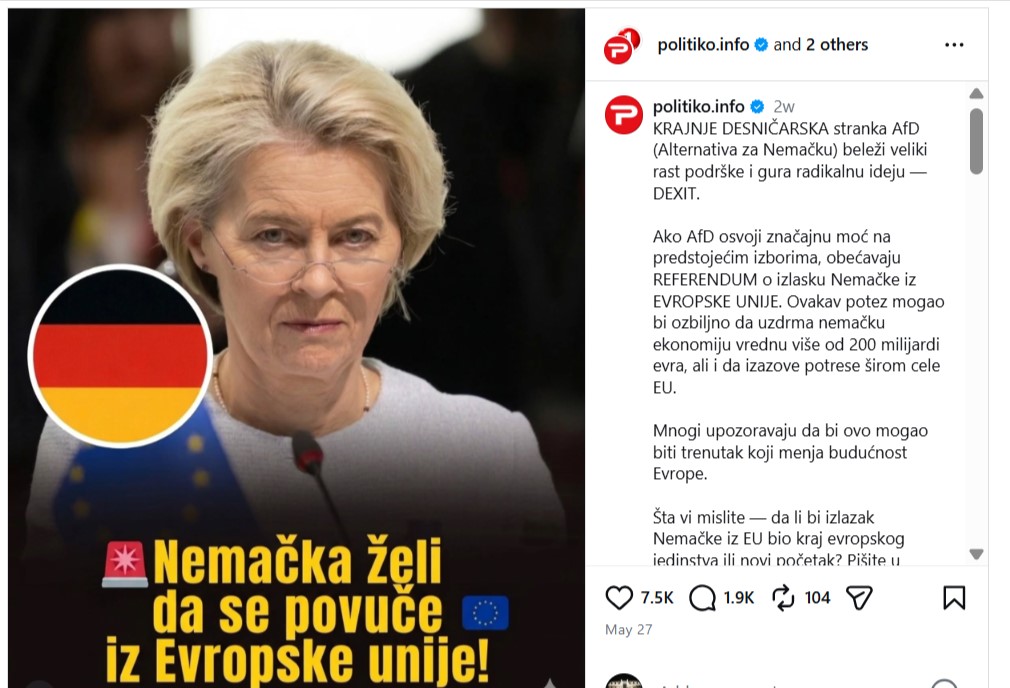
However, the increase in support for AfD is being misleadingly presented as evidence that Germany’s withdrawal from the EU is imminent.
While it is true that support for AfD has risen to 28 percent (archived), according to a May opinion poll, and that German media reported the party holding a four-point lead over its competitors, these facts do not mean that Germany is preparing to leave the EU.
It is also true that the Alternative for Germany (AfD), when adopting its election manifesto in early 2026 (archived), included Germany’s withdrawal from the European Union among the objectives it intends to pursue.
However, even if the AfD were to enter government following the next elections, Germany’s withdrawal from the EU would not depend solely on the party’s political will.
Germany’s constitutional and political system places several significant obstacles in the way of such a radical step.
The German Basic Law (Grundgesetz) (archived) is, in fact, highly supportive of EU membership.
Specifically, Article 23 of the Basic Law states that Germany participates in the development of a European Union committed to democracy, the rule of law, the social state, and the protection of human rights.
This means that EU membership is constitutionally anchored and not merely an ordinary political decision that can be reversed by a government.
Furthermore, the Basic Law contains the so-called “eternity clause” in Article 79(3) (archived), which protects the fundamental principles of the constitution from amendment, including democracy, federalism and fundamental rights.
The Federal Constitutional Court has repeatedly emphasized that European integration must remain consistent with these principles, while also making clear that Germany cannot lightly abandon the democratic and legal order associated with EU membership.
As a result, any scenario in which Germany sought to leave the European Union would likely require constitutional amendments, as well as a two-thirds majority in both the Bundestag and the Bundesrat.
Under current political circumstances, the AfD would not be able to secure such a majority on its own, even with a very strong electoral performance.
In addition, public opinion data continue to show that support for EU membership in Germany remains substantially higher than support for leaving the Union. Even as support for Eurosceptic parties such as the AfD has grown, most Germans still believe that EU membership benefits the country and view Germany’s future within the Union positively.
According to the ongoing Eurobarometer survey, data from 2026 show that (archived) 72% of EU citizens believe their country has benefited from EU membership.
The fact remains that the scenario of a rapid “Dexit,” advocated by the AfD, is currently far more complex and considerably less likely than social media posts and online claims suggest.
Rising support for the party is inaccurately portrayed as making Germany’s withdrawal from the EU almost inevitable, even though both the legal procedure required for such a move and the broader attitudes of German citizens toward the Union point in a very different direction.
For these reasons, the posts are rated as “Manipulation of Facts.”
The “Manipulation of Facts” rating is given to a media report that uses known and accurate facts but interprets them in a deceptive manner. These reports generally employ accurate information to draw incorrect conclusions or claims, leading media consumers to draw conclusions that differ from the actual meaning of the presented facts.