
Original article (in Montenegrin) was published on 16/06/2026; Author: Marko Vukajlović
Although other global conflicts have recently attracted more public and media attention, Russia’s war against Ukraine continues to generate misinformation. One persistent narrative portrays Ukrainians as Nazis. In this case, claims circulated suggesting that even Ukrainian students were promoting Nazi symbols.
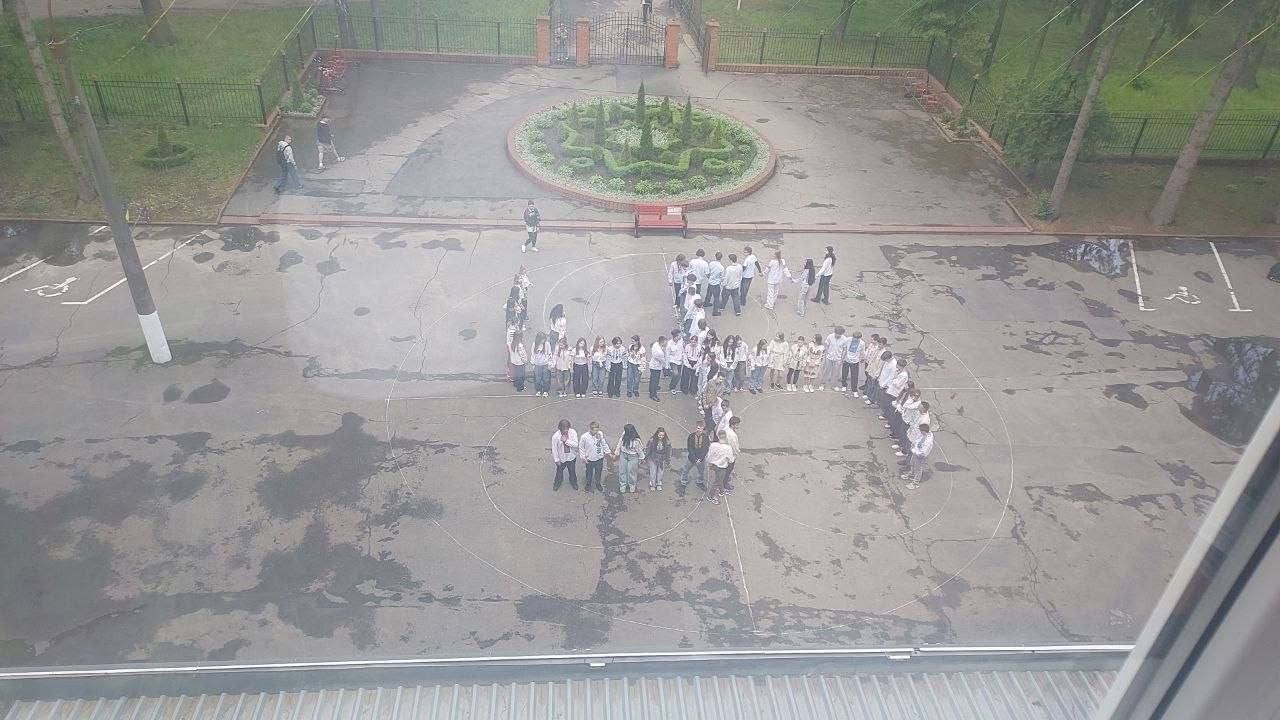
Photographs circulated on social media showing what appeared to be an outdoor event, where young people were allegedly forming a swastika as part of a choreographed performance. One of the posts was accompanied by the following text: (archived here)
“Nothing unusual, just a college in Vinnytsia practicing formations. These were not included in the official report, but people photographed the other formations. Of course, the colony must continue financing a country where Nazi ideology has been rehabilitated, because that is what its super-Nazi and Zionist masters demand.”
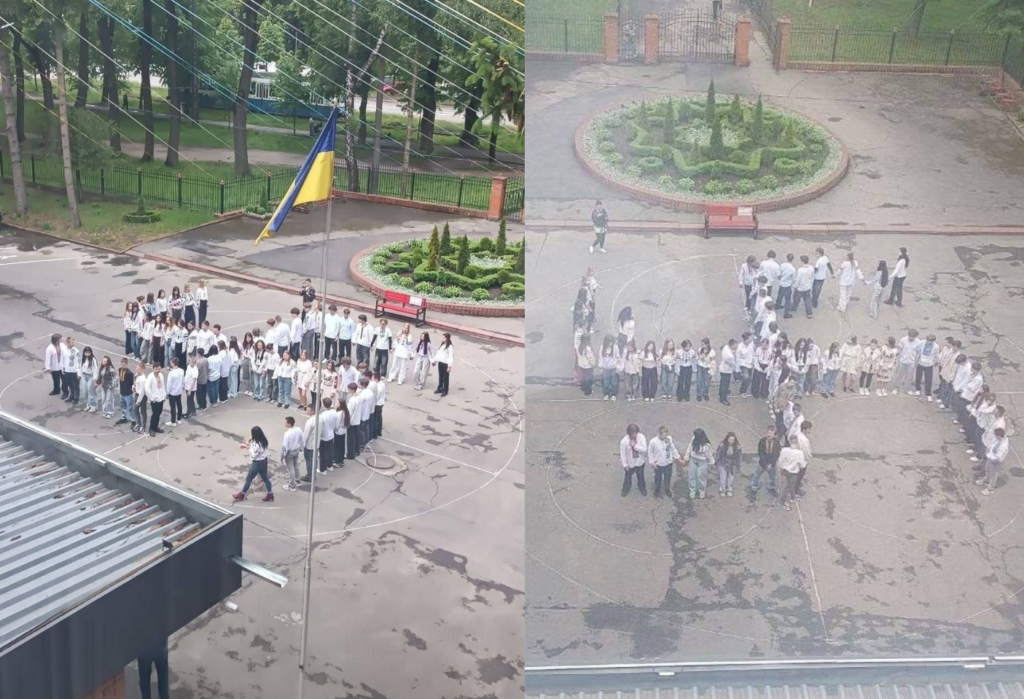
However, the students of the college in Vinnytsia were not celebrating Nazi symbols. They were marking Vyshyvanka Day, dedicated to the traditional embroidered shirt that Ukrainians regard as “a symbol of memory, unity, cultural heritage and support for the country during wartime.” The college explained on its website:
“A bright, emotional and spectacular event dedicated to Vyshyvanka Day was held at our college. Nearly 200 participants transformed the area in front of the main entrance into a living ornament – a sign of the unity of generations, strength and the indomitable spirit of a people whose women have encoded these values into embroidered patterns since ancient times. The ‘Crooked Dance’, the sun, the cross, the star, the trident and the dynamic svarga – constantly in motion, students took turns recreating traditional symbols of fire found in Ukrainian embroidery…”
According to Myth Detector, the social media claims represent a manipulation of the event. The outlet explains the meaning of the svarga symbol, which is sometimes confused with the swastika:
“Svarga, a symbol known in the West as the swastika, is a rotating cross used in some cultures as a symbol associated with sun worship. In ancient Ukrainian culture, it was linked to the hearth, home and family well-being. Depending on the direction in which the rotating cross is oriented, svarga can represent either the movement of the sun (clockwise) or ‘spiritual fire’ (counter-clockwise). Various artefacts depicting this symbol date back some 4,000 years in the territory of present-day Ukraine. As for its appearance in traditional embroidery, the practice dates back to the Sarmatians, who lived in what is now Ukraine during the first century BCE. Some sources trace the origins of such decorative motifs as far back as the fifth century BCE.”
Myth Detector further notes that the symbol known as svarga, or Yarga/Kolovrat in Russian culture and history, was also used by the Red Army during the Russian Civil War.
Media outlets reported on the event itself, but not on the alleged svarga or “swastika” highlighted by Russian propaganda. Reports indicate that the photographs may have been taken during preparations for the event and that Ukrainian media, as well as the college itself, may have intentionally omitted those images from official coverage in order to avoid associations with Nazi Germany.
The Estonian media outlet Delfi reported:
“On 21 May 2026, students (not schoolchildren) in Vinnytsia did at one point form a svarga – a traditional Ukrainian pattern resembling a swastika, but not identical to the version used in the Third Reich. Several days later, photographs of the formation went viral on a Ukrainian Telegram channel and were subsequently altered to make them appear more similar to the Nazi symbol. In that form, the images spread through Russian-language media.”
Raskrinkavanje has previously examined cases involving the misuse of symbols that are today widely associated with the swastika, despite the fact that such symbols were used for centuries, even millennia, before they became associated with the greatest evil of the twentieth century. We have written, for example, that a Ukrainian general was not wearing a swastika but a Celtic symbol, and that the Finns are not Nazis despite the fact that the Finnish Air Force used a swastika symbol beginning in 1918. The symbol originated from an aircraft donated by a Swedish nobleman that bore a swastika emblem. At that time – and still today in some parts of the world – the swastika was regarded as a talisman and a symbol of good fortune.
For all of these reasons, the post is rated as “Manipulation of Facts.”
The “Manipulation of Facts” rating is given to a media report that uses known and accurate facts but interprets them in a deceptive manner. These reports generally employ accurate information to draw incorrect conclusions or claims, leading media consumers to draw conclusions that differ from the actual meaning of the presented facts.