

Original article (in Serbian) was published on 25/6/2025; Author: Stefan Janjić
Have you been feeling smarter lately? And what about the people around you—how are they doing? According to a report by the portal Alo, the “Serbian IQ is on the rise,” and Serbs are “among the most intelligent nations in the world.” If there were a legitimate way to actually prove something like that, maybe Alo would be right. However, the provided evidence is so flawed that it cannot be considered valid.
Where did Alo get the data from?
What Alo calls a “world intelligence ranking” is actually the website International IQ Test, where you can take an IQ test, and your score will be added to your country’s average. The entire system is voluntary, with no pre-selection of participants. Thus, the top 10 includes China with over 200,000 participants, but also Armenia, with only 438. At the bottom of the list (126th place) is Gabon, which Alo labeled as having the “inglorious title of the least intelligent nation.” Not only is it “the least intelligent,” one might think it’s getting dumber too—since the average score has dropped by 0.67 over the past year. Serbia, on the other hand, is supposedly getting smarter: currently ranked 18th, with an average IQ of 100.86, and an increase of 0.35 compared to the previous year.
Is Gabon really “the least intelligent nation”?
There are several ways to answer this question, and they all lead to the same conclusion: no. First, geographically speaking, there are 193 internationally recognized countries, while the International IQ Test list includes only 126. Second, from a statistical standpoint, it’s unfounded to label a country the least intelligent based on just 275 completed online IQ tests. And now we get to the core question: Is it even possible to measure national IQ?
Can national IQ be measured at all?
FakeNews Tragač addressed this topic in the publication KLIQBEJT (2022), which offers a more detailed discussion. If we wanted to compare countries by average intelligence quotient, the basic requirement would be that each country conducts testing on a representative sample of its population under identical testing conditions. Such research has never been conducted on a global level, which means the International IQ Test analysis doesn’t even meet the basic prerequisites. Even if we managed that, a fundamental question would remain: is the test itself culturally neutral?
Dr. Patricia Greenfield from the University of California points out that even supposedly non-verbal tests, like Raven’s Progressive Matrices, rely on cultural constructs that are ubiquitous in some societies and virtually nonexistent in others. Take, for example, one of the tasks from the International IQ Test, which essentially requires knowledge of the English alphabet:
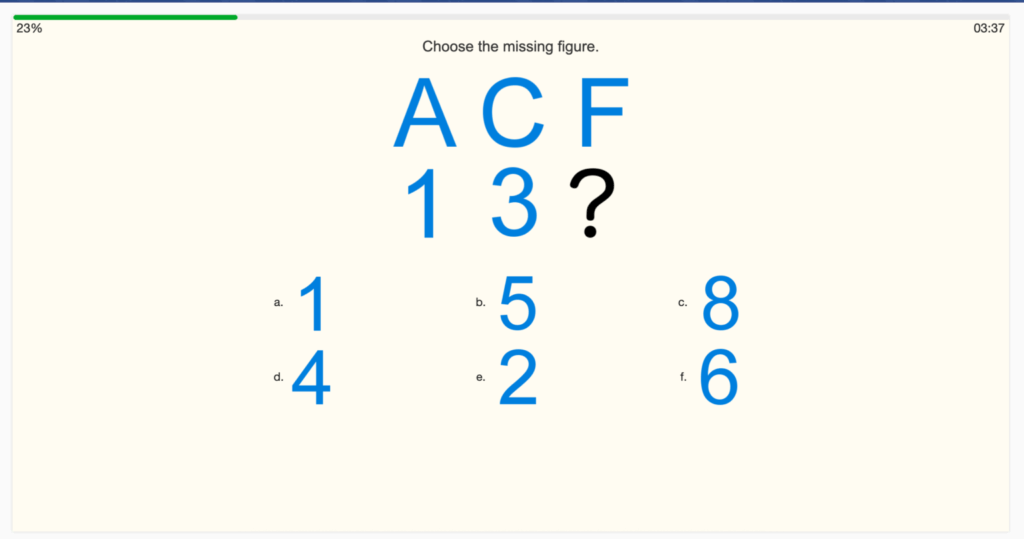
Letter A is first, C is third, and F is… sixth? Yes, in the English or Spanish alphabets. But in the Icelandic and Romanian alphabets, F is the eighth letter; in Polish, the ninth; in Serbian and Lithuanian, the tenth; in Czech, the eleventh; and in Vietnamese, it doesn’t exist at all. Add to that the fact that the majority of the world’s population does not primarily use the Latin alphabet.
What research do the test authors cite?
On the International IQ Test platform, the authors cite four studies that supposedly explain why IQ varies between countries. The first reference is to a study on infectious diseases, which was later retracted due to serious methodological issues. The journal’s editorial board found that the underlying data contained “significant inaccuracies and biases that cast serious doubt on the conclusions.” The second reference explores the link between IQ and diet/physical activity—but only among elementary school children in Dorud, a city in Iran, the size of Subotica (a mid-sized Serbian town). The third reference is about chess and is also limited to children—specifically, 67 third-graders from Romania. The fourth reference concerns the heritability of IQ, and the author is extremely cautious in interpreting the findings, emphasizing that the samples are exclusively from Western democracies and that all participants had undergone modern education programs typical for those societies.
So, what can we conclude?
The online IQ test used as the basis for the “research” may be a fun way to spend 20–30 minutes, but the results cannot be used to compare intelligence across countries—especially not in the way Alo presents it. We can’t, therefore, “track live” how certain nations become smarter or dumber over time, nor how Serbia dominates its neighbors. Besides the numerous methodological issues we’ve described, you’ll likely notice some yourself if you try the test. For example, if you get bored after ten questions and start clicking randomly to finish faster—watch out not to disappoint Alo in 2026: your lack of patience could contribute to the impression that Serbia has become “dumber.”