Original article (in Croatian) was published on 10/7/2025; Author: Anja Vladisavljević
Slovenian Prime Minister’s party has floated the idea, but no official referendum initiative has been launched.
A viral claim circulating on social media suggests that Slovenia has officially called a referendum to leave NATO.
“Is Slovenia leaving NATO? Referendum announced! Support to Slovenians in rejecting the globalist military alliance,” reads a Facebook post dated July 6, 2025 (archived here).
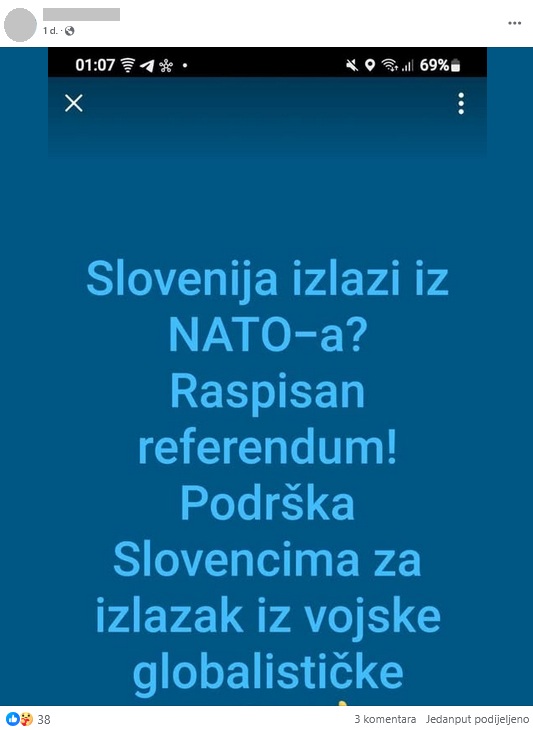
The post was widely shared across the region, accompanied by celebratory reactions and anti-globalist commentary. But despite the excitement among some users, the reality is quite different.
It Was a Political Announcement
On July 4, Slovenia’s ruling party, the Freedom Movement (Gibanje Svoboda) – led by Prime Minister Robert Golob – announced its intention to propose an advisory referendum on Slovenia’s NATO membership.
This announcement followed the Slovenian National Assembly’s vote in favor of holding a consultative referendum on increasing the country’s defense spending, in line with NATO commitments. The proposal was supported not only by Golob’s coalition partners—the Left (Levica) and the Social Democrats (SD) – but also by opposition parties New Slovenia (NSi) and the Slovenian Democratic Party (SDS).
All MPs from the ruling Freedom Movement voted against that referendum. In response, the party announced plans to initiate a separate referendum – this time on NATO membership itself.
“There are only two options: either we remain in the alliance and pay the dues, or we leave. Everything else is political deception,” Golob wrote on X (formerly Twitter), criticizing the current referendum initiative as “nonsensical” and “pushed through by a coalition of SDS, NSi, and SD.”
He stated that the Freedom Movement would propose their own referendum to “remove any doubt about the true will of the people.”
Political Tensions and No Formal Submission Yet
Following the announcement, Slovenian President Nataša Pirc Musar urged all sides to act responsibly. She called for political calm and open dialogue to avoid international embarrassment.
As of the time of writing, no official referendum proposal has been submitted to the National Assembly.
“The proposal is expected in the coming days,” reported public broadcaster MMC on July 7. However, legal experts are questioning whether such a referendum on NATO membership is even feasible – and whether it would gain sufficient support in parliament.
Leaders of smaller coalition parties, SD and Levica, have publicly expressed support for the idea of a NATO membership referendum. Nevertheless, tensions within the ruling coalition are rising. Over the weekend, members of the coalition engaged in online disputes, with speculation of a possible coalition breakup – though party representatives have denied any rift.
Opposition parties have also responded. Former Prime Minister and SDS leader Janez Janša dismissed the proposal as meaningless, arguing that a two-thirds majority in parliament would likely be required to leave NATO – something the ruling coalition does not have.
According to MMC’s July 9 report, Prime Minister Golob has begun consultations with constitutional law experts. These experts have clarified that a referendum on international relations, unlike an advisory referendum, would be legally binding. This distinction could have major implications for the referendum’s form and impact.
NATO Membership and the Legal Framework
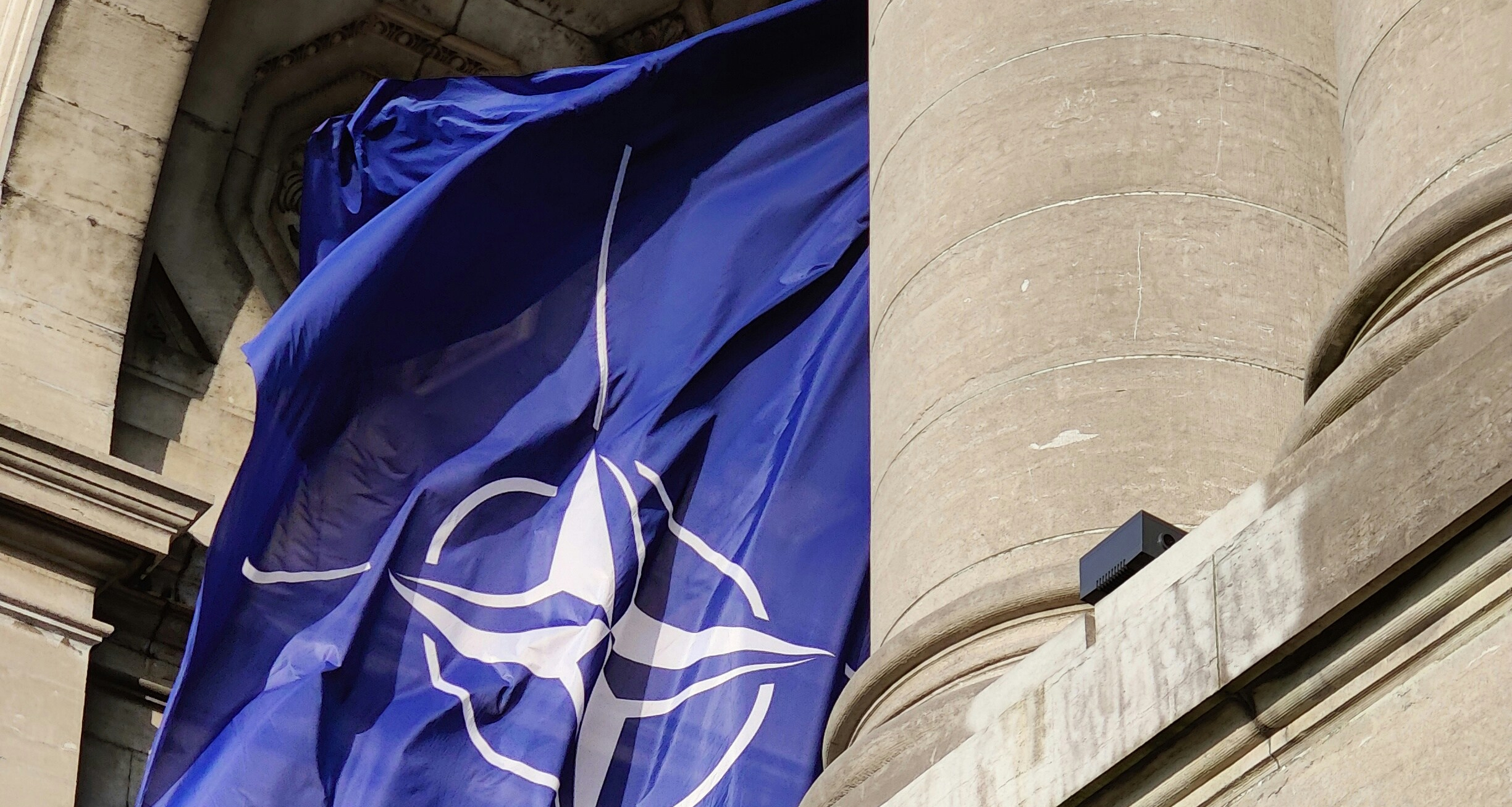
NATO is a military and political alliance of 32 countries across Europe and North America, established in 1949 through the North Atlantic Treaty. Article 13 of the treaty allows any member to withdraw one year after notifying the United States government, which then informs the other members.
Slovenia joined NATO on March 29, 2004, during the alliance’s largest enlargement, alongside Bulgaria, Estonia, Latvia, Lithuania, Romania, and Slovakia.
Public dissatisfaction with NATO in Slovenia has reportedly grown since the alliance’s June 2025 summit in The Hague, where member states agreed to increase military spending to 5% of GDP by 2035. Slovenia has yet to meet the previous target of 2% by 2024, though it has pledged to do so by the end of 2025.
If pursued, the proposed referendum by the Freedom Movement would be consultative – meaning it would allow voters to express their opinion but would not be binding on the government or parliament (1, 2).
“When Slovenia joined NATO and the EU, we established the constitutional mechanism for a binding referendum on such matters. So, even if a non-binding referendum results in a vote against NATO, any actual withdrawal would still require a two-thirds majority in parliament – which is currently unrealistic,” explained former Prime Minister and legal scholar Miro Cerar in an interview with Radio Slovenia.
In conclusion, the claim that Slovenia has called a referendum on NATO membership is false. While the ruling party has announced plans to propose such a referendum, no official initiative has been submitted to the parliament. Prime Minister Golob is currently consulting legal experts and coalition partners to evaluate the feasibility of moving forward.