
Original article (in Slovenian) was published on 14/10/2025; Author: Lara Drugovič
Borut Batagelj from the Faculty of Computer and Information Science, University of Ljubljana conducted an analysis and determined that the photo was computer-generated.
On 4 October, the Slovenian Press Agency (STA) published a news article headlined Participants of Intercepted Flotilla Gradually Leaving Israel, reporting that participants of a flotilla carrying humanitarian aid for Gaza who had been detained by Israel were leaving the country.
The article included a photograph showing a group of ships with Palestinian flags and the signs Sumud Flotilla and Aid for Gaza. The caption under the photo stated that it depicted Humanitarian flotilla Sumud carrying aid for Gaza, with Facebook cited as the source.
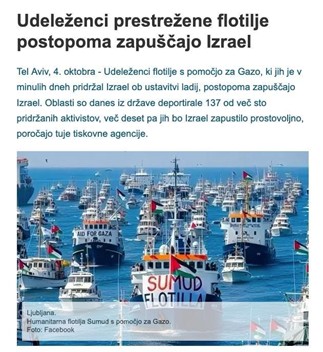
The article in which the photo was published. Source: screenshot/Razkrinkavanje.si
A check using Google’s reverse image search showed that the same photo had been posted by a Facebook user on 1 September, though it could not be confirmed with certainty that this was the first appearance of the image. Variants of the photo later spread across other social media platforms, including Instagram and X.
Borut Batagelj, an assistant professor at the Faculty of Computer and Information Science (FRI), University of Ljubljana who researches artificial intelligence, told Razkrinkavanje.si that the photo had been computer-generated, as evident from “several visible errors.” He pointed out that the flags “look almost identical and have an unusually static shape, which would be difficult to expect in real-life conditions with moving ships.” He also singled out one flag that appears to “float in the air rather than being attached to a pole.”
He further noted the text on the vessels, describing it as “distorted and inconsistently shaped,” which suggests that it was artificially produced. The shape of the letters on the banners does not correspond logically to the parts of the ships to which they appear to be attached. Some portions of the banner text are blurred or partially missing.
Another characteristic feature of AI-generated images, Batagelj explained, is the presence of recurring patterns, seen here in the motifs of the ships and the waves.
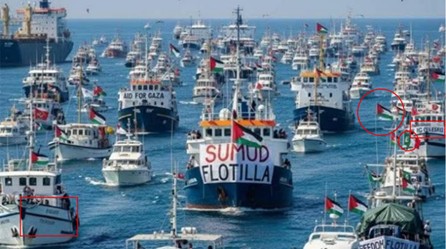
Screenshot of the photograph with Batagelj’s markings showing the errors indicating that the image was artificially generated. Source: Borut Batagelj/FRI
The authenticity of the photograph was also verified using the online tool Hive Moderation, which detects image manipulation. The analysis showed a 99.6% probability that the photo had been created using artificial intelligence or deepfake technology.
Under the new Slovenian Media Act in force since September 11, any content that has been partially or fully generated using artificial intelligence must be clearly labeled as such, either with a text description or with symbols. The law also stipulates that media publishers must inform readers about how they use artificial intelligence, particularly if AI-generated content could affect the use or understanding of media content.
The act considers the use of artificial intelligence misleading if it deceives or could deceive users in any way, thereby influencing their behavior or opinions.
We have informed both the STA and the Facebook user about our findings. The STA removed the photo from the article after receiving our questions. Aljoša Rehar, STA’s editor-in-chief, told Razkrinkavanje.si that the publication of the photo had been a mistake and that the editorial office would “introduce several new measures to make sure that this does not happen again.”
We will publish the Facebook user’s response once we have received it.
According to Razkrinkavanje.si’s methodology, the publication of the photo with the caption “Humanitarian flotilla Sumud carrying aid for Gaza” in the STA article is classified as sloppiness, because the STA has acknowledged the mistake and removed the image.