

Original article (in Serbian) was published on 30/3/2026; Author: Stefan Kosanović
Local elections held across ten municipalities in Serbia on March 29 were marred by numerous incidents and allegations of irregularities, including violence against citizens, activists and journalists, as well as footage suggesting vote buying and organized voting. Observers and independent media reported a tense atmosphere and clashes at polling stations throughout the day, while police largely failed to respond to calls from citizens seeking protection. Pro-government tabloids, however, focused on alleged violence by “blockaders” and described President Aleksandar Vučić’s victory as “fair.”
Reports from Serbia’s local elections in ten municipalities on March 29 described a day marked by violence, irregularities and allegations of voter manipulation.
Incidents reported by observers, activists and independent media included the presence of weapons such as guns, axes, batons and pepper spray, as well as damaged vehicles, shattered windshields and groups of black-clad men clashing with citizens and activists. There were also claims of parallel voter lists, vote buying, mobile call centres, organized voting and breaches of ballot secrecy.
Police largely failed to intervene, according to multiple accounts and videos circulating on social media. Instead, officers were seen securing locations where activists from the ruling Serbian Progressive Party were allegedly hiding duplicate voter lists. Footage also appeared to show police accompanying groups of men accused of attacking citizens, while reports of assaults on activists, injuries to civilians and attacks on journalists went largely unaddressed.
Pro-government tabloids, however, presented a sharply different narrative on their front pages on Monday, carrying near-identical messages that Serbia had backed President Aleksandar Vučić, portraying him as a guarantor of stability who had “defeated the blockaders” by a wide margin.
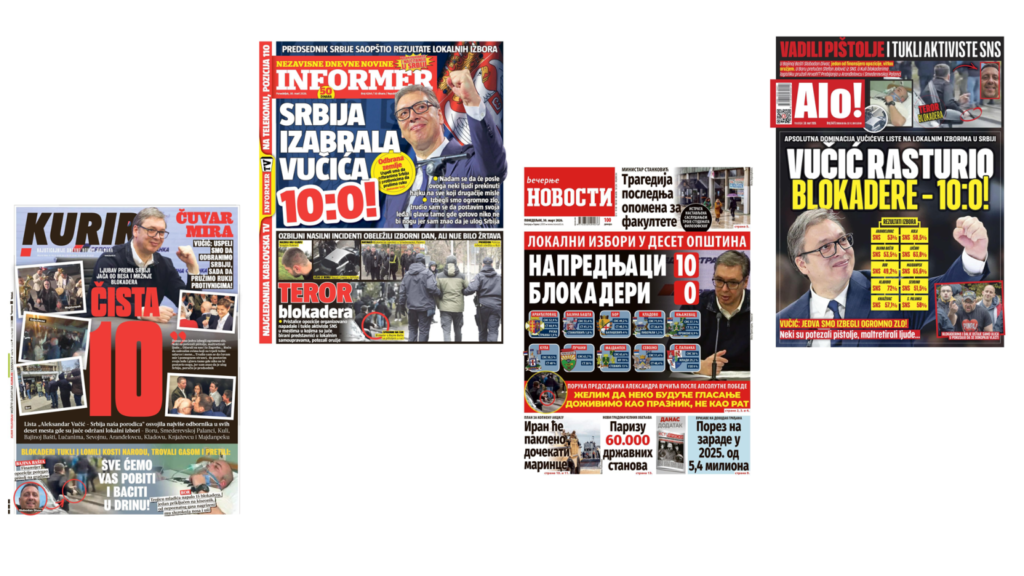
Their reporting stood in stark contrast to what was observed on the ground and documented by independent media outlets.
This election cycle appears to have recorded the highest number of incidents and reported irregularities since the Serbian Progressive Party (SNS) came to power.
Pro-government media reported in a largely one-sided manner throughout the day, focusing almost exclusively on alleged violence by “blockaders” against “the people,” while ignoring numerous documented cases of violence that, according to accounts from the ground, were carried out by SNS activists and masked groups.
The elections also highlighted a high degree of centralization within the SNS, as pro-government outlets placed greater emphasis on portraying the outcome as a victory for President Aleksandar Vučić, rather than reporting on local candidates who won and will govern municipalities in the coming period.
What was happening on election day?
It is difficult to list all the incidents that took place on election day, so only some are highlighted.
Reports of irregularities were coming in continuously, minute by minute, while a large number of activists, journalists and citizens were reported injured.
The most serious incidents were recorded in Bor, Kula and Bajina Bašta – areas previously assessed as having weaker support for the ruling Serbian Progressive Party (SNS).
The election monitoring mission CRTA, which has observed elections at all levels for years, said the day could “hardly be called an election.” Its lawyer, Vladimir Tupanjac, was injured outside SNS headquarters in Bor, where a group of around twenty people physically attacked three students who had noticed what they believed to be duplicate voter lists. Tupanjac tried to assist them and was struck hard in the head during the incident.
In Bajina Bašta, masked men charged even at police officers, who eventually pushed them back into nearby premises. They later exited without being detained, despite earlier attacks on several citizens and journalists at that location.
Journalist Darko Gligorijević of Zumer was also attacked. Unknown individuals took his phone, punched him in the head and sprayed him with pepper spray, even though he was clearly identified as a journalist.
Several students were also beaten in Bajina Bašta, as evidenced by videos circulating on social media, while a number of cars were damaged.
In a village near Bor, journalists Lazar Dinić and Ivan Bjelić were attacked and beaten, and their equipment was damaged. Journalist Zorica Popović was also assaulted, receiving two blows to the stomach. According to available information, masked attackers – one of whom was carrying an axe – kicked Bjelić in the head, while Dinić sustained fractures to his sinus bones.
According to Bjelić, the attackers filmed Dinić and forced him to say “Aca is the president,” while questioning him about the funding of his activism.
In Knjaževac, students reported irregularities taking place just dozens of meters away, but police officers ignored their complaints and instructed them to file reports at the station instead.
Footage captured by a drone and shared on social media appeared to show police calmly entering the premises of a football club in Kula alongside individuals suspected of attacking citizens with metal bars.
In Aranđelovac, individuals posing as police officers were reported, wearing masks and using vehicles with fake license plates.
CRTA also recorded attacks on its observers.
“The most seriously injured was a student who had already been attacked earlier that morning. He was knocked to the ground and beaten while lying there. After being struck in the back of the head, he experienced numbness. His phone was taken. The injured student was transported to hospital,” CRTA said in a statement.
The European Democratic Party said the local elections in Serbia were held in an atmosphere of violence and pressure, citing irregular voter lists. In a statement, it said observers and citizens were attacked, journalists detained, and that police often reacted passively or appeared to side with the authorities. It added that such conditions are not in line with Serbia’s European path and called on the European Commission to respond.
Translated in English using AI tools, then thoughtfully refined by a human editor.